When it comes to commercial flat roof repairs, most building owners find themselves budgeting anywhere from $300 to $4,500 for a single job. While a common patch for a straightforward leak might land near the $700 mark, the final invoice really comes down to the roofing material, the severity of the damage, and how difficult it is for a crew to access the area.
Your Guide to Commercial Flat Roof Repair Costs
If you own or manage a commercial building in the Chicago area, you know that first tell-tale sign of a leak—a dark spot blooming on a ceiling tile or a steady drip in the corner of your warehouse. It's more than just a maintenance headache; it's the start of a budget puzzle. Getting a handle on what a commercial flat roof repair might cost is the first step toward protecting not just your building, but your bottom line.
Think of it this way: your roof isn't just a lid on your building. It’s a crucial asset, and ignoring its health is like ignoring the check-engine light on a delivery truck. A small, seemingly harmless issue today can quietly spiral into a massive expense, causing operational shutdowns and extensive damage to the interior of your property.
So, What Are the Real Numbers?
The cost of a repair isn't one-size-fits-all. It's a spectrum, and where your project falls on it depends entirely on the size and scope of the problem. For example, 2026 industry data shows that while a simple patch on an EPDM or built-up roof can be as cheap as $150, the price climbs quickly from there.
Fixing a damaged section of about 100 square feet could run you from $200 to $1,000. If that damaged area is closer to 500 square feet, you're likely looking at a cost between $1,000 and $5,000. You can see a more detailed breakdown of these commercial roofing repair cost averages on equitycommercialroofing.com.
Key Takeaway: Procrastination is the most expensive thing in roofing. A simple seam repair that might cost a few hundred dollars today can turn into a multi-thousand-dollar project if you wait. Once water gets past the membrane and soaks the insulation or starts to rot the roof deck, the cost to fix it can easily multiply tenfold.
To give you a better sense of what to expect, the table below breaks down some of the most common repairs we see out in the field.
Average Commercial Flat Roof Repair Costs at a Glance (2026)
| Type of Damage | Typical Cost Range | Common Cause |
|---|---|---|
| Minor Leak/Puncture | $300 – $900 | Dropped tools, foot traffic, storm debris |
| Flashing/Sealant Failure | $450 – $1,200 | Age, UV degradation, building movement |
| Blistering/Bubbling | $600 – $2,500 | Trapped moisture, improper installation |
| Ponding Water Remediation | $750 – $3,500+ | Poor drainage, structural settling |
| Damaged Insulation Area | $1,500 – $5,000+ | Unaddressed leaks, membrane failure |
Of course, these numbers are just a baseline. Local factors, especially in a climate like Chicagoland with its brutal freeze-thaw cycles and heavy snow loads, can add a whole other layer of complexity—and cost. We’ll dig into those specifics next.
How Roof Type Affects Repair Costs
When it comes to figuring out your commercial flat roof repair cost, the single biggest factor is the material sitting on top of your building. No two roof types are exactly alike, and the cost to fix one can be wildly different from another.
Think of it this way: the tough, rubbery membrane on a warehouse roof is a completely different beast than the classic, asphalt-based roof on an older brick building. Each has its own strengths, its own common weak points, and requires a totally different set of skills and materials to repair. A simple patch on one system might be a quick job, while the same size leak on another could demand specialized heat-welding tools and far more labor, bumping up the price tag.
Knowing what kind of roof you have is the first real step in understanding what a repair might cost you.
TPO Roof Repair Costs
Thermoplastic Olefin, or TPO, is a crowd favorite here in Chicago, and for good reason. It's that bright white, single-ply membrane you see on a lot of modern commercial buildings. It's known for being energy-efficient (it reflects the sun's heat) and having incredibly strong, heat-welded seams.
Where we see TPO roofs run into trouble is usually with punctures from a dropped tool or poorly-installed flashing around a new HVAC unit. And if the original installation wasn't perfect, the seams themselves can sometimes become an issue down the road.
- Average Repair Cost: $6 to $10 per square foot.
- Common Issues: Punctures, seam separation, and leaky flashing around vents, pipes, and drains.
- Repair Process: Fixing TPO is a precise process. We thoroughly clean the damaged spot, apply a special primer, and then use a hot-air welder to fuse a new piece of TPO over the hole. This creates a permanent, waterproof bond that's just as strong as the original roof.
Given its durability and energy savings, it’s no surprise so many Chicago property owners are choosing TPO. You can dive deeper into the benefits of TPO roofing for Chicago flat roofs in our detailed guide.
EPDM Roof Repair Costs
Ethylene Propylene Diene Monomer, which everyone just calls EPDM, is the other major player in the single-ply roofing world. It’s essentially a big sheet of synthetic rubber—durable, flexible, and known for lasting 20 to 30 years. You'll typically see it in black.
The main vulnerability with EPDM isn't the material itself, but the way it's put together. The seams are glued, not welded. Over many years, those adhesives can start to break down and let go, which is where leaks often begin.
EPDM's Achilles' heel is often its glued seams. While the material itself is incredibly resilient, the adhesives are the first point of failure, especially under the stress of Chicago's extreme temperature swings which cause the building to expand and contract.
For most EPDM repairs, we're cleaning the surface meticulously, applying a primer, and then using special seam tapes or liquid sealants to patch things up.
- Average Repair Cost: $5 to $9 per square foot.
- Common Issues: Adhesive failure at the seams, punctures from storm debris, and occasional shrinkage over its lifespan.
- Repair Process: Small holes are easily handled with sealant and a patch. For failing seams, the real work is in the prep—cleaning the old surface to ensure the new adhesive and tape create a lasting, watertight seal.
Modified Bitumen and BUR Repair Costs
Now we get into the more traditional, heavy-duty systems: Modified Bitumen and Built-Up Roofing (BUR). These are the classic "tar and gravel" or asphalt-based roofs, built from multiple layers for redundancy. You'll often see them installed with blowtorches ("torch-down") or hot-mopped asphalt.
These roofs are tough as nails, but their age and composition bring unique problems. Blisters can form when moisture gets trapped between layers, and years of sun exposure can cause a cracked, scaly pattern that roofers call "alligatoring."
- Average Repair Cost: $8 to $12 per square foot.
- Common Issues: Blisters, alligatoring (surface cracking), and failures in the flashing where the roof meets a wall.
- Repair Process: These repairs can be messy. Fixing a blister means carefully cutting it open, letting it dry completely, and then sealing it back up with roofing cement and reinforcing fabric. Large cracked areas are often coated with specialized sealants.
This chart helps put the potential range of repair costs into perspective. A small fix is one thing, but a major issue can quickly escalate.
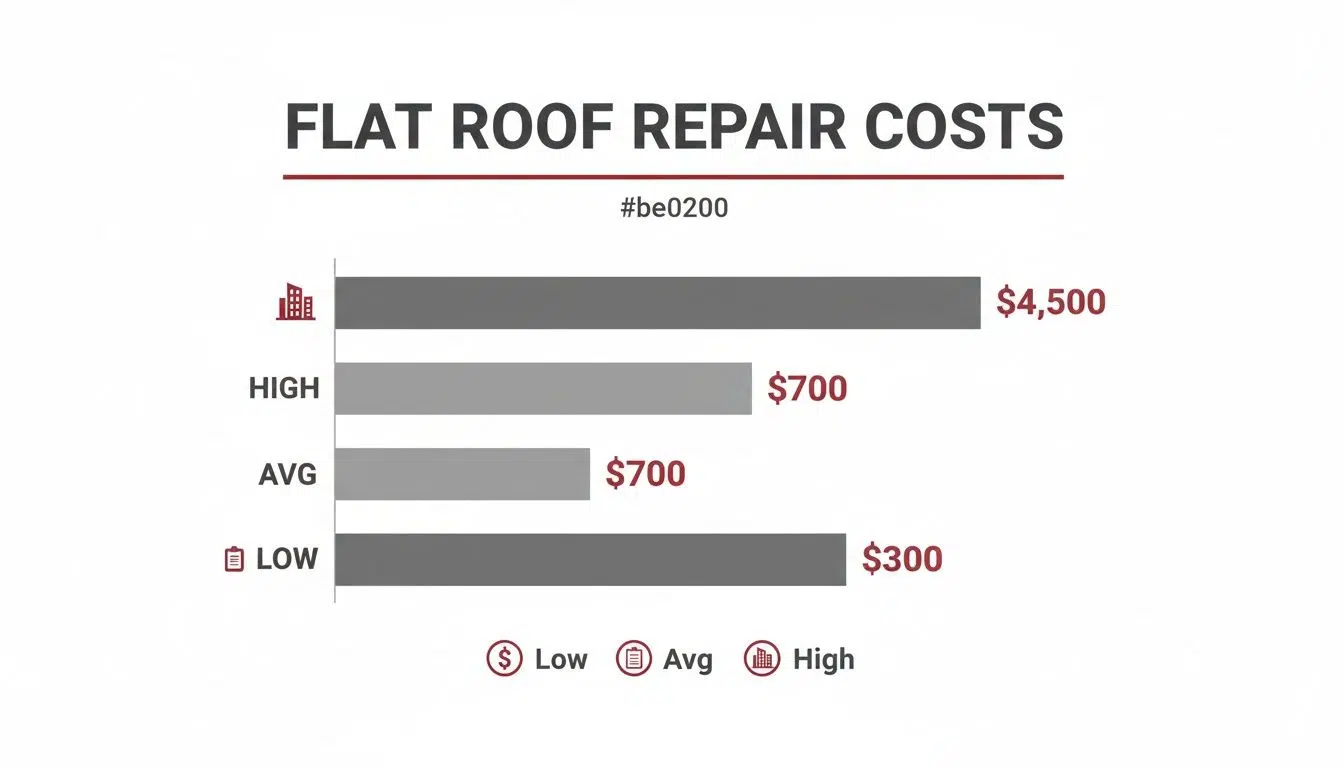
As you can see, while the average repair might seem manageable, the high-end costs for widespread damage underscore why catching problems early through regular maintenance is so important.
Key Factors That Influence Your Final Repair Bill
The type of roofing material on your building is just the starting point. When we put together a repair estimate, we're looking at a whole host of other factors that can dramatically change the final price. It’s a lot like a car repair bill—the make and model matter, but the real cost is determined by what’s actually broken under the hood.
Getting a handle on these variables will help you understand a contractor’s quote and sidestep any shocking surprises. After all, two leaks that look identical from the ground can have completely different price tags once we get up on the roof and see what's really going on.
Extent and Nature of the Damage
The most straightforward driver of cost is, of course, the damage itself. A simple, clean puncture—say, from a dropped tool or a piece of debris—is usually a quick and inexpensive fix. We can clean the area, apply a patch, and be done in less than an hour.
It gets more complicated with widespread problems like blistering. When you see blisters bubbling up on a roof's surface, it's a red flag for trapped moisture. A roofer can't just patch over that. We have to cut the blister open, make absolutely sure the underlying layers are bone dry, and then carefully install a new, properly sealed patch. That’s a far more involved, and therefore more expensive, process.
Things get even pricier when that moisture has worked its way down into the insulation.
A roof's insulation is basically a giant sponge. Once it gets wet, it’s useless. It loses all its R-value and creates the perfect environment for mold and rot. This is how a simple membrane repair snowballs into a major project involving tear-out and replacement, which can easily double or triple the cost.
Roof Accessibility and Building Height
This is a big one that many building owners overlook: how easy is it for my crew to get on your roof? A single-story warehouse with a big, empty parking lot is a dream scenario. We can pull our trucks right up, load materials easily, and move around freely. That keeps labor costs in check.
Now, picture a ten-story building in downtown Chicago. Access might be limited to a small service elevator, or worse, we might need to bring in a crane just to get materials and equipment to the rooftop. That crane rental alone can add thousands to the bill before a single repair is even made.
Here’s what we’re looking at:
- Height: The taller the building, the more time, effort, and safety equipment it takes just to get people and materials where they need to go.
- Obstructions: Is your roof a maze of HVAC units, pipes, vents, and solar panels? Every single one of those requires careful, detailed work around its flashing, which takes a lot more time than working on a wide-open surface.
- Staging Area: If there’s no space on-site to park a dumpster or store materials, we have to figure out the logistics. That extra coordination and labor adds up.
Underlying Roof Deck and Insulation Condition
What’s happening underneath the roofing membrane is just as critical as what’s happening on top. If a leak has been slowly dripping for months or years, there’s a good chance the roof deck itself—the wood, steel, or concrete structure—has been compromised. Repairing rotted plywood or rusted steel panels is a structural fix, and it has to be done before we can make the roof watertight again.
Waterlogged insulation is the other hidden budget-killer. Any good roofer will take a core sample or use an infrared camera to hunt for moisture you can't see with the naked eye. If we find saturated insulation, the commercial flat roof repair cost will have to include the labor and materials to tear out those wet sections and replace them. You simply can't roof over wet insulation; it’s a guaranteed failure.
Permits and Local Code Requirements
Here in the Chicagoland area, we have tough building codes for a reason. Our weather is brutal. Pulling the right permits for a repair job adds an administrative cost, and sometimes, the city might require new drawings or engineering specs to approve the work.
Chicago's climate presents specific challenges that directly impact repair costs:
- Snow Loads: Roofs here have to support a lot of heavy, wet snow. Any repair we do must ensure the roof's structural integrity is maintained to handle that weight.
- Freeze-Thaw Cycles: The constant temperature swings put enormous stress on seams and flashings. We often need to use more robust materials or specialized techniques to make sure our repairs can withstand that constant expansion and contraction.
- Ice Damming: Poor drainage can lead to ice building up at the roof's edge. This can force water back up and under the membrane, and fixing the root cause often requires more than just a simple patch.
When you're dealing with older roofs, you might also run into extra layers or old coatings that need to be removed before a proper repair can be made. For a closer look at that specific issue, check out our guide on flat roof coating removal cost in Chicago.
Deciding Between Major Repairs or a Full Replacement
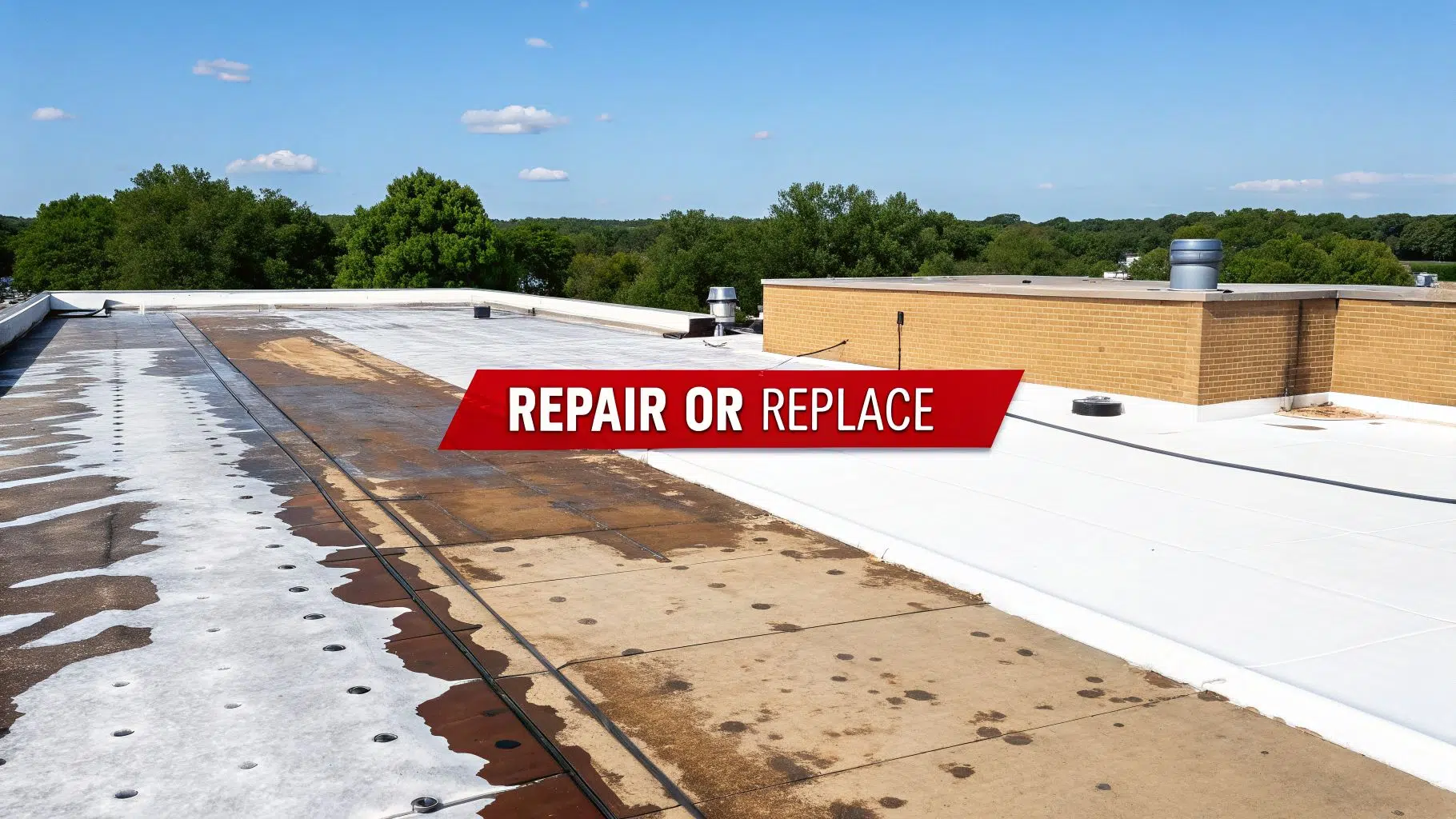
Sooner or later, every property manager hits a fork in the road with an aging flat roof. When does it stop making sense to keep patching leaks and start budgeting for a total replacement? It's a tough call, pitting a smaller, immediate expense against a significant long-term investment.
Continuing to pump money into a roof that's on its last legs is a losing battle. It’s like keeping a delivery van with a bad transmission—sure, you can fix the latest breakdown, but you know another one is just around the corner. The real cost isn't just the repair bills; it's the emergency calls, the operational downtime, and the constant worry.
The 25% Rule: A Roofer's Rule of Thumb
In the field, we have a straightforward guideline for making this decision. It’s a bit of industry wisdom we call the 25% Rule, and it’s a surprisingly accurate benchmark for building owners.
If the damage on your commercial roof—blisters, cracks, widespread leaks, or compromised seams—covers more than 25-30% of the total surface, it's time to stop thinking "repair" and start planning for "replace."
Trying to patch a roof with that much damage is just not practical. You're essentially creating a checkerboard of old and new materials, which is a recipe for failure where the patches meet the existing roof. At that point, you’re not really fixing the problem; you're just chasing it around the roof, one expensive invoice at a time.
Looking at the Full Financial Picture
When you're weighing the commercial flat roof repair cost against a full replacement, you have to look beyond the number at the bottom of the first quote. Based on 2026 data, a full replacement using a modern single-ply system like TPO or EPDM typically runs between $8 and $14 per square foot.
That means a small 500-square-foot roof on a storefront might cost $4,000–$7,000. For a larger warehouse, the project could easily hit $24,000 or more, with national averages falling anywhere from $3,328 to $11,524. As detailed in this commercial roof replacement cost guide from clevercoat.com, hesitating when damage exceeds 25% can lead to catastrophic failures and cost spikes of up to 140%.
While the upfront price of a new roof is substantial, it's an investment that pays you back in ways that a patch-up job never will:
- A Rock-Solid Warranty: New roofs come with powerful manufacturer and workmanship warranties, often protecting your investment for 15-30 years. Most repair warranties expire in just a year or two.
- Lower Energy Bills: A new, reflective "cool roof" can make a huge difference in your building's energy consumption, noticeably cutting down your summer cooling costs.
- Code Compliance: A full replacement brings your entire roof up to current building codes. This is a big deal in places like Chicago, where codes are strict and constantly updated.
- Genuine Peace of Mind: There's immense value in knowing your property, inventory, and tenants are protected by a brand-new, professionally installed system. No more worrying about the next storm.
Cost Scenario Repair vs. Replace for a 5,000 sq. ft. Roof
To see how the numbers play out over time, let's compare the two paths for a 5,000-square-foot commercial roof that's 15 years old and showing its age with widespread issues.
| Cost Factor | Extensive Repair Scenario | Full Replacement Scenario |
|---|---|---|
| Initial Outlay | $12,000 (Repairs on 20% of roof) | $55,000 (TPO Replacement at $11/sq. ft.) |
| Recurring Costs (Years 2-5) | $8,000 (Additional annual repairs) | $0 (Covered by warranty) |
| Energy Savings (Annual) | $0 | -$1,500 (Improved insulation/reflectivity) |
| Warranty | 1-2 years on repaired sections only | 20 years on entire system |
| 5-Year Total Cost | $20,000 | $47,500 (factoring in energy savings) |
| Long-Term Risk | High (Risk of major failure remains) | Low (New, reliable system) |
As the table demonstrates, the "cheaper" repair option gets expensive fast. While the initial hit is smaller, the ongoing costs and risks add up. Over a 5- to 10-year period, a full replacement almost always delivers better financial value, protects your asset, and gives you a predictable, stable budget.
How Proactive Maintenance Slashes Your Long-Term Costs
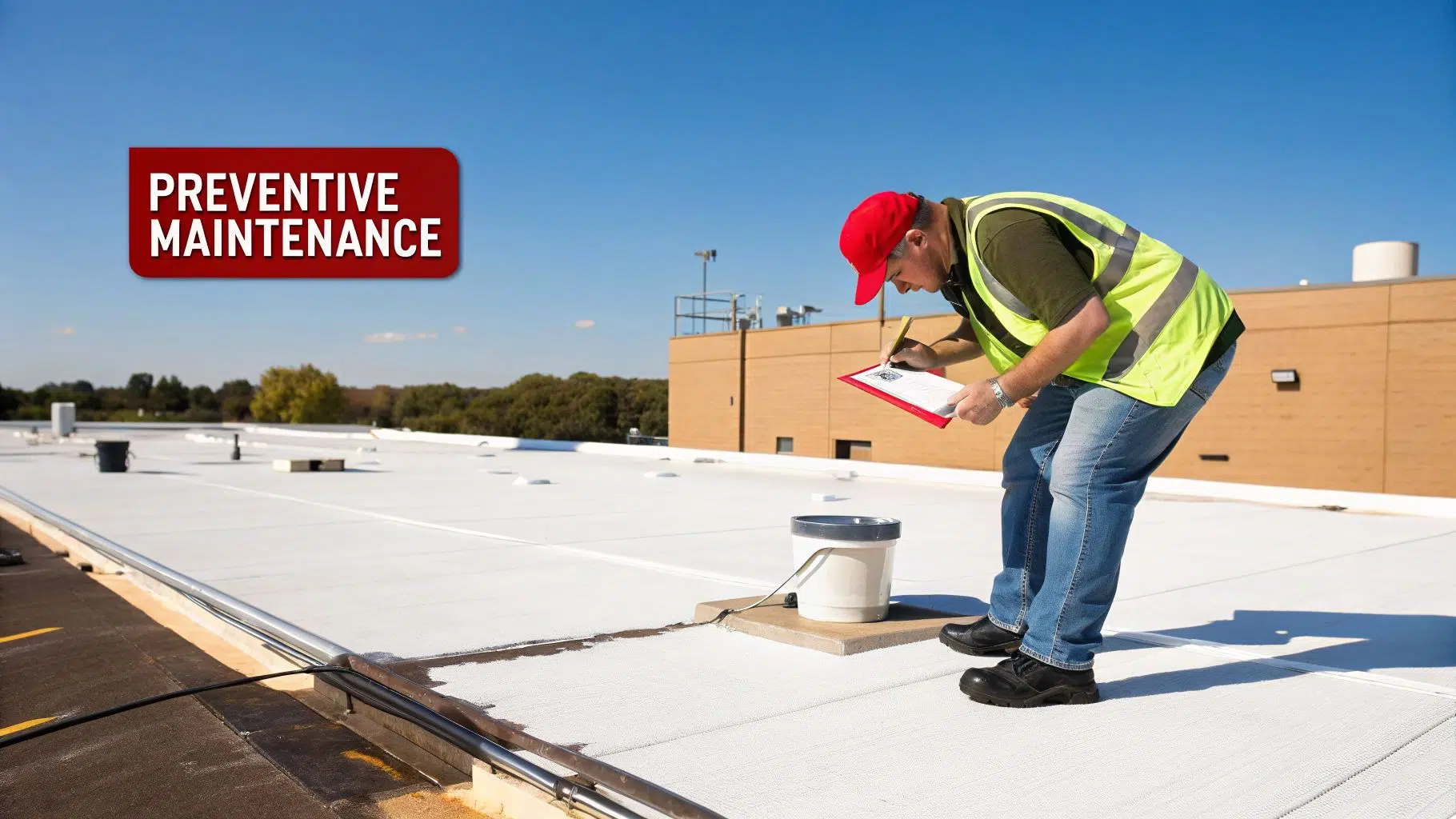
It’s easy to forget about your roof. After all, it's out of sight, and as long as water isn't dripping on your head, everything seems fine. But that "out of sight, out of mind" approach is a gamble that almost always leads to much higher expenses down the road. The single best way to control your commercial flat roof repair cost isn't by reacting to disasters, but by stopping them before they start.
Think of your roof like a critical piece of machinery or a fleet vehicle. You’d never skip oil changes and just wait for an engine to seize. A proactive maintenance plan is the "oil change" for your roof—a small, predictable expense that prevents a massive, unexpected financial disaster.
The Business Case for Proactive Care
What looks like a simple clogged drain today can easily become a catastrophic failure tomorrow. When water has nowhere to go, it ponds. That standing water adds an incredible amount of weight, puts immense stress on seams, and will eventually find a way through the membrane. A minor drainage issue can quickly escalate, causing structural damage, ruining inventory, and bringing your business to a halt.
Routine inspections, which can cost as little as $0.50 to $1.00 per square foot, are designed to catch these small problems while they're still small. A trained roofer can spot a failing sealant, clear a drain, or patch a tiny puncture long before water soaks through the insulation below.
The numbers don't lie. Neglecting your roof can shorten its lifespan by as much as 50%. This turns what should have been manageable fixes into major, disruptive projects. As one industry analysis shows, an issue that could have been a simple $700 leak repair can snowball into a $20,000+ replacement in just 10 years, cutting the roof's expected 20-30 year life in half.
What's Actually in a Maintenance Plan?
A good commercial roof maintenance program is far more than a quick glance from the ground. It’s a strategic, hands-on process meant to protect your investment and track its condition over time.
A solid plan will always include:
- Semi-Annual Inspections: We recommend at least two visits a year, typically in the spring and fall. This lets us check for any damage caused by winter ice or summer heat and storms.
- Debris and Drainage Clearing: It’s crucial to remove leaves, branches, trash, and anything else blocking drains, scuppers, and gutters so water can get off your roof fast.
- Minor Sealant and Flashing Repairs: This means touching up caulking around pipes, vents, and HVAC units and fixing any small gaps in flashings before they become a leak.
- Detailed Condition Reporting: You should always get a full report with photos and clear notes. This documents your roof's health and flags any areas we need to watch, helping you plan for the future.
The Bottom Line: A maintenance plan flips the script. It moves your roofing expenses from the "unpredictable emergency" column to the "predictable operating" column. By budgeting for care, you stabilize costs, prevent disruptions, and get a clear picture of your roof's health for smart, long-term capital planning.
The Clear Return on Your Investment
The ROI on a maintenance plan is undeniable. The biggest win is a much longer lifespan for your roof. By catching and fixing minor wear and tear as it happens, you can often add 5, 10, or even 15 years to your roof’s service life. That pushes a multi-thousand-dollar replacement project far into the future.
You'll also find yourself making far fewer emergency calls. That doesn't just save you from the premium cost of urgent service; it protects your building, inventory, and equipment from costly water damage. Ultimately, proactive care transforms your roof from a potential liability into a well-managed asset.
For those of us dealing with Chicago's wild weather, a tailored strategy is non-negotiable. To get started, you can explore our comprehensive flat roof maintenance for Chicago properties to build a plan that truly holds up.
Choosing the Right Chicago Roofing Contractor
Picking the right materials for your roof is only half the battle. The contractor you hire to install or repair it is just as important—their workmanship will ultimately decide how long your roof lasts and whether your warranty holds up. In a market as crowded as Chicago, finding a truly reliable pro who gets the local codes and climate is key to protecting your building.
Think of it this way: you wouldn't hire a random, unvetted mechanic to service your entire fleet of company vehicles. You'd want a certified expert who knows what they're doing. Your roof, the single most important asset protecting your entire building, deserves that same careful consideration. A fair commercial flat roof repair cost is an investment in long-term value, not just a quick patch.
The Non-Negotiables: License, Bond, and Insurance
Before you waste time looking at a single quote, your first move is to vet the contractor themselves. Any legitimate roofing company will have this information ready to go. In Illinois, these aren't suggestions; they're requirements.
Here’s what you absolutely must confirm:
- Licensed: They need a current Illinois roofing license. This is your proof that they’ve met the state’s standards for skill and ethical business practices. No license, no conversation.
- Bonded: A bond is your financial safety net. If the contractor bails on the job, fails to pay their suppliers, or messes up the permits, the bond protects you from financial loss.
- Insured: Ask to see certificates for both general liability and worker’s compensation insurance. If you don't, you could be on the hook for any accidents or property damage that happens on your job site.
A contractor who gets defensive or makes excuses when you ask for their license, bond, and insurance is waving a giant red flag. This is standard paperwork for any professional. Don't just take their word for it—insist on seeing the actual certificates.
How to Spot a Bad Quote (It's Not Just About the Price)
Once you’ve got a few qualified contractors lined up, it’s time to compare quotes. It’s always tempting to go for the lowest number, but an unusually cheap estimate should set off alarm bells. It often means they're cutting corners on materials, skipping crucial prep work, or, worse, operating without proper insurance.
Look for these red flags in the estimates you receive:
- Vague Descriptions: A good quote is specific. It should clearly outline the scope of work, the exact materials being used (brand and type), the total square footage, and the step-by-step process. "Repair roof" isn't enough.
- High-Pressure Tactics: Be very skeptical of anyone pushing you to sign on the spot with "limited-time offers." A confident contractor stands by their pricing because it reflects the quality of their work.
- Missing Warranty Details: A professional proposal will always include clear information on both the material warranty (from the manufacturer) and the workmanship warranty (from the contractor).
Your goal isn't to find the cheapest price but the best value. Look for a partner who provides a detailed, itemized quote and is happy to explain every single line item. A fair commercial flat roof repair cost reflects skilled labor and quality materials from a team that plans to do the job right the first time.
Frequently Asked Questions About Roof Repair Costs
When it comes to commercial flat roof repair costs, a few questions pop up time and time again. Let's tackle some of the most common concerns we hear from building owners right here in Chicagoland.
Does Emergency Flat Roof Repair Cost More?
In a word, yes. Calling a crew for an emergency leak or after-hours service will always cost more than a scheduled job. You can expect to pay anywhere from 25% to 50% more for the urgent dispatch and overtime labor.
It’s just the reality of pulling a team together on short notice. The best way to sidestep these surprise expenses is with a proactive maintenance schedule. Finding and fixing small problems early is the single most effective way to keep your roofing budget in check.
Is a Roof Coating a Good Alternative to Repair?
Sometimes. A roof coating can be a fantastic, budget-friendly option, but it's not a magic bullet. Think of it as a great solution for a roof that's showing its age with widespread, minor issues like hairline cracks or granule loss. In these scenarios, a coating can refresh the surface and add years to its life.
However, a coating is never a substitute for a real repair when you have serious damage. It won't fix a big puncture, an open seam, or insulation that's already soaked. You have to fix the underlying problems first. It’s like painting a car—you wouldn't just paint over a deep rust spot and expect it to hold.
The longevity of any repair really comes down to the quality of the work and materials. A professional patch on a TPO or EPDM roof can easily last 5-10 years, and sometimes for the rest of the roof's lifespan.
On the other hand, a simple sealant fix might only buy you a couple of years before it needs to be looked at again. Always ask about the warranty for the specific repair work being done. It's a great indicator of a contractor's confidence in their own fix.
Don't leave your property's protection to chance. Expert Super Seal Roofing & Tuckpointing provides transparent quotes and expert repairs backed by decades of Chicago-area experience. For a free, no-obligation estimate and a repair that's done right the first time, visit us at https://www.supersealroofing.com.