
A $30,000 roof replacement in Chicago can be reasonable, especially on a larger or more complex home, because local pricing for a 3,000-square-foot house can run from $15,928 to $30,692. But for a straightforward asphalt shingle roof on a smaller home, $30,000 is usually on the high side.
If you're staring at a quote that starts with a three and has four zeros behind it, the reaction is usually the same. Something feels off. Homeowners often wonder if they're being overcharged, if prices really climbed that much, or if they're comparing a premium job to a basic one without realizing it.
That concern is justified. Roofing quotes in Chicago can vary hard from one contractor to the next because the number isn't just about shingles. It reflects roof size, roof shape, tear-off work, labor intensity, flashing details, ventilation, disposal, permit requirements, and sometimes problems nobody can confirm until the old roof comes off.
The good news is that you can break a quote apart and test whether it makes sense. That's the core question behind Is $30000 Too Much For a Roof in Chicago. Not whether the number feels high, but whether the work behind it justifies the number.
Is a $30,000 Roofing Quote Normal in Chicago?
Sticker shock is normal. Most homeowners don't replace a roof often, so a large proposal can feel disconnected from what they expected.
In Chicago, $30,000 is not automatically excessive. A local cost guide notes that an average roof replacement is $18,923, while a 3,000-square-foot house can cost $15,928 to $30,692, which puts a $30,000 quote near the upper edge of the expected range for that size in this market. The same guide places higher-end Chicago roof replacements at $21,902 to $29,439. You can review that local pricing context in this breakdown of how much a new roof costs in Chicago.
When $30,000 makes sense
A quote at that level usually starts to make sense when the roof has one or more of these traits:
- Large roof area with a lot of actual roofing surface
- Steep pitch that slows production and raises labor difficulty
- Multiple penetrations and details like chimneys, skylights, valleys, dormers, and wall flashing
- Premium material selection instead of a standard asphalt system
- Full tear-off and replacement of underlying components rather than a simple overlay
When it probably doesn't
If you're dealing with a smaller, simple roofline and standard asphalt shingles, then the same number deserves extra scrutiny. A basic roof on a modest home shouldn't be priced like a custom, high-detail system unless the quote includes work the homeowner hasn't fully understood yet.
Practical rule: Don't judge a roofing quote by the total alone. Judge it by the roof type, the scope of work, and how clearly the contractor explains the labor involved.
A fair quote should answer obvious questions before you ask them. What material is going on the roof? How many layers are coming off? Is flashing included? Is ventilation included? Are they budgeting for bad decking if they find it?
If the contractor can't explain the quote in plain language, the number is less important than the lack of clarity.
Chicago Roof Replacement Cost Ranges in 2026
Homeowners need a benchmark before they can tell whether a quote is fair. Chicago pricing has a wide spread, and that spread is the reason one homeowner hears a number in the teens while another hears a number closer to thirty.
One Chicago-specific study reports an average roof replacement cost of $18,923, and estimates that a 3,000-square-foot house can cost $15,928 to $30,692, with higher-end Chicago replacements ranging from $21,902 to $29,439 according to Chicago roof replacement cost data. If you want a broader planning reference beyond Chicago-specific pricing, this overview can help you understand 2026 roofing costs.
2026 Estimated Chicago Roof Replacement Costs
| Roof Size (Approx. Home Sq Ft) | Architectural Asphalt Shingles | Standing Seam Metal | Flat Roof (TPO/Modified Bitumen) |
|---|---|---|---|
| Smaller home | Usually below the top end of the local market for a standard system | Can move into premium pricing faster than shingles | Often depends more on layout and edge detail than footprint alone |
| Around 3,000 sq ft | $15,928 to $30,692 for a Chicago-area replacement benchmark on this size home | Can reach or exceed $30,000 depending on design and scope | Can vary widely depending on insulation, tear-off, penetrations, and drainage |
| Large or complex home | Often pushes toward the upper end of local ranges, especially with complexity | Commonly enters premium-project territory | Multi-level and parapet-heavy buildings can price more like custom work than commodity work |
How to read that table
That table isn't meant to spit out your exact price. It's meant to show where $30,000 sits on the spectrum.
For standard asphalt, $30,000 is usually an upper-end number. It tends to fit larger homes, complicated roofs, or scopes that include more than a basic replacement. For metal, the same number may be completely ordinary depending on layout and detail work. For flat roofing, the structure itself matters a lot. A clean, open roof is one thing. A Chicago building with parapet walls, multiple penetrations, and drain work is another.
A roofing price only means something when you pair it with the roof system and the amount of labor hidden inside the scope.
Why homeowners get confused
Many quotes look similar on the surface. Two contractors may both write "tear off and replace roof," but one includes upgraded underlayment, flashing replacement, ventilation work, and cleanup details, while the other leaves those items vague.
That's why a $24,000 quote can be more complete than a $19,000 quote, and a $30,000 quote can either be justified or padded. The difference is in the details, not the headline number.
Deconstructing Your Roofing Quote What Are You Paying For
A roofing quote looks intimidating when it's one lump sum. It gets easier to evaluate when you break it into pieces, the same way you'd look at a recipe by ingredient instead of staring at the finished dish.
Here's the visual version of that breakdown.
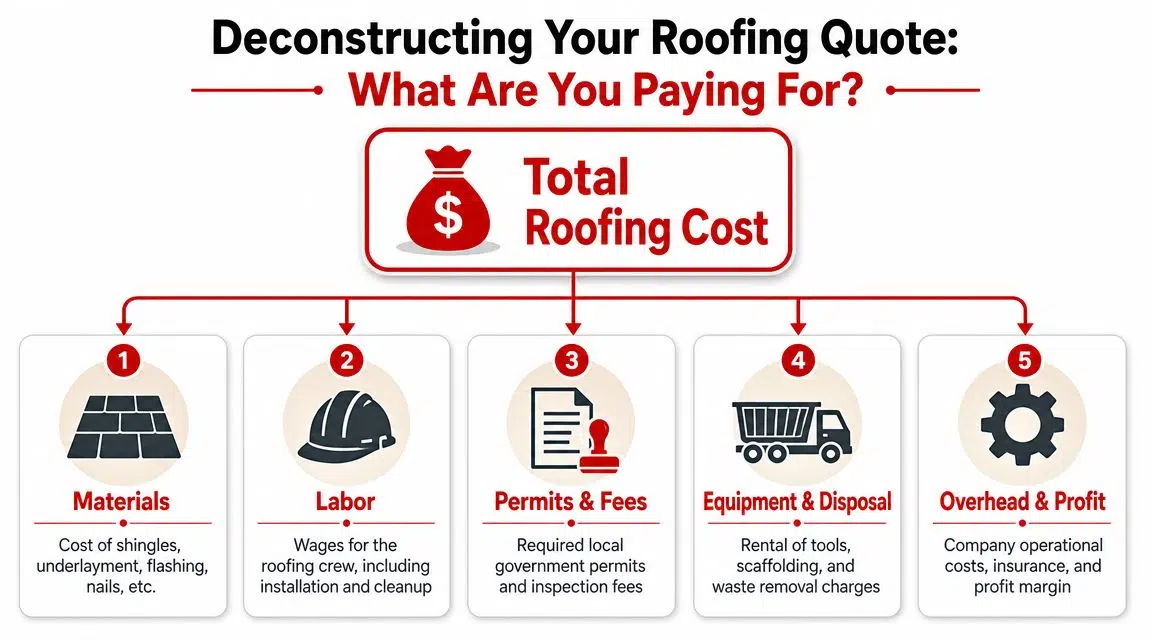
In the Chicagoland area, labor can make up about 60% of a total roof replacement cost, and pricing is often calculated by the roofing square, with Illinois pricing commonly falling between $500 and $1,100 per square installed according to this Chicago roofing cost guide. If you want a focused explanation of where money tends to go, this article on the most expensive part of replacing a roof in Chicago is useful background.
Materials are only one slice
Homeowners often fixate on shingle price, but the roof system includes much more:
- Primary roofing material such as architectural shingles, metal panels, or flat roofing membrane
- Underlayment that protects beneath the finished roof covering
- Flashing components around walls, chimneys, vents, and other transitions
- Starter, ridge, and accessory components that complete the system
A quote that only names the top-layer material isn't telling you enough.
Labor drives the hard jobs
Two roofs can use the same shingle and still land in different price ranges because labor changes everything. A crew works much faster on a simple walkable roof than on a steep bungalow with cut-up sections, valleys, and chimney flashing.
That is why labor-heavy roofs often trigger the biggest jump in price. Not because the contractor is adding mystery charges, but because the crew needs more time, more setup, more safety effort, and more cleanup.
The other line items that matter
A complete quote should also account for:
- Tear-off and disposal of old materials
- Permit and inspection requirements
- Equipment use such as ladders, scaffolding, or dump trailers
- Company overhead and warranty responsibility
What to ask: "What exactly is included in this number, and what could change after tear-off?"
That one question does a lot of work. It forces the contractor to identify what is fixed, what is allowance-based, and what hidden conditions could affect the final bill.
The best proposals don't just state a price. They show their math in practical terms.
Key Factors That Drive Up Roofing Costs in Chicago
Most homeowners don't get tripped up by the base price. They get tripped up by the variables that turn a routine roof into an expensive one.
At this point, a lot of $30,000 quotes either become understandable or start looking suspicious.
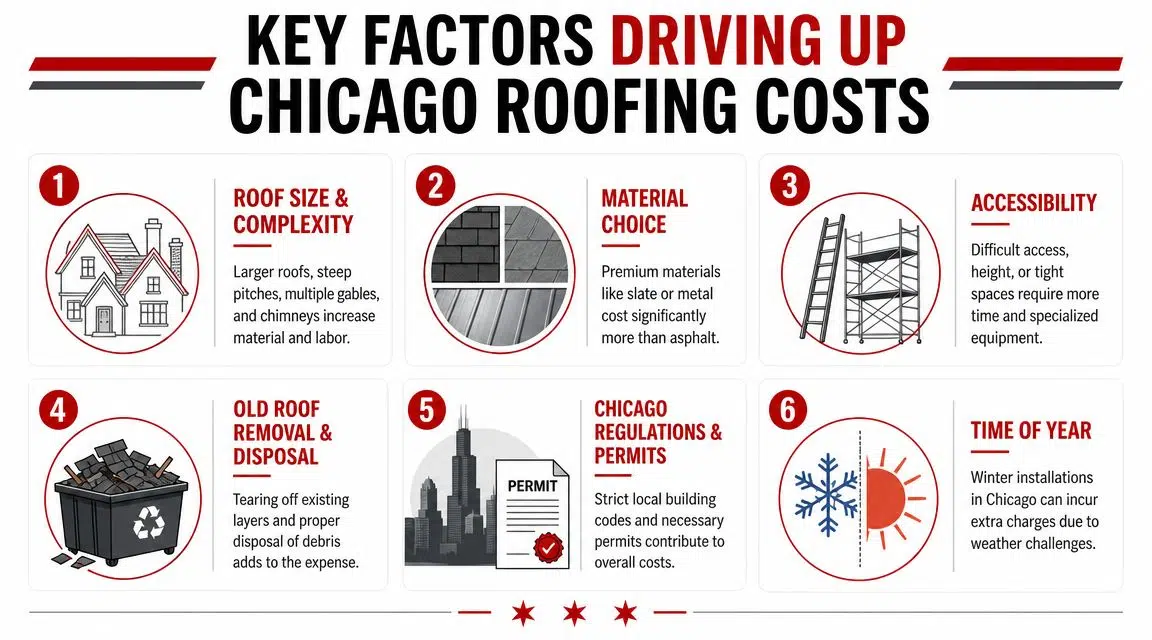
Roof shape changes everything
A simple rectangle is cheaper to roof than a house with intersecting lines, dormers, dead valleys, skylights, and chimney flashing. Each detail creates more cutting, more waste, more time, and more opportunity for water intrusion if the installer gets sloppy.
Chicago homes create this problem often. Bungalows, older multi-story homes, two-flats, and additions done over several decades can turn one replacement into a detail-heavy project.
Material choice can move a quote fast
Material upgrades change the pricing conversation completely. In Chicago, a new metal roof averages $28,482 to $45,782, and a slate roof on a 1,700-square-foot home can run $28,900 to $64,600 according to Chicago premium roofing material pricing.
That means $30,000 could be low for some premium systems. It could also be too high for a plain asphalt replacement on a smaller and simpler home.
Hidden structural work is a real cost driver
A roof can look tired from the outside and still be structurally sound. The opposite also happens. Once the old roof comes off, the crew may find soft or damaged decking, old repairs, moisture damage around penetrations, or bad edge details that need correction before the new system goes on.
Those aren't optional upgrades. They're part of building a roof that lasts.
If a contractor promises a very low price before addressing tear-off conditions, be careful. The cheapest quote often turns into the least predictable final invoice.
Building type matters in Chicago
A single-family shingle roof is not the same project as a flat roof over a two-flat, a multi-unit building with parapet walls, or a home with masonry conditions at the roofline. Access, staging, debris handling, flashing transitions, and code details can all complicate the work.
For homeowners comparing envelope-related construction costs more broadly, this Chicago architect's guide to SIP expenses is helpful because it shows the same principle seen in roofing. Shape, detailing, and installation complexity affect price just as much as the material itself.
A useful way to test a $30,000 quote
Ask yourself three things:
- Is this roof large or difficult to work on?
- Is the material premium or specialty-grade?
- Does the quote include details that cheaper bids often leave out?
If the answer is yes across the board, $30,000 may be justified. If the answer is no, then you're probably looking at a quote that needs a harder review.
Red Flags to Spot in a High Roofing Quote
Price alone doesn't tell you whether a roofer is honest. The paperwork, the sales process, and the missing details usually tell you faster.
This is the kind of clause and wording you need to read closely.
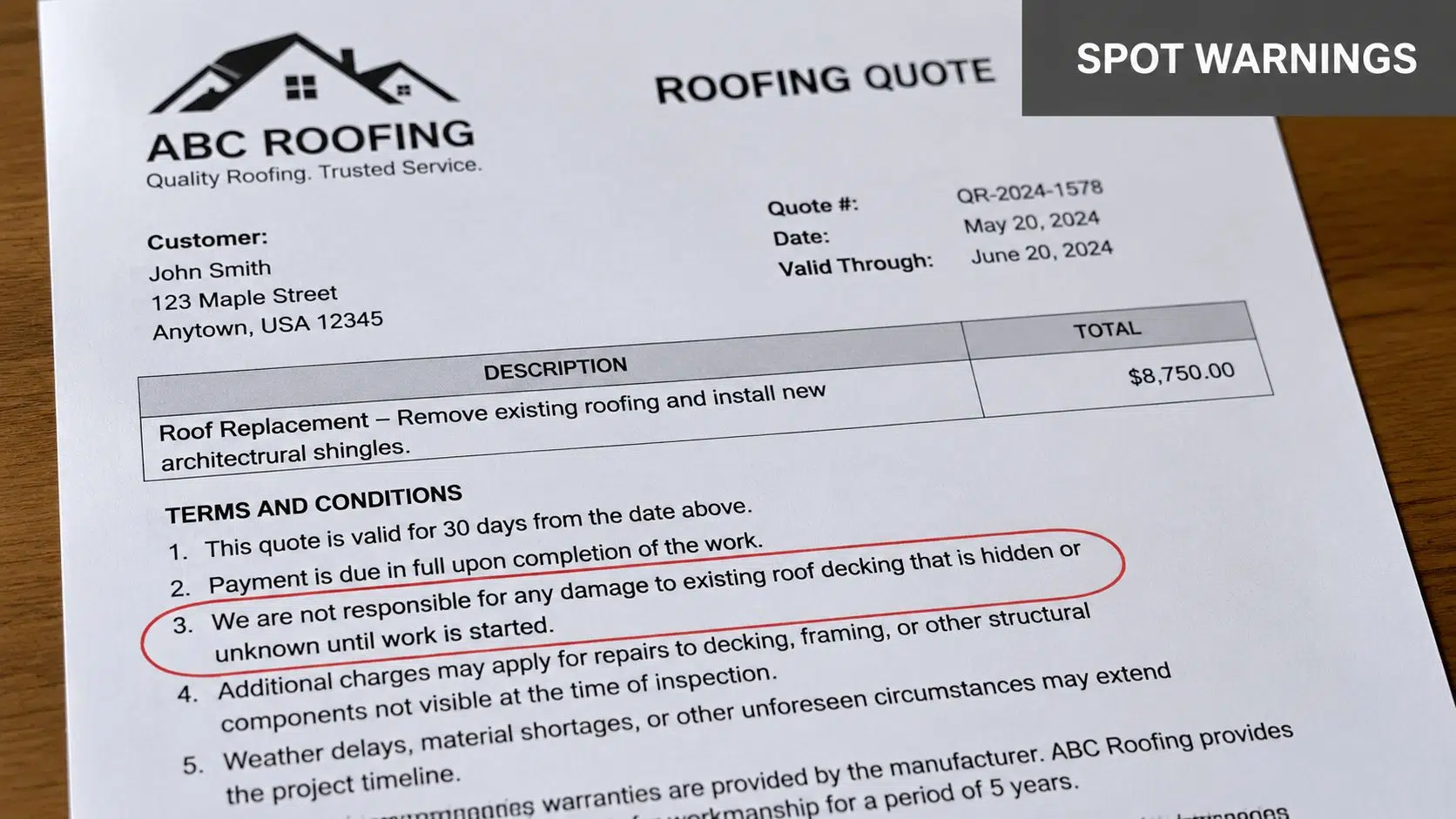
Vague scope is a major warning sign
If the proposal says little more than "replace roof" and gives one total, that is not enough. You need to know what roof system is being installed, what old material is being removed, what flashing is included, and what happens if the crew finds bad decking.
A high quote with no scope detail is hard to trust. A lower quote with no scope detail isn't safer. It's just less expensive confusion.
Watch for pressure tactics
Be cautious when a contractor pushes same-day signing, limited-time pricing, or dramatic claims that your home can't wait another week when there is no active emergency. Good roofers explain urgency when it exists. They don't manufacture urgency to force a commitment.
Review these items before signing
- Insurance proof. Ask for current liability and workers' compensation documentation.
- License status. Confirm you're dealing with a legitimate local contractor.
- Crew disclosure. Find out who will perform the work.
- Change-order process. Ask how additional repairs are documented and approved.
- Warranty terms. Make sure workmanship and manufacturer coverage are both explained in writing.
A trustworthy contractor doesn't get annoyed when you ask detailed questions. They expect them.
Deposits and payment terms should make sense
A quote can be fair in price and still be risky in structure. Be careful if the payment schedule feels lopsided, confusing, or front-loaded before materials arrive and work starts.
Also pay attention to what the contractor avoids discussing. If they don't want to talk about ventilation, flashing, drip edge, cleanup, or who handles permits, that's useful information. Silence around scope is one of the biggest warning signs in this business.
The best high quote is still a clear quote. If it's expensive but specific, you can evaluate it. If it's expensive and vague, you can't.
Smart Ways to Manage Your Roofing Investment
If you've confirmed the roof really is expensive, the next move isn't panic. It's strategy.
Lower the cost without cutting the wrong corners
Some savings are smart. Some are false economy.
Good ways to control the price include:
- Choose value-driven materials instead of jumping to premium options that don't match your goals.
- Ask for alternate scopes. A contractor may price one option with upgraded accessories and another with a more standard configuration.
- Handle ventilation correctly during the replacement so the new roof system isn't undermined by attic heat and moisture issues.
- Compare itemized bids side by side so you can remove unnecessary upgrades without removing critical waterproofing details.
What doesn't work is cutting flashings, reusing questionable components, skipping tear-off when the existing layers are a problem, or choosing the lowest bidder without understanding the exclusions.
Financing can make a necessary job manageable
Homeowners usually pay for roof work in one of a few practical ways:
- Home equity financing for larger projects
- Personal loans when speed matters more than rate-shopping
- Contractor financing programs when available
- Phased budgeting for related work such as gutters, masonry, or ventilation upgrades
If you're weighing payment options, this guide on financing a roof covers the common routes homeowners look at.
For owners who want estimates from established local contractors, Expert Super Seal Roofing & Tuckpointing is one Chicago option that handles residential and flat-roof replacement, inspections, and written estimates. The key is not which company you call first. It's whether the quote is detailed enough for a real comparison.
Think in lifecycle terms
The cheapest roof is rarely the lowest-cost roof over time. A roof installed with weak flashing details or poor ventilation may force repair bills much sooner than expected.
A better question than "How do I make this quote smaller?" is "How do I make sure this money buys a roof that performs?"
Your Next Steps for a Fair Chicago Roofing Project
If you're trying to answer Is $30000 Too Much For a Roof in Chicago, don't settle for a gut feeling. Use a process.
Step 1
Get at least three written, itemized quotes from local contractors. Every quote should identify materials, tear-off scope, flashing work, ventilation, cleanup, and how hidden damage is handled.
Step 2
Ask the same questions to every bidder. Keep it simple:
- What material system are you installing?
- What flashing are you replacing?
- What is included in the tear-off?
- What could change after the roof is opened?
- Who is performing the work, and what warranty is provided?
That makes comparison easier because you're measuring the same things.
Step 3
Judge value, not just price. A lower quote isn't better if it leaves out important waterproofing components, and a higher quote isn't worse if it includes critical work the other bids ignored.
The fairest roofing quote is the one that matches your actual roof, explains the scope clearly, and leaves fewer surprises after tear-off.
When homeowners slow down and compare details instead of totals, the decision gets clearer. Sometimes the $30,000 quote is inflated. Sometimes it's the only one that accurately reflects the job.
Frequently Asked Questions About Chicago Roofing Costs
Can homeowners insurance pay for a new roof?
Sometimes, but it depends on why the roof failed. Insurance may help when the replacement is tied to covered storm damage. It usually doesn't function as a maintenance plan for an old roof that has worn out over time.
The important move is documentation. If you suspect wind, hail, or a sudden event caused the damage, ask for a professional inspection and clear photos before assuming the claim will or won't apply.
Is it cheaper to repair or replace a roof?
A repair is cheaper in the short term when the problem is isolated and the rest of the roof still has useful life left. Replacement makes more sense when the roof has widespread wear, recurring leaks, or multiple weak points that keep showing up in different areas.
Illinois homeowners typically pay $9,500 to $23,000 for a complete roof replacement, but large or complex jobs can reach $30,000+, and key cost drivers include steep pitch, full tear-off of multiple old layers, and damaged decking underneath, according to Illinois roof replacement pricing guidance. If repeated repairs are stacking up and the roof still needs major work, replacement often becomes the cleaner long-term decision.
What kind of warranty should I expect?
Ask about two separate warranties. One covers the materials from the manufacturer. The other covers the workmanship from the contractor.
Those are not the same thing. A manufacturer may stand behind the product while excluding installation mistakes. A contractor may offer workmanship coverage, but you still need the terms in writing so you understand what is covered and for how long.
Why do two roof quotes differ so much if they use similar materials?
Because the material line on the quote is only part of the story. Contractors may differ on tear-off assumptions, flashing replacement, ventilation upgrades, disposal, crew experience, scheduling, and how much detail they include up front versus leave to change orders later.
When two numbers are far apart, don't ask only, "Why is one more expensive?" Ask, "What is the cheaper bid leaving out?"
Is a $30,000 quote high for my roof type?
It can be. On a basic asphalt roof for a smaller home, that number deserves a close look. On a large roof, a steep roof, a flat roof with complicated details, or a premium material system, it may be completely in line with the scope.
The right move is to compare the quote against your actual roof conditions, not against a neighbor's invoice from a different house and a different roof style.
If you want a second opinion on a high roofing bid, Expert Super Seal Roofing & Tuckpointing can provide a written estimate and help you compare scope, materials, and labor details so you can tell whether a $30,000 quote is justified for your Chicago property.