
A Chicago roof replacement deductible usually isn't one fixed number. It can be a flat $1,000 on one policy or a percentage-based amount like $6,000 on a $300,000 home, so your deductible is often the biggest factor in what you pay out of pocket after a storm.
If you're reading this, there's a good chance you've already seen the problem. Maybe you found water on a top-floor ceiling after an ice dam backed up under the shingles. Maybe hail hit hard in the suburbs and now the roof looks fine from the street but the insurance adjuster is coming tomorrow. Or maybe your carrier already sent paperwork and you're trying to figure out why the numbers don't match what a new roof costs.
Many Chicago property owners often misunderstand a key aspect. They focus on whether insurance will “cover the roof,” but the better question is what is the deductible for a roof replacement in Chicago, and how does that deductible work with your policy type.
On a bungalow, a two-flat, a brick commercial building, or a flat-roofed condo association property, the math can change fast. Chicago weather creates real claims. Chicago building types create real complexity. And your insurance policy decides how much of that bill lands on you.
Decoding Your Roof Insurance Deductible
You see staining on a top-floor ceiling after a freeze-thaw week, or an adjuster is coming out after a hailstorm. Before anyone talks about shingles, modified bitumen, or interior repairs, the first number to pin down is your deductible. That number decides how much cash you need to bring to the table if the claim is approved.
A deductible is the portion of a covered loss that stays with you. Insurance pays above that amount, subject to the policy terms. On Chicago properties, that can be straightforward or it can get expensive fast, especially if the policy uses a percentage tied to the insured value of the building.
Two deductible types you need to recognize
Most roof claims in the Chicago area fall under one of these setups:
- Fixed-dollar deductible. Your policy sets a specific amount, such as $1,000 or $2,500, for a covered claim.
- Percentage-based deductible. The deductible is calculated from the insured value of the home or building, not from the roofing estimate.
Percentage deductibles cause the most confusion. I see owners look at a repair or replacement proposal and assume the deductible will be a small slice of that number. Then we review the declarations page and find the percentage applies to the structure value instead. On a higher-value brick home, a two-flat, or a mixed-use building, that changes the budget immediately.
Practical rule: If your deductible is a percentage, calculate it from the insured value on the policy, not from the roof contract.
The comparison is simple. A fixed deductible works like a set service charge. A percentage deductible rises as the insured value rises. That matters in Chicago because property values can be high even when the roof area looks modest from the street.
Why this matters more in Chicago
Chicago claims are rarely generic. Ice dams can damage a sloped roof along the eaves while water backs into plaster and insulation. Hail can bruise shingles on a bungalow, dent metal flashings on a three-flat, or damage coatings and seams on a low-slope roof. Those are different roof systems on different building types, but the deductible still hits first.
The local building stock adds another layer. Flat roofs on condos and commercial buildings often involve drains, parapet walls, coping, and flashing transitions. Older brick buildings can hide moisture problems until the roof is opened up. If the policy carries a separate wind or hail deductible, the out-of-pocket number can be a lot higher than the owner expected. That is why deductible math needs to be checked before any contractor starts talking about supplements, change orders, or upgrade options.
What to check on your declarations page
Look for these items on your policy paperwork:
- Deductible format, whether fixed-dollar or percentage-based
- Separate wind or hail deductible, if one applies to storm claims
- Named peril wording for wind, hail, and water intrusion related to roof damage
- Settlement type, meaning ACV or RCV
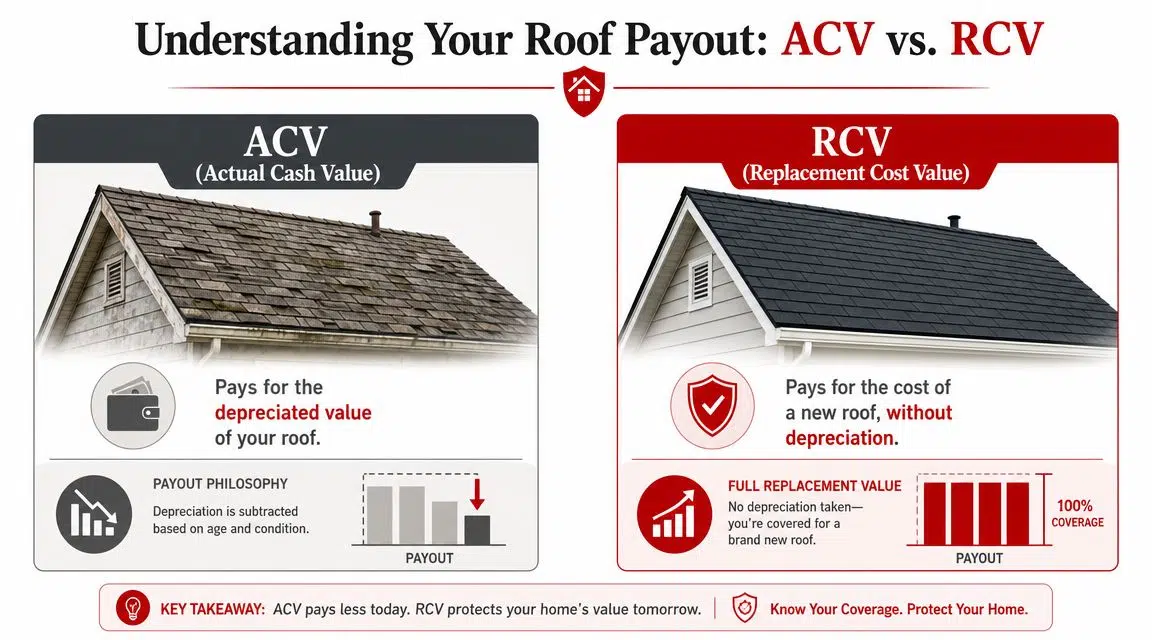
ACV and RCV affect the payout calculation, not the deductible itself, but they still belong in the same policy review because owners often mix the two up. ACV works more like the value of a used roof at the time of loss. RCV is closer to the cost to replace it with today's materials, subject to the policy terms. If you want a plain-English breakdown, Audit Genius on ACV vs RCV explains the difference clearly.
Before you file or sign anything, pull the declarations page and confirm the deductible in writing. On a Chicago roof claim, that one step prevents a lot of bad assumptions.
How Insurance Companies Calculate Your Payout
A Chicago owner gets approval for storm damage, sees the first insurance check, and assumes the carrier missed half the roof. In many cases, the math is working exactly the way the policy allows. The confusion usually comes from two places. How the roof is valued, and when the carrier releases the rest of the money.
ACV and RCV in plain English
Insurance companies usually settle roof claims under one of two methods:
- ACV, or actual cash value
- RCV, or replacement cost value
ACV works like the value of a used roof on the day it was damaged. Age, wear, prior repairs, and remaining service life all cut the number down.
RCV is closer to the cost to replace the damaged roof with comparable materials at current pricing, subject to the policy terms. On a Chicago claim, that difference can be substantial because labor, tear-off, insulation, flashing, and code-related items can add up fast, especially on flat roofs and older brick buildings.
How depreciation changes the check
Depreciation is a key part of this calculation. If the roof is older, the carrier may reduce the first payment heavily even when the damage is covered.
That is why two buildings on the same block can have the same hail date and very different claim outcomes. One owner may have an RCV policy on a newer architectural shingle roof. The other may have an ACV policy on an older membrane or shingle system with years of wear already built into the valuation.
Under ACV, the insurer typically calculates the loss, subtracts depreciation, and then subtracts the deductible. Under RCV, the insurer often issues an initial payment based on the depreciated amount, minus the deductible, and holds back the recoverable depreciation until the work is completed and documented.
A lot of claim frustration starts when the owner treats the first check like the final number.
The payout sequence that causes confusion
The order matters:
- The insurer determines the replacement cost of the damaged roof
- Depreciation may be withheld based on roof age and condition
- The deductible is subtracted
- The first payment is issued
- Any recoverable depreciation is released later if the policy allows it and the work is completed on time
On paper, an approved claim can still look short. In the field, I see that with older Chicago roofs after hail strikes, winter ice dam leaks, and wind damage near eaves or parapet edges. The carrier may agree the roof needs replacement, but the first check still feels low because the owner did not realize depreciation would be withheld before the deductible was taken.
Why this gets more complicated in Chicago
Local roof systems add friction to the valuation process. Flat roofs on condos and mixed-use buildings often include drains, scuppers, coping, modified bitumen or membrane tie-ins, and multiple flashing transitions. Older brick buildings can hide wet insulation, rotted nailers, or failing masonry at parapet walls that do not show up until tear-off starts.
Insurance carriers do not change the basic formula for Chicago. They still value the loss, apply depreciation if the policy calls for it, and subtract the deductible. But on this building stock, the scope review matters more because weather damage from hail and ice does not always stop at the field of the roof. It often reaches flashing metal, edges, drainage details, and adjoining components that affect the true replacement cost.
Real-World Deductible Scenarios in Chicago
A Chicago owner gets a claim approved after a spring hailstorm, then opens the estimate and wonders why the numbers still do not cover the roof. That happens all the time, especially on older homes, two-flats, and flat-roof buildings where the deductible structure and policy type matter as much as the damage itself.
Sample Chicago roof replacement deductible calculations
| Scenario | Home Insured Value | Deductible Type | Deductible Amount | Policy Type | Insurance Payout | Your Out-of-Pocket Cost |
|---|---|---|---|---|---|---|
| Hail-damaged single-family home with percentage deductible | $300,000 | Percentage-based | $6,000 | RCV example | $14,000 | $6,000 |
| Older roof with depreciation and fixed deductible | Not stated | Fixed-dollar | $1,000 | ACV example | $6,500 | Amount includes deductible plus unrecovered depreciation |
| Chicago property with policy-dependent deductible structure | Varies by policy | Fixed or percentage | About $1,000 to several thousand dollars | ACV or RCV | Varies | Varies |
These examples reflect the kind of claim math Chicago owners run into after hail, ice dam leaks, and wind damage along eaves, parapet walls, and roof edges.
Scenario one with the math shown clearly
Start with a common hail claim on a single-family home.
- Roof replacement cost: $20,000
- Home insured value: $300,000
- Deductible: 2%
- Deductible amount: $6,000
- Insurance payout: $14,000
- Homeowner cost: $6,000
The surprise is the deductible base. On a percentage deductible, the carrier usually applies that percentage to the dwelling coverage amount, not to the roofing invoice. A $20,000 roof can still leave a $6,000 owner responsibility if the home is insured for $300,000.
I have this conversation often after big hail events. The owner sees visible roof damage and assumes the policy will handle almost the whole replacement. Then the estimate lands, and the deductible is larger than expected because it tracks the insured value of the house.
Scenario two shows the ACV squeeze
Now look at an older roof under an ACV policy.
- Roof replacement cost: $15,000
- Depreciation: $7,500
- Deductible: $1,000
- Insurance payout: $6,500
ACV works like getting paid for a used roof, not a new one. If the roof is older or already worn, the carrier may value it much lower than the actual replacement cost. Then the deductible comes off that reduced number.
That is why a fixed deductible can look manageable on paper and still produce a painful out-of-pocket result. The primary hit is often the unrecovered depreciation, not the deductible itself.
Owners who focus only on the deductible often miss the larger cost sitting in depreciation.
A Chicago flat-roof example
The math gets harder on Chicago buildings with flat or low-slope roof systems. A condo building or mixed-use property may have membrane tie-ins, coping metal, drains, scuppers, parapet flashing, and rooftop equipment curbs. If hail or winter weather affects several of those components, the replacement scope can climb fast.
A percentage deductible on that kind of building can be substantial because insured values are higher. An ACV policy can create another problem if the roof is older modified bitumen or an aging membrane system. The carrier may agree there is covered damage but still issue a first payment that feels light compared with what the contractor needs to replace the full assembly correctly.
What these examples mean in practice
A few patterns show up again and again in Chicago claims:
- Percentage deductibles hit harder on higher-value properties. That is common on larger homes, multi-unit buildings, and mixed-use properties.
- ACV policies create the biggest gap on aging roofs. Older shingles, low-slope membranes, and patched roof sections usually suffer the most from depreciation.
- RCV policies usually produce a better path for full replacement. The owner still needs to watch deadlines, documentation, and payment timing.
- Chicago roof systems add scope disputes. Ice-dam damage near eaves, hail hits on soft metals, and leakage around parapets or drains can expand the actual repair area beyond what the first estimate shows.
For a bungalow with steep slopes, the weak spots are often valleys, eaves, and flashing details after ice backs up. For a brick two-flat or courtyard building, the claim discussion often shifts to coping, masonry transitions, and flat-roof edge metal. Same deductible concept. Very different claim fight.
Chicago-Specific Factors That Impact Your Claim
A roof claim in Chicago isn't just an insurance question. It's a building and weather question too.
Weather damage here is rarely simple
Hail gets the attention, and for good reason. It can bruise shingles, damage soft metals, and leave enough functional damage to justify replacement. But Chicago claims often involve more than one problem at the same time.
Ice dams are a good example. On bungalows and older homes, snow melts unevenly, refreezes at the eaves, and pushes water back under the roofing system. The owner sees an interior leak. The actual problem may involve insulation, ventilation, flashing, underlayment, and hidden decking conditions.

Building type changes the claim conversation
Chicago's building stock is unusually varied. You may have:
- Flat roofs on multi-unit buildings, where ponding, membrane splits, coping details, and parapet transitions matter
- Brick homes with steep sections, dormers, valleys, and chimney flashing that create more failure points
- Older structures with layered repairs, where the visible leak isn't the full story
That affects how the roof is inspected, documented, and priced. It also affects disputes. Insurance carriers may focus tightly on the visible storm damage. Contractors often have to document the related components required to complete a proper replacement.
Code and access can complicate replacement
Chicago work also involves permits, inspections, staging, debris handling, and access constraints. On a narrow lot, on a dense city block, or on a building with masonry details and parapet walls, replacement is not as simple as dropping shingles on an open suburban lot.
A roof claim that looks simple from the sidewalk can become much more technical once crews get onto the roof and into the flashing, drainage, and wall connections.
That doesn't mean every claim becomes a fight. It means local knowledge matters. The contractor needs to understand flat roofing systems, winter damage patterns, and the details common to Chicago brick buildings so the scope submitted to insurance reflects the actual work needed.
The Roof Replacement Insurance Claim Process
Claims move more smoothly when the owner follows a clean sequence and documents everything. Most problems happen when someone waits too long, throws away evidence, or signs a contract before understanding the insurance scope.
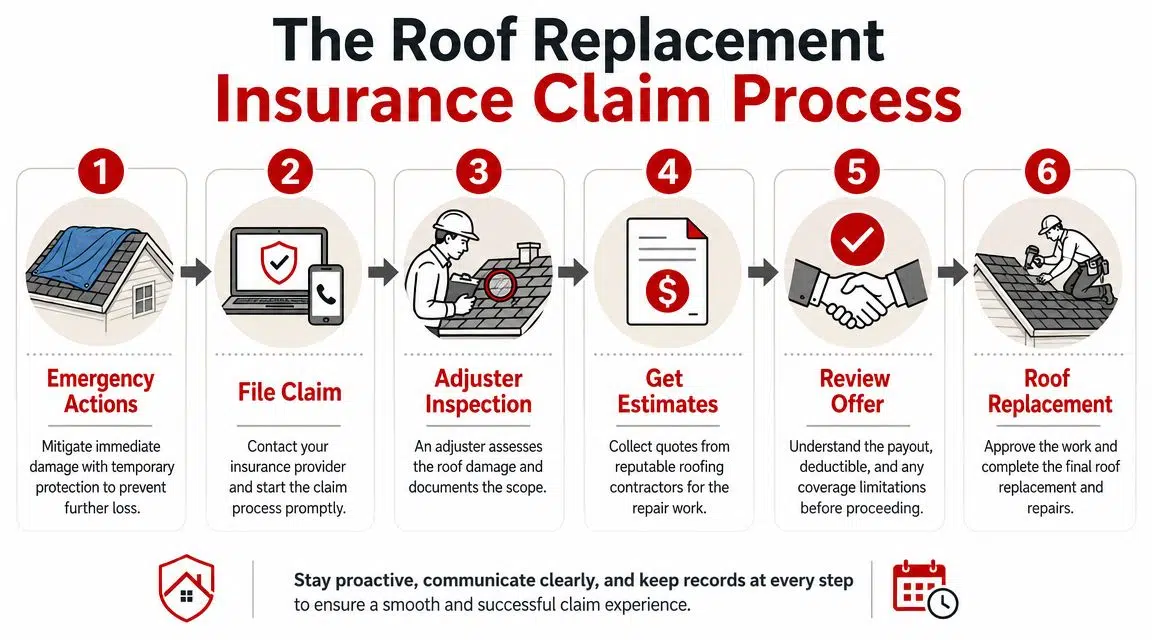
The six steps that usually work best
Stop active damage first
If water is entering the building, mitigate it. Tarp the area if needed and protect interiors. Insurance carriers expect owners to prevent additional damage after the loss.Get a professional inspection
Have a qualified roofer inspect the full system, not just the obvious leak point. On Chicago buildings, that may include shingles or membrane, flashing, coping, parapet details, vents, and drainage components.Document everything before cleanup goes too far
Take photos of the roof, ceilings, attic or top-floor damage, downspouts, gutters, metal accessories, and anything displaced by wind or hail. Keep notes on storm timing and when the leak first appeared.File the claim with the carrier
Once you have a documented basis for the claim, call the insurer and start the process. If you want a good outside explanation of claim mechanics and payment timing, this article on understanding roof replacement insurance payout is a useful companion read.Meet the adjuster with your contractor present
This is one of the most important moments in the process. A contractor can point out damage the adjuster may miss and explain what the roof needs to be restored correctly. Companies such as Expert Super Seal Roofing & Tuckpointing also publish guidance for owners who've already received an insurance check and need to understand the next step.Review the scope before replacement starts
Don't focus only on the bottom-line check amount. Review line items, code-related work, and whether the insurer has omitted pieces of the roofing system that must be addressed to complete the job correctly.
Where claims stall
The most common choke points are familiar:
- The adjuster scope is too narrow
- The owner mistakes the first check for the full settlement
- The replacement deadline is missed
- Interior and exterior damage are documented separately and incompletely
A strong claim file fixes a lot of that. Photos, notes, contractor documentation, and a clear scope reduce confusion and give the carrier less room to interpret the loss too narrowly.
Practical Tips for Chicago Property Owners
A lot of Chicago claim problems start before the storm, not after it. A February ice dam on a brick two-flat, or a summer hail hit on an aging flat roof, is hard enough to deal with. It gets more expensive when the owner does not know whether the policy carries a flat deductible, a wind or hail deductible, or an actual cash value settlement on an older roof.
Review your policy before you need it
Read the declarations page once a year, then read the roof-related endorsements. On Chicago buildings, small wording changes matter. A percentage deductible on a higher-value home can feel very different from a fixed deductible, and some owners do not realize that until the claim is already in motion.
Check three things closely:
- Your deductible type, including whether wind or hail uses a separate deductible
- Your valuation method, so you know whether the roof is paid as ACV or RCV
- Any deadline to complete repairs or replacement before withheld depreciation can be released
ACV works like a used-car payout. The carrier pays for what the old roof was worth right before the loss, not what a new roof costs to install. RCV is broader, but owners still need to complete the work and submit the right paperwork before the full amount is released, as noted earlier.
Build a simple record in calm weather
This does not need to be elaborate. It needs to be usable.
Take clear photos in spring and fall. Save invoices for maintenance, coatings, repairs, and any interior leak work. If you own a flat-roof building, keep records of ponding areas, drain cleaning, and previous patch locations. If you own a steep-slope home, note shingle age and any past repair areas around chimneys, valleys, and flashing.
Those records help answer the questions that slow claims down in Chicago. Was the membrane already patched? Was that ceiling stain old? Did the leak start after hail, after an ice dam, or because the drain backed up during a hard rain?
Know the mistakes that raise your out-of-pocket cost
Chicago owners get into trouble in a few predictable ways.
- Waiting too long to have the roof inspected after hail, wind, or ice damming
- Focusing only on the check amount instead of the scope and exclusions
- Assuming every interior leak is a covered storm claim
- Agreeing to a deductible side deal with a contractor
That last point matters. Your deductible is your share of the covered loss. If a contractor offers to absorb it through inflated invoices, fake upgrades, or vague credits, the paperwork usually falls apart when the carrier reviews the file.
Match the contractor to the roof type
Chicago roofing is not one category. A bungalow with architectural shingles, a six-flat with modified bitumen, and a mixed-use brick building with parapet walls create very different claim issues.
Ask the roofer whether they regularly handle your roof type and whether they understand the details insurers often miss in the city. On flat roofs, that can include flashing height, drain work, coping metal, and tie-ins around rooftop equipment. On older masonry buildings, it can include how roof work intersects with parapet walls, tuckpointing, and water entry paths that are not obvious from the living room ceiling.
Think past the claim
A replacement roof can affect premiums and insurability, but not always in the way owners expect. The age of the new roof helps. So do the material, installation quality, and claim history on the property. This overview of whether a new roof can lower your insurance gives a useful big-picture explanation.
When to call a roofer
Call after a storm that produced visible hail, high winds, or ice buildup at the eaves. Call when you see a new ceiling stain, bubbling paint on an upper-floor wall, loose flashing, membrane splits, or water backing up on a flat roof.
Early inspection gives you options. Sometimes the answer is maintenance. Sometimes it is a repair. Sometimes it is a claim. The sooner you sort that out, the less likely a small problem turns into interior damage, denied line items, or a replacement rushed under a deadline.
Frequently Asked Questions
Can a roofer pay my deductible for me
No. A contractor offering to waive, absorb, or secretly cover your deductible is a major warning sign. The deductible is your contractual share of the covered loss. If someone tries to erase that number through side deals, inflated invoices, or fake upgrades, you should slow the conversation down immediately.
What happens if the insurance check is less than the roofing estimate
That happens often. The first step is to compare scope to scope, not just total to total. Sometimes the insurer missed line items. Sometimes depreciation is being withheld. Sometimes the policy itself limits what can be paid. The right response is to review the adjuster estimate carefully and have the contractor identify any omissions or mismatches.
How long do I have to finish the roof after a claim is approved
It depends on the policy language. In the verified Chicago guidance cited earlier, recoverable depreciation under RCV is often tied to completion within about 180 days. Don't assume your policy uses the same wording. Read the deadline in your documents and calendar it.
Does the deductible apply only to full roof replacement
Not always. Deductibles generally apply to covered claims, whether the result is a repair scope or a full replacement scope. The key question is whether the loss is covered and how the policy settles it.
Why is my out-of-pocket cost higher than just the deductible
Because the deductible may not be the only amount you absorb. On ACV claims, depreciation can reduce the payout before the deductible is subtracted. On older roofs, that can create a larger owner share than expected.
Is a roof replacement tax deductible in Illinois
Usually, homeowners should treat that as a separate tax question, not an insurance question. If you want a more detailed discussion of that issue, this article on roof replacement tax questions in Illinois is a useful starting point.
If you're dealing with storm damage, an insurance scope that doesn't make sense, or a leak on a Chicago flat or shingle roof, Expert Super Seal Roofing & Tuckpointing handles inspections, repairs, replacements, and claim-related roof documentation across Chicagoland. The practical next step is simple: get the roof inspected, get the policy details in front of you, and make sure the deductible and payout method are clear before work begins.