TL;DR: For a primary residence in Illinois, a roof replacement is generally not deductible, but it does add to your home's cost basis. For rental or commercial properties, a full replacement is usually a depreciable asset, with 27.5 years for residential rentals and 39 years for commercial property, while some energy-efficient components may qualify for a 30% federal credit up to $1,200 annually through 2032.
A lot of Illinois property owners ask the same question right after they see a roofing proposal. The number is large, the work is necessary, and the first thought is simple: can any of this come off my taxes?
That question matters whether you own a bungalow in Chicago, a three-flat in Waukegan, or a warehouse near O'Hare. The answer depends less on the roof itself and more on how the property is used, whether the work is a repair or full replacement, and whether you qualify for a specific credit or disaster-related exception.
Facing a New Roof in Chicago? Here's the Tax Truth
A common Chicago-area situation goes like this. A homeowner gets through another winter, notices curling shingles or recurring leaks around flashing, and calls for estimates in spring. The quote comes in, and before they think about shingle color or underlayment, they ask the tax question.
That question is fair. In this region, roofing isn't cosmetic. Snow load, freeze-thaw cycles, wind, ponding water on flat roofs, and storm damage all push roofs harder than in milder climates. When the project is big enough, owners want to know whether the IRS treats it like a write-off, an improvement, or something in between.
The short answer isn't the same for everyone.
A homeowner living in the property usually gets one answer. A landlord with a rental building gets another. A commercial owner may have more options, but also more accounting rules to follow. If the roof was damaged in a federally declared disaster area, the analysis changes again. If the project includes qualifying energy-efficient materials or insulation, there may be a credit even when the roof itself isn't broadly deductible.
Most confusion starts when people lump together three different ideas: a tax deduction, depreciation, and a tax credit. They're not the same thing, and treating them like they are leads to bad decisions.
In practice, the tax side of a roofing job starts with a few basic questions:
- Who uses the property: Is it your primary home, a rental, or a business property?
- What work was done: Was it a patch, partial repair, or a full tear-off and replacement?
- What paperwork do you have: Can your invoice separate roofing, insulation, coatings, and related building-envelope work?
- Why was the work needed: Was it age and wear, storm damage, or code-driven replacement?
Those details matter more than most owners realize. The roofing scope should be built correctly, but it should also be documented correctly.
The IRS View on Your Primary Residence Roof
For a primary residence in Illinois, a full roof replacement is generally not tax deductible as a direct expense. The IRS treats it as a home improvement, not a personal deduction. As summarized in this explanation of IRS roof replacement tax basics, IRS Publication 530 says improvement costs like a new roof must be added to the home's basis and states, "You can't deduct these costs."
Why the IRS calls it a capital improvement
A new roof isn't treated like cleaning gutters or sealing a small leak. It's considered a capital improvement because it extends the useful life of the house and becomes part of the property itself.
Think of your home's cost basis like a running ledger of what you've invested into the property. The purchase price starts the ledger. Major improvements get added to it. When you sell later, that higher basis can reduce capital gain.
That doesn't put cash back in your pocket this tax season. But it can matter later, especially if you've owned the home a long time and made several substantial improvements.
What works and what doesn't
If you're asking, "Is roof replacement tax deductible in Illinois for my own house?" the standard answer is still no. That's the part many articles get right.
What they usually don't explain well is what you should do next:
- Keep the final contract and paid invoice: You may need it years from now to support your adjusted basis.
- Make sure the description is specific: "Complete roof replacement" is better than a vague lump-sum invoice.
- Save permit records and change orders: They help show the scope was a true improvement, not just maintenance.
Practical rule: If the roof is on the home you live in, assume it is not a current deduction unless you clearly fit a separate exception like a qualifying energy credit or disaster-related loss.
The Illinois angle homeowners miss
Illinois doesn't create a special state override that turns a personal roof replacement into a standard deduction. For most homeowners, the tax value is indirect. It sits in your records, not on this year's return as a simple write-off.
That means the ultimate financial decision isn't "Can I deduct it?" It's whether you're installing the right system for the building, climate, drainage conditions, ventilation setup, and expected lifespan.
How Rental and Commercial Roofs Change the Tax Game
Once the property is a rental, commercial building, or industrial facility, the roof moves out of the personal-expense category and into the business-asset category. That's where tax treatment changes sharply.
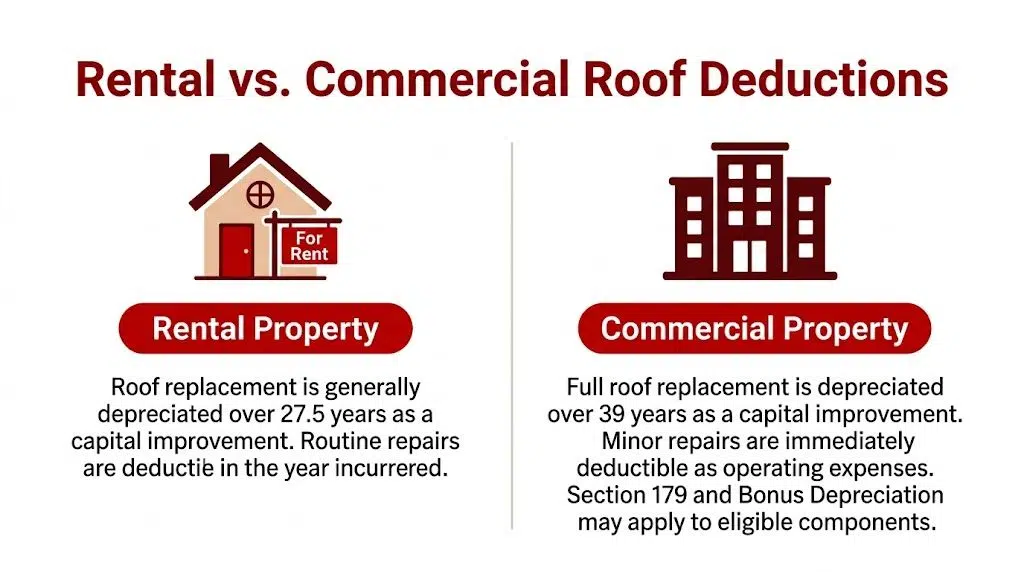
For these properties, a full roof replacement usually isn't deducted all at once. It is generally capitalized and depreciated. According to this guide on tax treatment for roof repairs and replacements, residential rental roof replacements are depreciated over 27.5 years, commercial roofs over 39 years, and repairs are generally deductible in the year incurred. That same source gives a simple example: a $50,000 roof on a rental property yields roughly $1,818 yearly in depreciation on Form 4562.
Repair versus replacement
Owners and property managers often get tripped up by this distinction. A repair keeps the roof functioning in its current state. A replacement restores or renews the roof system in a bigger way and usually has to be capitalized.
Here's the practical split:
| Work type | Typical tax treatment |
|---|---|
| Localized leak patching | Usually deductible in the same year |
| Small flashing repair | Usually deductible in the same year |
| Full tear-off and new roof system | Usually depreciated |
| Major replacement of the roof assembly | Usually depreciated |
The accounting classification has to match the actual field scope. If a contractor tears off and replaces the roof system, calling it a repair on paper doesn't make it one.
What landlords should pay attention to
For rental owners, the details on the invoice matter almost as much as the roof itself. If part of the job is true repair work and part is full replacement, your tax professional needs enough detail to sort that out.
A few examples matter in real life:
- A recurring leak repair on a flat roof is usually treated differently from replacing the entire membrane.
- Patching deteriorated sections is not the same as a full re-roof.
- Related masonry work around parapets or coping may need its own description, not a buried line item.
If you're budgeting a major project, it helps to review the scope with both your contractor and accountant before the work starts. Owners replacing aging systems on apartments, mixed-use buildings, or factories often also compare options like TPO, EPDM, modified bitumen, and coatings based on service needs, drainage, and future maintenance. If you're evaluating a full business roof project, commercial roof replacement options in Chicago usually need to be reviewed with both lifecycle cost and tax treatment in mind.
Commercial property adds another layer
Some business owners may also explore Section 179, which can allow accelerated expensing for qualifying business roofs. Whether that applies in your situation depends on the entity, the property use, and how the tax professional classifies the work.
The key point is simple. For income-producing property, the question usually isn't "Can I deduct it?" It's "Do I deduct it now as a repair, or recover it over time as a capital improvement?"
Finding Savings Through Tax Credits and Disaster Relief
The general rule for a primary residence is restrictive, but there are still situations where Illinois property owners can find legitimate tax relief. The two big areas are energy-efficient upgrades and federally declared disaster losses.

Energy-efficient components can qualify
A roof replacement by itself is not automatically a tax credit project. Eligibility depends on the specific materials and related work. According to this Illinois roofing rebates and incentives overview, the federal Energy Efficient Home Improvement Credit under IRC §25C allows a 30% credit up to $1,200 annually through 2032 for qualifying components such as ENERGY STAR-certified shingles and associated insulation, and those benefits can stack with local utility rebates such as ComEd.
That means the tax question isn't just "Did you replace the roof?" It's also:
- Were the shingles or roofing components eligible
- Was insulation or air sealing included in the project
- Do you have manufacturer certification and clear invoices
- Did the installation meet applicable code requirements
A lot of owners miss this because they only hear the blanket phrase "roofs aren't deductible." That's too broad to be useful.
A tax credit is better than a deduction in one important way. It directly reduces tax liability if you qualify. But qualification has to be documented, not assumed.
For storm-prone homes, this issue often comes up during restoration work. If the roof project follows severe weather and includes related efficiency upgrades, owners should sort the paperwork early. Chicago storm roof repair guidance often becomes relevant long before tax filing season.
Disaster-related losses are different
If a roof is damaged in a federally declared disaster, the tax treatment may be different from an ordinary aging-roof replacement. The verified rule allows casualty losses tied to that declared event, subject to the usual adjustments for insurance and loss valuation.
The practical issue is timing and evidence. Owners need to preserve inspection reports, photos, insurance paperwork, and the contractor's scope showing what was damaged and what was replaced. If the rebuild includes upgrades beyond restoring the pre-loss condition, not every dollar necessarily gets treated the same way.
What Illinois owners should do before signing
The best time to ask about credits or disaster treatment is before the final contract is written.
Ask for the proposal to separate:
- Roof replacement work
- Insulation or air-sealing work
- Storm-related damage scope
- Any code-required upgrades
That level of detail makes life easier for your CPA and reduces the chance of claiming something you can't support later.
Essential Paperwork for Every Illinois Roofing Project
Bad paperwork causes tax problems even on good roofing jobs. The roof may be installed correctly, but if the contract is vague and the invoice is one lump sum with no material detail, your accountant has less to work with.
For Illinois owners, the goal is simple. Build a file that explains what was done, why it was done, when it was done, and how it was paid.

What your contractor should give you
If you're hiring for a replacement, repair, or storm-restoration project, keep these records together:
- Signed contract: It should identify the property, scope, materials, and whether the work is repair, replacement, or both.
- Itemized invoice: Ask for separation between tear-off, membrane or shingle installation, insulation, flashing, masonry, coatings, and emergency work where applicable.
- Proof of payment: Keep canceled checks, card records, financing papers, or bank confirmations.
- Permit and inspection records: Especially important for larger jobs and for showing the work was properly completed.
- Manufacturer documentation: If you're pursuing an energy credit, keep certification materials for qualifying products.
- Insurance file: For storm losses, hold onto adjuster reports, claim summaries, correspondence, and payment records.
- Photos before and after: These help show whether the work was a patch, a restoration, or a full replacement.
Why itemization matters
A vague invoice can blur an important tax distinction. For example, if part of the project involved emergency leak containment and part involved a full replacement, those may not be treated the same way.
Bring your roofer's itemized invoice to your tax preparer, not just the total contract amount. Classification starts with documentation.
A simple file structure that works
Keep one digital folder and one physical folder if you prefer paper backup. Label documents by date and type.
A practical setup looks like this:
| Folder item | Why it matters |
|---|---|
| Contract and change orders | Shows agreed scope |
| Final invoice | Supports cost and work description |
| Payment records | Proves amount paid |
| Permit records | Supports compliance |
| Product certifications | Supports credit claims |
| Insurance documents | Supports casualty analysis |
Owners usually regret missing documents years later, not the week the job is done. Save the file while it's fresh.
Roofing Tax Scenarios from Chicagoland Properties
Rules make more sense when you apply them to actual buildings.
A Lincoln Park homeowner replacing an aging shingle roof
The owner lives in the house full-time. The old shingle roof has reached the point where patching doesn't make sense anymore, and the new project is a complete replacement.
The big tax point is straightforward. This isn't a current personal deduction. The owner should keep the contract, final paid invoice, permit records, and product information with other home-improvement records for future basis tracking.
If the project also includes qualifying insulation or eligible ENERGY STAR-certified components, that part may need separate documentation. That's where a detailed invoice matters. A one-line bill makes it harder to sort eligible work from non-eligible work.
A Waukegan landlord replacing a flat roof on a three-flat
This owner has a residential rental property with repeated leak issues. For a while, patching bought time. Eventually, the membrane and substrate condition make full replacement the only responsible move.
In that scenario, the owner and CPA usually need to split the thinking into two buckets. The localized patching done earlier may fall under same-year repair treatment. The full replacement is the capital project that gets depreciated.
Poor paperwork creates difficulties. If the roofer's invoice shows only "roof work," the accountant has to guess. If the invoice distinguishes earlier repairs from the later replacement, the tax treatment is easier to defend.
Clean paperwork protects the owner twice. It helps with tax treatment, and it helps prove what work was actually completed if there's a dispute later.
An industrial facility near O'Hare after a major storm
A facility manager notices water intrusion after severe weather. The roof system has storm-related damage, and there may be insurance involvement. The manager also has to think about operations, interior protection, and whether sections can be repaired or whether replacement is the safer long-term move.
This kind of project brings several moving parts together at once. There may be business-property depreciation issues, storm-loss documentation issues, and scope-separation issues if temporary repairs are performed before full replacement.
The smart move is to build the paper trail in real time:
- preserve photos and maintenance logs
- document the storm-related condition
- separate emergency stabilization from permanent replacement
- keep insurance and contractor records aligned
That doesn't make the tax answer simple, but it does make it supportable.
Making a Tax-Smart Decision for Your Illinois Property
If you're still asking, is roof replacement tax deductible in Illinois, the cleanest answer is this: for a primary home, usually no as a current deduction. For rental and commercial property, usually not immediately, but often recoverable through depreciation. For some qualifying energy-efficient components or federally declared disaster situations, there may be real tax relief if the job is documented properly.
That tax piece matters, but it shouldn't drive the whole roofing decision.
A cheap roof with weak flashing details, poor drainage planning, or sloppy membrane seams can cost more than any tax benefit saves. The best financial outcome usually comes from a roof system that fits the building, is installed correctly, and comes with documentation your accountant can use.
Before you sign, do three things:
- Ask your tax professional how your property type changes the treatment
- Ask your contractor for itemized paperwork before the work starts
- Compare roof systems based on long-term performance, not just whether a line item might be deductible
If you're also budgeting the project itself, it helps to review what a new roof typically costs in Chicago alongside the tax implications so you're looking at the full picture.
If you need a detailed roofing proposal with clear scopes, itemized paperwork, and practical guidance for residential, rental, commercial, or industrial properties, Expert Super Seal Roofing & Tuckpointing serves Chicago and the surrounding suburbs with free estimates, experienced crews, and documentation that helps property owners make informed decisions.