Yes, often, but it's not automatic. In many cases, a new roof can reduce homeowners insurance by 5% to 35%, and in some situations the savings can go higher, but the result depends on the roof's age, material, and local risk factors.
If you're staring at a roof estimate and wondering whether the insurance company will finally give you a break, that's the right question to ask before the crew shows up. Around Chicago, homeowners replace roofs because shingles are curling, leaks keep coming back, ice dams are starting trouble, or the last storm made it clear the roof has reached the end of the line. The insurance angle matters, but it only pays off when the replacement changes how the carrier sees your risk.
The short version is simple. Insurance companies don't reward the phrase “new roof.” They reward lower risk they can verify. An old roof is like a car running on bald tires. It might still be moving, but the odds of a bad outcome are a lot higher, and the insurer prices that in.
That's why the key question isn't just, “Will getting a new roof lower your insurance?” It's, “What kind of roof are you installing, how was it documented, and did your carrier get the right paperwork to recognize it?”
Why a New Roof Can Mean Lower Insurance Premiums
A roof sits at the top of the insurer's worry list for one reason. Water gets in from above, and when it does, the claim rarely stays small. A worn roof can lead to interior damage, mold issues, insulation problems, damaged decking, and repeat claims after wind or hail. Carriers know that, so they use roof age and condition as major pricing signals.
Progressive's explanation of roof type and insurance rates puts it plainly: the age, material, and shape of a roof can significantly affect homeowners insurance rates, and newer roofs built with durable materials may cost less to insure than older roofs that are more vulnerable to damage. The same source also notes that some policyholders may see discounts ranging from about 10% to 50% in certain cases, depending on the upgrade, the material, and state rules.
Why the carrier cares so much
Insurers aren't paying for roofing beauty. They're pricing the chance that they'll have to write a check.
A newer roof changes that calculation in a few ways:
- Lower failure risk: New materials are less likely to crack, lift, or leak during wind, hail, snow, and freeze-thaw cycles.
- Better insurability: Older roofs can trigger tougher underwriting, higher deductibles, or renewal issues.
- Fewer gray areas in claims: A roof in solid condition gives the carrier less room to argue that neglect contributed to damage.
Practical rule: A new roof helps most when the old roof was the reason the insurer saw your home as a problem.
That last point matters. If your premium is high mainly because of non-roof issues, replacing the roof might improve your overall file without producing a dramatic rate drop. But if the carrier has been nervous about age, brittleness, prior patchwork, or storm vulnerability, a replacement can move the needle.
A new roof is a risk upgrade, not a coupon
Homeowners sometimes expect the discount to arrive automatically after installation. That's not how it works. The roof has to be the kind of upgrade the insurer values, and the insurer has to be made aware of it.
Replacing old brakes on a work truck offers a good comparison. The truck is safer the moment the job is done. But your insurance company won't price that safer condition correctly if nobody tells them what parts were installed, who installed them, and whether the work meets the standards they look for.
How Insurance Companies Evaluate Your New Roof
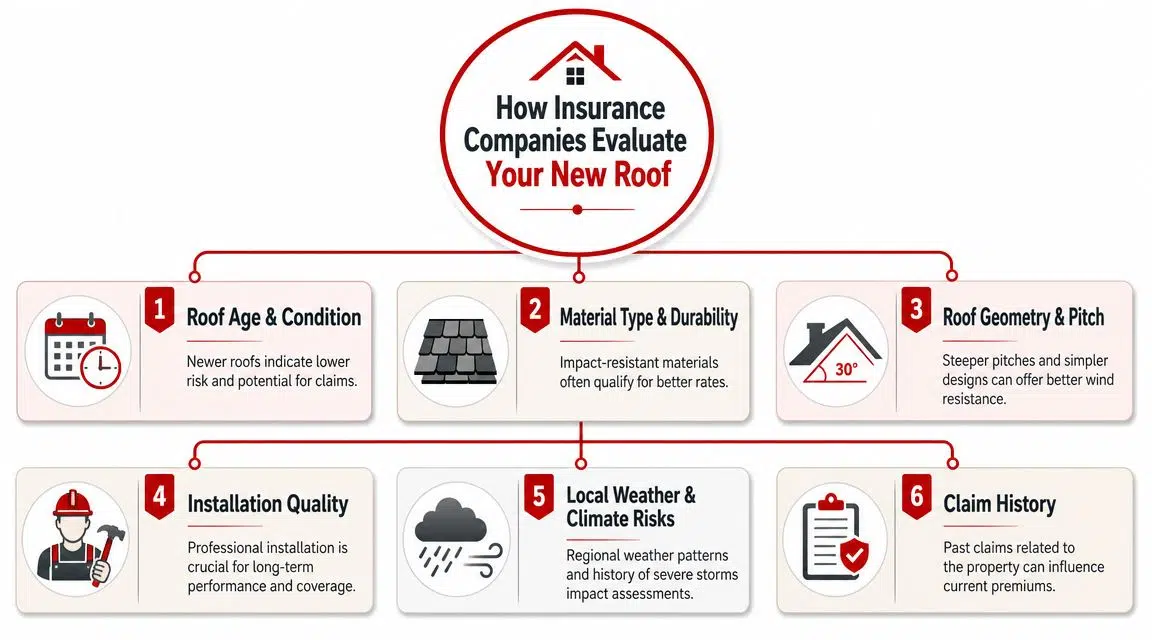
Insurance underwriters don't look at a new roof as one single item. They break it into a handful of risk signals. Some are obvious, like age. Others are more technical, like impact ratings, wind resistance, and installation quality.
The factors that actually matter
Here's what the carrier usually wants to know before they decide whether the new roof deserves better pricing.
| Evaluation factor | What they look for | Why it matters |
|---|---|---|
| Roof age | Date of full replacement | Newer roofs generally signal lower claim risk |
| Material type | Asphalt, metal, slate, or another system | Some materials resist weather better than others |
| Impact and wind ratings | Product certifications and testing standards | Certified products give underwriters a measurable basis for credit |
| Installation quality | Licensed contractor, proper workmanship, code compliance | Bad installation can wipe out the value of good materials |
| Local weather exposure | Wind, hail, snow, ice, water backup patterns | Carriers price roofs against regional loss patterns |
| Claim history | Prior roof-related or weather-related losses | The roof is part of the file, not the whole file |
Material quality changes the math
The strongest insurance argument usually comes from durability, not just freshness. According to Premier Roofing's discussion of roofing materials and premium reductions, installing impact-resistant roofing with a UL 2218 Class 4 rating or wind-rated roofing can lead to 10% to 20% or greater premium reductions. The same source explains why: underwriters model claim probability against material durability, especially for wind and hail damage.
That's the language homeowners should pay attention to. A carrier may not care that your roof is “premium” in a sales sense. They do care if the shingles or panels have recognized ratings that indicate better resistance under stress.
What those ratings mean in plain English
A few terms show up again and again in insurance conversations:
- UL 2218 Class 4: A recognized impact-resistance rating that can matter in hail-prone markets.
- Wind-rated roofing: Products and systems built to perform better under uplift pressure and gusts.
- Class A fire rating: Another standardized classification some carriers want documented.
These aren't marketing labels. They're the product specs that help your agent or underwriter justify a better risk profile internally.
A standard replacement fixes a problem. A certified, well-documented replacement gives the insurer a reason to change the premium.
Installation still decides whether the roof counts
A high-grade shingle installed poorly can still leak, blow off, or fail inspection. That's why insurers also care about who did the job and whether the installation can be documented cleanly.
In Chicago, this gets practical fast. If the file shows a licensed contractor, permit record where required, manufacturer specs, and a final invoice that clearly identifies the installed system, you've made the underwriter's job easier. If the file is vague, handwritten, or missing product details, homeowners often leave savings on the table even when the roof itself is solid.
Estimating Your Potential Insurance Savings
Most homeowners want a usable answer, not a shrug. Here's the workable way to think about savings: you're not buying a guaranteed discount. You're creating a stronger case that your house presents less roof-related risk than it did before.
The broad range most homeowners hear is 5% to 35% for roof replacement scenarios, depending on the insurer, the material, and the difference between the old roof and the new one. The higher end usually requires more than “new shingles.” It usually means the replacement clearly improved durability.
Estimated insurance premium savings by new roof type
| Roof Material | Key Feature | Estimated Premium Discount |
|---|---|---|
| Standard new asphalt shingles | Replaces an aging roof with a newer system | 5% to 35% |
| Impact-resistant shingles | Better hail resistance, may include UL 2218 Class 4 certification | 10% to 20% or greater |
| Wind-rated roofing system | Improved resistance to uplift and storm exposure | 10% to 20% or greater |
| Metal or slate | Durable materials that may be priced more favorably than older vulnerable roofs | Qualitatively, these may cost less to insure than older roofs |
Those ranges come from the verified source material already cited earlier in this article. They're benchmarks, not promises.
What moves your number up or down
A few examples make this clearer.
If you replace a visibly aged roof with another basic roof and your insurer already had no issue with the old one, the pricing change may be modest. If you replace a roof that was nearing underwriting trouble with a properly documented, impact-resistant system, the discount conversation gets more serious.
That's why homeowners should compare two numbers before they sign a contract:
- Roof installation cost
- Likely insurance recognition of the upgrade
If you're budgeting the project itself, this guide on how much a new roof costs in Chicago helps frame the construction side of the decision.
Use this rule of thumb
Don't ask your agent, “Do you give a new roof discount?”
Ask instead:
- Will you re-rate the policy based on full roof replacement?
- Do you recognize Class 4 impact-resistant products?
- Do you need the contractor invoice, permit information, or product data sheet?
- Will the credit appear as a separate discount or inside the base premium?
That last question is important. Some carriers don't show a line item called “new roof discount.” They re-price the home more favorably after the update. If you don't ask how they apply it, you may assume nothing changed when the pricing was adjusted another way.
The Chicago Factor Roofing and Insurance Premiums
Chicago roofs don't live an easy life. The issue isn't one single weather event. It's the combination. High winds, hail, wet snow, freeze-thaw cycles, ice buildup at eaves, and heavy seasonal temperature swings all put pressure on the roofing system in different ways.
That matters because insurers don't evaluate your roof in a vacuum. They evaluate it against the kind of losses they expect in this market.

Why Chicagoland changes the conversation
In this area, a roof has to handle more than simple rain shedding.
- Wind exposure: Gusts can test shingles, flashing, ridge details, and edge metal.
- Hail risk: Even when damage looks minor from the ground, bruising and granule loss can change the roof's future performance.
- Ice dam conditions: Poor ventilation and weak underlayment details often show up after repeated freeze-thaw cycles.
- Snow load and drainage: Flat and low-slope systems on Chicago buildings need strong drainage planning and disciplined maintenance.
A carrier looking at a Chicago home will care whether the replacement addressed those local realities. A roof built for mild conditions somewhere else may not present the same risk profile here.
The roof system matters more than the shingle bundle
Homeowners often focus on the visible material. Insurers and experienced contractors think in systems. Underlayment, flashing details, ventilation, drainage, edge securement, and workmanship all influence whether the roof will survive the next ugly stretch of weather.
That's especially true on Chicago bungalows, two-flats, and older multifamily buildings where transitions, dormers, parapets, and masonry tie-ins can become leak points if the crew cuts corners. A beautiful shingle on top of weak details is still a weak roof.
In Chicagoland, the best insurance argument is a roof that was built for wind, hail, ice, and drainage. Not just a roof that looks new from the street.
What local homeowners should highlight to their carrier
When you or your contractor speak with the insurer, emphasize the parts of the project that reduce weather-related claim risk in this region:
- Wind-focused installation details: Especially important for exposed slopes and edge conditions.
- Impact-resistant product selection: Useful when hail is part of the carrier's concern.
- Ice dam mitigation measures: Ventilation, underlayment choices, and proper edge work matter.
- Flat-roof drainage improvements: Important on many Chicago homes and commercial properties.
That's the difference between a generic roof update and a roof replacement that reads as a serious risk reduction in a local underwriting file.
Your Step-by-Step Guide to Securing the Discount
This is the part most homeowners miss. The roof can be excellent, and the insurance savings can still slip away if nobody submits the right documents in the right order.
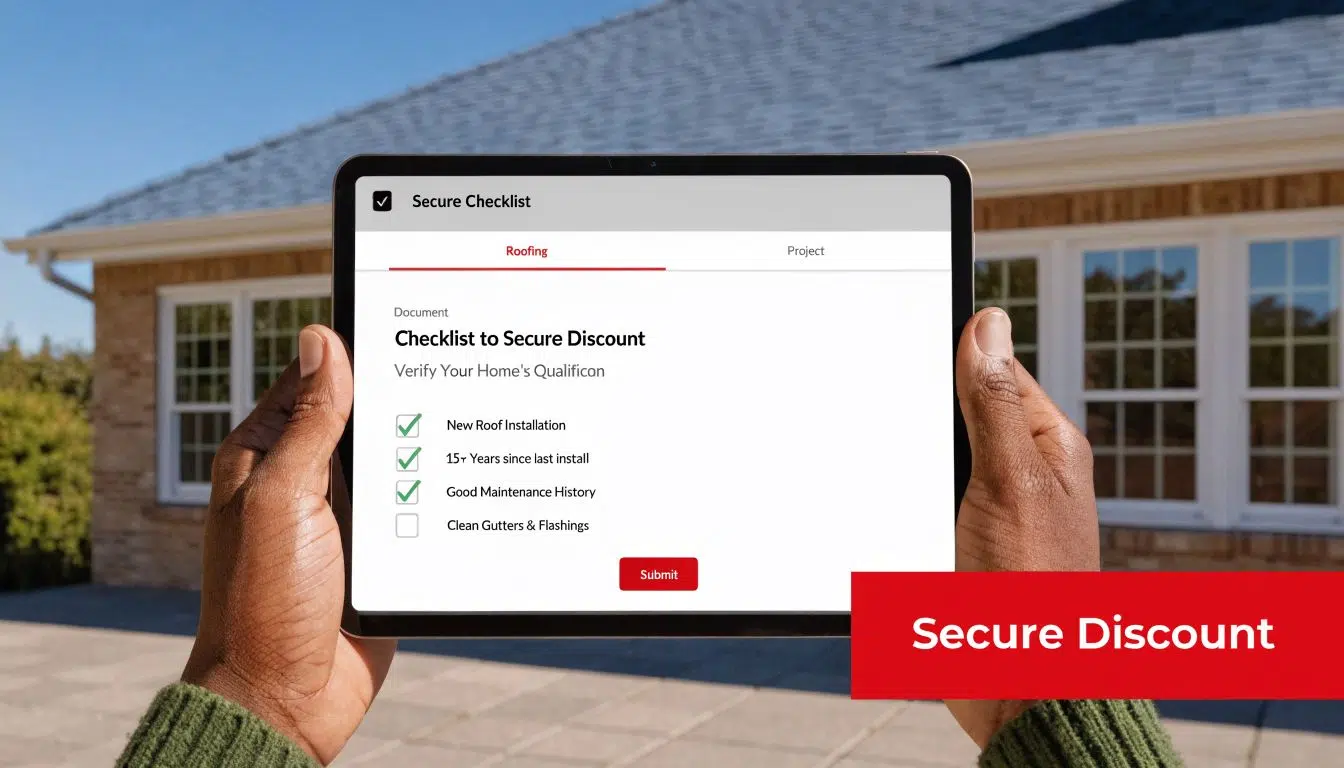
Cedur's explanation of roof replacement and insurance pricing notes that roof condition is arguably the most influential factor in discount determination and that homeowners should notify insurers of the replacement, provide proof of installation by licensed contractors, and retain certification documentation. The same source also points out that some insurers fold roof condition into base pricing rather than offering a separate named discount.
The playbook that works
Follow this sequence after the installation is complete.
Call your insurer or agent right away
Don't wait for renewal if the roof was a major weakness in your file. Ask them to update the dwelling information based on full roof replacement.Submit the final contractor invoice
The invoice should clearly show the property address, date of completion, contractor identity, and what was installed. If the description only says “roof work,” that's weak documentation.Provide product and certification details
If your roof includes impact-resistant or wind-rated materials, send the product data sheet or manufacturer documentation that shows the relevant rating.Keep proof the contractor is licensed, bonded, and insured Some carriers care significantly about this. Even when they don't ask for it first, having it ready speeds things up.
Build a clean insurance packet
The strongest submission is simple and complete. Include:
- Final paid invoice: This proves the job is done, not just scheduled.
- Material specification sheet: Especially useful when the roof includes Class 4 impact resistance or other recognized performance ratings.
- Permit or closeout paperwork where applicable: It helps show the replacement was formal and code-conscious.
- Warranty information: This supports the idea that the system was professionally installed.
- Photos of the completed roof: Helpful if the agent needs quick confirmation before underwriting review.
Worth doing: Put every document into one PDF before sending it. Agents and underwriters respond faster when the file is organized.
Ask the right follow-up questions
A lot of homeowners stop after sending documents. Don't. Ask for specifics.
- Has the policy been updated to reflect full roof replacement?
- Was the new material type entered correctly?
- Do you need an inspection or additional photos?
- Will any premium change show now or at renewal?
If there's a storm claim involved anywhere in the process, tread carefully in your communication. This guide on what not to say to a roof insurance adjuster is worth reading before those conversations start.
One common mistake
Homeowners assume the contractor and insurer are talking directly. Sometimes they are. Often they aren't. Unless someone confirms the carrier updated the file, act as if it's still your job to push the paperwork through.
That one follow-up call can be the difference between “we never received the rating documents” and “your revised premium is already in process.”
Why a New Roof Might Not Lower Your Premium
This is the part people don't like hearing, but it's real. A new roof doesn't guarantee cheaper insurance.
Sometimes the replacement helps with eligibility and long-term claims posture more than it helps with the immediate premium. That can still be valuable, especially if the old roof was putting renewal at risk.
Common reasons the premium doesn't move much
Here are the usual causes.
- The old roof wasn't the main pricing problem: If the carrier was more concerned about other property-level risks, the new roof may not drive a big rate change.
- The new roof was basic, not a durability upgrade: Standard replacement can be worthwhile, but it may not earn the same recognition as impact-resistant or wind-rated materials.
- The insurer uses roof condition inside base pricing: You may not see a separate discount line item, even if the policy was re-rated.
- The homeowner never submitted documentation: No paperwork often means no update.
- The work came from a weak or unverifiable install record: If the carrier can't confirm what was installed and by whom, they may leave pricing unchanged.
Chicago-specific disappointments
In this market, another issue shows up. Some homeowners replace visible shingles but leave the insurer unconvinced that the local risk picture improved. If the roof still appears vulnerable to wind uplift, ice dam trouble, or drainage problems, the underwriter may not view the project as a meaningful reduction in claim risk.
That's one reason older roofs in Chicago become such a headache over time. If you're trying to judge whether age itself is already working against you, this article on whether a 20-year-old roof is too old in Chicago gives useful local context.
Sometimes the win isn't a dramatic discount. It's avoiding underwriting trouble, higher deductibles, or a non-renewal conversation later.
Don't confuse replacement with maximum credit
A homeowner can absolutely make the right decision by installing a standard new roof. The house may be better protected, the leak headaches may stop, and the property may be easier to insure going forward.
But if the goal is to maximize insurance savings, the roof has to check more boxes than “brand new.” It needs stronger materials, cleaner documentation, and a carrier that rewards those upgrades.
Frequently Asked Questions and Your Next Steps
How soon should you contact your insurer after the roof is installed
As soon as the job is finished and you have the paperwork in hand. Waiting until renewal can delay the update, and some homeowners forget by then. A quick call followed by a complete document packet is the cleanest approach.
Can your premium ever go up after a roof replacement
A roof replacement itself is supposed to improve the home's risk profile, but insurance pricing is broader than one feature. If your renewal lands during a market-wide rate increase or the carrier changes how it prices your area, the premium may still rise even though the roof helped your file.
Do you need a special inspection
Sometimes. Some carriers accept invoices, photos, and product documentation. Others may want an inspection or additional underwriting review before changing the policy details.
Is a full replacement better than patchwork if insurance savings matter
In many cases, yes. Insurers usually respond better to a complete, well-documented replacement than to a series of repairs, because the replacement gives them a clearer picture of the roof's age and expected performance.
What should you keep in your records after the job is done
Keep the invoice, warranty, product data sheets, photos, and any permit or closeout paperwork. If the carrier asks questions months later, you don't want to hunt through old emails while the file sits untouched.
What's the practical takeaway
Will getting a new roof lower your insurance? Often, yes. But the homeowners who secure the savings are the ones who treat the roof replacement like both a construction project and a documentation project.
They choose materials the insurer recognizes. They make sure the installation record is clean. They notify the carrier. They follow up until the policy file reflects the new roof accurately.
That's how you turn “it depends” into the best answer your house is likely to get.
If you want a roof replacement that's built for Chicago weather and documented properly for insurance review, Expert Super Seal Roofing & Tuckpointing is a strong place to start. As a family-owned Chicago contractor serving the area since 1972, the company handles residential, commercial, and industrial roofing with the kind of paperwork, material knowledge, and local experience that helps homeowners avoid missed details after installation. Whether you need a full replacement, storm-related repair guidance, or a second opinion on the right roofing system for your building, their team can help you get the job done right the first time.