Late winter and early spring are when the phone starts ringing. Snow is sliding, ice is cracking loose, the gutters are dripping, and somebody inside the house or building is wondering the same thing: Is my roof still fine, or am I about to pay for a problem I can’t see yet?
That’s a fair question in Chicago. A roof here doesn’t live the life it would in a milder climate. It gets baked in summer, frozen hard in winter, pushed by wind, loaded with snow, and tested over and over by freeze-thaw cycles. That’s why how long should a roof last in Chicago has a different answer than the one printed on a brochure or warranty sheet.
Most owners don’t need a generic roofing article. They need a realistic one. A bungalow owner on the Northwest Side, a condo board with a flat roof, and a warehouse manager in the suburbs all have different roof systems, but they’re dealing with the same local truth. Chicago weather shortens roof life, and the details matter.
The Question Every Chicago Property Owner Asks
A thaw tells you a lot about a roof.
You hear ice dropping off the edge. You see dark streaks where meltwater has started moving. Maybe a top-floor ceiling stain appears, or maybe nothing shows inside at all. That’s often when owners start looking up and asking how much life is really left.
Manufacturer warranties matter, but they don’t tell the whole story here. In Chicago, roofs age from real exposure, not from paper promises. The stress comes from repeated heating and cooling, wind-driven weather, snow sitting where it shouldn’t, and drainage that works fine until it suddenly doesn’t.
What owners usually want to know
Most calls come down to a few practical concerns:
- How much time is left: Not theoretical life. Real remaining service life in this climate.
- Whether a repair is enough: Owners want to know if a leak is isolated or a sign of wider failure.
- When to budget for replacement: Especially for condos, landlords, and commercial properties.
- What material holds up better here: That question matters more now because weather swings have gotten harder on roofs.
Chicago roofs rarely fail all at once. Most of the time, they warn you first. The problem is that owners miss the warning signs or trust the warranty more than the roof.
Why location changes the answer
A roof in Arizona, Tennessee, or even downstate Illinois won’t age the same way as one in Chicago.
Here, a sloped asphalt roof and a low-slope membrane roof face different problems, but both take a beating. Shingles lose granules, adhesives weaken, flashing opens up, drains clog, seams split, and ponding starts wearing down areas that looked fine a season earlier.
That’s why the right answer isn’t “a roof should last X years.” The better answer is: it depends on the material, the installation quality, the maintenance, and how well that roof handles Chicago’s climate year after year.
Realistic Roof Lifespans for Chicago Buildings
A Chicago roof ages on the roof, not on the warranty sheet. Two houses can install the same product in the same year and get very different results if one has clean drainage, solid flashing, and regular service while the other gets ignored until the first interior stain shows up.
For most owners, the useful question is simple: how long does this roof usually give you here before repairs stop making financial sense?
Asphalt shingle roofs in Chicago commonly last about 15 to 30 years, with 3-tab shingles often landing in the 15 to 20 year range and architectural shingles more often in the 20 to 25 year range, with some lasting longer under favorable conditions, according to local Chicago roofing data on asphalt roof lifespan.
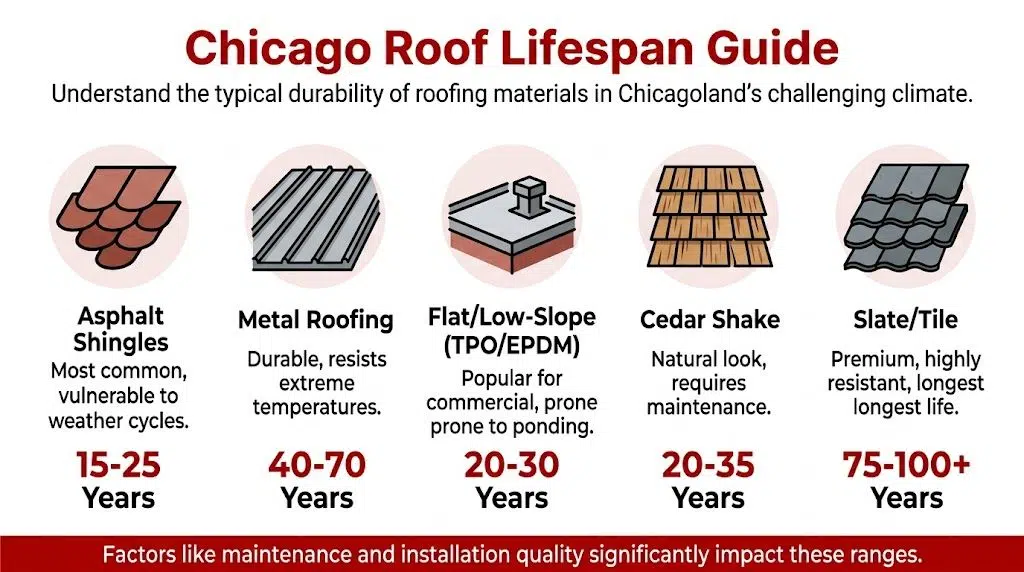
Chicago Roof Lifespan Comparison
| Roofing Material | Manufacturer Warranty | Chicago Reality |
|---|---|---|
| 3-tab asphalt shingles | Often sold with long-term warranty language | 15-20 years in Chicago conditions |
| Architectural asphalt shingles | Often sold with 30+ years warranty language | 20-25 years, sometimes up to 30 years under favorable conditions |
| Flat TPO or EPDM systems | Warranty depends on system and installer | Often 12-22 years on Chicago commercial roofs |
| Metal roofing | Varies by panel system and finish | Often 40-70 years in Chicago |
| Modified bitumen and coated low-slope systems | Depends on assembly and maintenance plan | Service life varies, but coatings can meaningfully delay tear-off on viable roofs |
Asphalt shingles on Chicago homes
Asphalt still dominates Chicago houses, two-flats, and many small condo buildings because the install cost is manageable and repairs are usually straightforward. That value is real. So is the shorter replacement cycle.
The same Chicago source notes that local roofs deal with strong storm gusts, winter snow loads, and repeated seasonal stress, which speed up granule loss, cracking, and sealant fatigue on asphalt systems by the time they reach older age. In the field, 3-tab roofs usually show that wear sooner than laminated shingles.
What these lifespan numbers mean on a real building
The material matters, but the roof assembly matters just as much.
- 3-tab shingles wear out faster: They are lighter, more prone to wind damage, and usually become brittle earlier.
- Architectural shingles buy time: They hold up better, but they still age out when seal strips weaken, flashing starts opening, and repairs begin stacking up.
- Installation quality changes the outcome: Bad nailing, sloppy valley work, and weak flashing details can cut years off a roof.
- Ventilation and drainage affect service life: Poor attic airflow on steep roofs and poor water movement on low-slope sections both shorten lifespan.
Practical rule: Once an asphalt roof in Chicago gets into the later teen years, owners should budget for replacement planning even if leaks are still intermittent.
Flat and low-slope roofs deserve equal weight in Chicago
Generic roofing articles miss the city.
A big share of Chicago buildings are not simple pitched-roof homes. Bungalows have low-slope sections. Two-flats and six-flats often have flat rear roofs or full membrane systems. Condo associations and commercial properties depend on low-slope assemblies where failure usually starts at seams, penetrations, parapet walls, drains, and ponding areas rather than with a missing shingle.
For Chicago flat commercial roofs, TPO and EPDM systems often last 12 to 22 years, based on Chicago flat roof lifespan and coating performance data. That range makes sense in practice. Once drainage slows down and snowmelt starts sitting on the roof, aging speeds up. Owners dealing with recurring winter buildup should also understand the role of flat roof snow removal for Chicago winter conditions, especially on older low-slope systems that already have marginal drainage.
Modified bitumen and coated low-slope roofs need a more careful cost analysis. A coating is not a rescue plan for a wet, failing roof. It is a way to extend a roof that is still structurally worth saving. On the right building, that can postpone a tear-off and improve return on the roof you already paid for.
Metal changes the long-term math
Metal roofing is a bigger upfront investment, but the service life can change the whole ownership plan.
According to this Chicago roof lifespan guide covering metal performance and long-term cost trade-offs, metal roofing can last 40 to 70 years in Chicago, while asphalt systems usually cycle out much sooner. That gap matters for owners who expect to keep the property, refinance it, or avoid paying for another full replacement in 20 years.
Metal is not the right answer for every building. The substrate has to be right. The detailing has to be right. The budget has to be there. But on the right Chicago property, especially where wind exposure and long hold time are part of the equation, metal often produces better long-term value than replacing asphalt twice.
Why Chicago Weather Is Your Roofs Worst Enemy
Chicago doesn’t destroy roofs with one dramatic event most of the time. It wears them down in stages.
The best way to describe it is slow-motion demolition. Materials expand, contract, hold moisture, dry out, freeze, flex, and repeat that cycle over and over until a weak point opens up.

Freeze-thaw does more damage than people think
Flat roofs in Chicago often fail early because winter water doesn’t just sit there harmlessly. It melts, refreezes, and works into seams and surface defects.
Verified local guidance says flat roofs in Chicago’s harsh winters often fail in 10-20 years due to ice dam formation, ponding water from snowmelt, and thermal expansion cracking, exacerbated by 50+ annual freeze-thaw cycles, with a 25% rise in flat roof claims from ice-related damage in 2025-2026 noted in that source at this Chicago roof failure article focused on weather-related damage.
That’s a real problem for condo boards and property managers because low-slope roofs often look fine from the street while water is already working underneath laps, flashings, or old repairs.
Snow and ice hit flat roofs differently
On a steep shingle roof, snow usually sheds eventually. On a flat or low-slope roof, snowmelt can collect around drains, edges, and low spots.
That’s why rooftop snow management matters. For many buildings, rooftop snow removal for flat roofs in Chicago winters isn’t cosmetic maintenance. It’s part of preventing overload, ponding, and ice-related membrane damage.
A few trouble spots show up again and again:
- Clogged interior drains: Water has nowhere to go, so it sits and refreezes.
- Parapet edges and scuppers: Snow and ice can trap drainage at the perimeter.
- Transitions between roof levels: Meltwater often collects where one section dumps onto another.
- Old patch areas: Previous repairs become weak points when movement starts.
Wind and sun are just as hard on roofs
Chicago’s winter gets the attention, but summer does its share of damage too.
UV exposure dries out roofing materials. Heat builds up on dark surfaces. Sudden temperature swings harden sealants, then crack them. Wind gets underneath aging shingles and loose membrane edges and turns a small opening into a larger failure.
If you’ve got a roof with one weak seam, one lifted shingle edge, or one bad flashing joint, Chicago weather will find it.
That’s why roof life here depends on system design and maintenance, not just material type. A roof that drains well, vents properly, and gets checked before and after winter usually lasts longer than a better-looking roof that nobody pays attention to.
Visual Signs Your Chicago Roof Needs Help
Most owners don’t need to climb a ladder to spot trouble. In fact, they shouldn’t. You can learn a lot from the ground, from the yard, alley, parking lot, or upper windows.
The key is knowing what you’re looking at. A roof rarely goes from healthy to failed overnight.
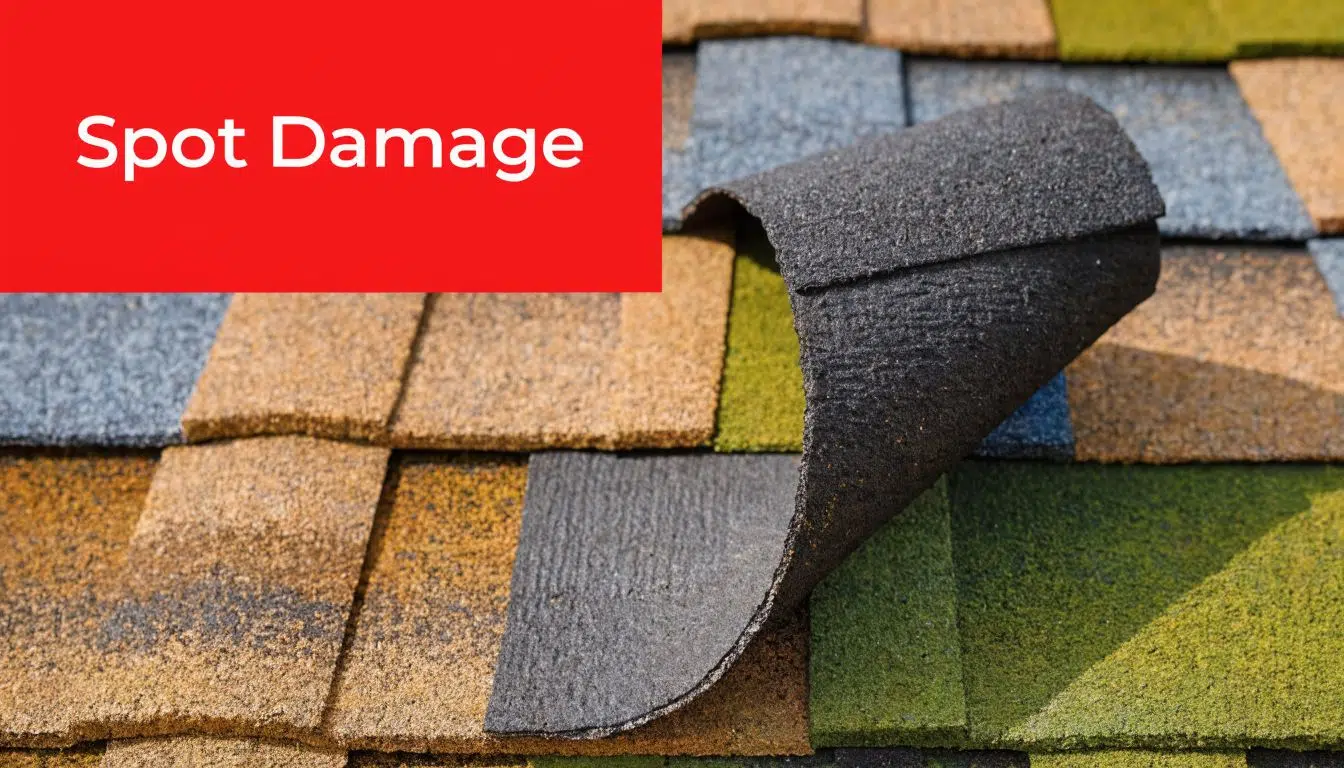
What to look for on shingle roofs
Shingle problems are often visible before leaks show up inside.
Watch for these signs:
- Curling or cupping shingles: The edges lift, and the shingle starts losing its flat profile. That usually means age, heat stress, or moisture-related wear.
- Bare or dark patches: Granule loss leaves shingles looking uneven or worn smooth in spots.
- Tabs that don’t sit tight: Wind can loosen older shingles before it tears them off.
- Flashing that looks bent, cracked, or separated: Trouble often starts around chimneys, walls, and roof penetrations.
- Debris in gutters that looks like roof material: If you’re seeing a lot of granules, the roof is shedding protection.
A roof can still be watertight while showing these warnings. That doesn’t mean ignore them. It means you still have time to make a smart decision before water gets in.
What to look for on flat and low-slope roofs
Flat roofs fail less obviously.
If you can see part of the roof from a deck, upper window, adjacent building, or safe access point, check for these signs:
Standing water after rain or thaw
A little temporary wetness is one thing. Water that sticks around is another. Ponding usually points to drainage trouble, sagging, or low spots that are stressing the membrane.
Blisters or bubbles
Raised areas in the membrane can mean trapped moisture or separation within the system.
Open seams and edge details
Membranes often start failing at joints, parapet flashings, corners, and terminations.
Surface cracking or worn coating
If the protective surface is breaking down, the underlying roof is more exposed.
A stain on the top floor doesn’t always mean the leak is directly above it. Water travels. The visible symptom may be several feet away from the roof opening.
Clues around the building matter too
Roof problems also show up off the roof.
Look at the building itself:
- Interior ceiling stains: Especially after thaw cycles or wind-driven rain.
- Peeling paint near upper walls: Moisture often shows there first.
- Masonry staining at parapets: That can point to coping, flashing, or roof edge issues.
- Overflow during rain: Gutters or drains may be backing up instead of moving water away.
If you manage a condo or commercial property, have maintenance staff photograph the same trouble spots after major weather events. Comparing those photos season to season often reveals slow changes that owners miss in day-to-day life.
Extend Your Roofs Life with Proactive Maintenance
A Chicago roof usually gives owners warning before it gives up. The catch is that those warnings are easy to miss if nobody is looking until water hits drywall.
The longest-lasting roofs I see are rarely the ones with the fanciest warranty. They are the ones with a routine. That matters even more here, where flat and low-slope roofs on bungalows, condos, and mixed-use buildings take a beating from freeze-thaw cycles, drifting snow, hard summer sun, and backed-up drainage.
What good maintenance looks like in Chicago
Maintenance should match the roof type and the building.
On a steep-slope shingle roof, the work is often straightforward: keep gutters open, replace damaged shingles, and stay ahead of flashing problems around chimneys and walls. On a flat or low-slope roof, the risks are greater because small drainage issues can keep water on the surface for days. That shortens the life of membranes, stresses seams, and raises the odds of interior damage.
A practical routine usually includes:
- Clearing drainage paths: Gutters, downspouts, scuppers, and roof drains need to move water off quickly, especially before winter and after heavy storms.
- Checking flashings and penetrations: HVAC curbs, plumbing vents, skylights, parapet walls, and edge metal are common leak areas.
- Watching interior conditions: Top-floor ceilings, attic spaces, and upper wall lines often show moisture before a leak becomes obvious outside.
- Inspecting after major weather events: High winds, snow load, ice, and repeated thaw cycles tend to expose weak details.
- Fixing small defects early: A loose seam, cracked pipe boot, or lifted flashing edge is a repair. Left alone, it often turns into deck repair, insulation replacement, and interior work.
For flat and low-slope systems, owners usually benefit from a structured plan for flat roof maintenance in Chicago instead of relying on occasional leak calls.
Coatings can extend service life, if the roof is still worth saving
Coatings make sense on some aging flat roofs. They do not make sense on all of them.
The Roof Coatings Manufacturers Association explains that a roof coating is a fluid-applied membrane that can renew the weathering surface, improve reflectivity, and help delay replacement when the existing roof is dry, stable, and properly prepared, according to the RCMA roof coatings overview. That lines up with what happens in the field. Coatings can be a smart investment on Chicago flat roofs with sound substrate and manageable moisture conditions, especially when the owner wants more years out of the system without a full tear-off.
The trade-off is simple. A coating can protect a serviceable roof. It will not correct saturated insulation, rotten decking, open seams across large areas, or chronic ponding caused by bad slope. If the roof has those problems, coating over them usually wastes money.
What pays off and what wastes money
Some maintenance work extends roof life in a measurable way. Some only hides the problem for one more season.
What pays off
- Cleaning drains and scuppers before freeze-ups
- Resealing or repairing flashing before water gets into the assembly
- Correcting small drainage issues on flat sections
- Using repair materials that match the existing roof system
- Scheduling roof checks after major storms and late-winter thaw cycles
- Using coatings as part of a plan, not as a shortcut
What wastes money
- Spreading roof cement over every leak area
- Ignoring ponding water because the roof has “always done that”
- Coating over trapped moisture
- Repatching the same section every year on a roof that has already aged out
Expert Super Seal Roofing & Tuckpointing is one Chicago contractor that handles flat roof repair, coatings, and snow-related service for TPO, EPDM, modified bitumen, and torch-down systems. That kind of fit matters on buildings where the leak path involves both the roof and the masonry at parapets, coping, or upper wall transitions.
Repair vs Replace Making the Right Call in Chicago
A Chicago owner usually calls for one of two reasons. Water just showed up inside, or the same roof section has needed attention two or three times and nobody is sure whether another repair still makes sense.
The right answer depends on what is failing. A localized puncture, an open seam, or flashing damage around a chimney, parapet, or vent can often be repaired if the rest of the roof system is still doing its job. A roof with widespread trapped moisture, failing insulation, repeated ponding, or large areas of membrane fatigue usually needs more than another patch.
When repair is the smarter move
Repair is the better choice when the roof still has real service life left and the failure is limited.
That often includes situations like these:
- The problem is confined to one section
- The surrounding membrane, shingles, or flashing are still sound
- The leak source is clear and accessible
- The drainage issue is minor enough to correct without rebuilding the roof assembly
- Past repairs have held, and this is not the same section failing every season
On Chicago flat and low-slope roofs, that might mean repairing seams, replacing damaged flashing at a parapet wall, fixing a split near a drain, or addressing a small area of ponding before winter turns it into a larger problem. On sloped shingle roofs, it may be a flashing repair, a limited shingle replacement, or localized decking work after a wind event.
When replacement is the better business decision
Replacement becomes the better call when repair money stops buying useful time.
That happens all the time on older Chicago buildings. A bungalow with repeated ice dam damage, a six-flat with chronic ponding near clogged interior drains, or a commercial roof with wet insulation under multiple sections may still be repairable on paper. In practice, the owner keeps paying for leak response, interior damage, tenant complaints, and another round of patching after the next hard weather cycle.
This is also where material choice matters. Asphalt is still common and often the lower upfront-cost option. But long-term owners should also price out better wind resistance, lower maintenance, and longer service life where the building and budget support it. For flat and low-slope roofs, a properly specified membrane restoration or coating system can make sense if the substrate is still dry and stable. For some homes and smaller buildings, metal can produce better long-term value because it handles Chicago weather abuse better than many lower-cost systems.
Analysts at Remodeling found that replacement projects can return a meaningful share of their cost at resale in the annual Cost vs. Value report, but resale is only part of the math in Chicago. The bigger ROI often comes from fewer leak calls, less emergency patching, lower disruption to tenants or operations, and a roof system that matches the building instead of fighting it.
For owners trying to budget the decision, what a new roof costs in Chicago is easier to judge after an inspection separates a repairable defect from full system failure.
Use three questions to make the call:
- How much service life is left in this roof
- Is the failure isolated, or does it show up across the system
- Will this repair stop the leak cycle, or only postpone replacement
If the repair only buys one more season, replacement is usually the cheaper decision.
If you’re trying to decide between a repair, a coating, or a full replacement, the next step is a direct inspection and an honest assessment. Expert Super Seal Roofing & Tuckpointing serves the Chicagoland area with residential, commercial, and industrial roofing, including emergency service, flat roof work, shingle systems, coatings, and snow-related response. A clear estimate now is usually cheaper than guessing wrong after the next storm.