
A lot of Chicago property owners ask the same question at the same moment. They look up at a chimney after winter, or they notice sandy mortar collecting near a brick wall, and they wonder whether insurance will cover the repair.
That question usually comes with pressure behind it. A homeowner is worried about a denied claim. A condo owner is not sure whether the association should handle it. A building manager is trying to decide whether filing a claim will help or create a bigger insurance problem at renewal.
The short answer is usually no. But the precise answer depends on what caused the damage, what type of property you own, and what kind of policy applies to that part of the building.
The Cracks Are Showing But Will Insurance Pay
In Chicago, this often starts after a hard stretch of winter weather. A single-family homeowner sees open joints around the chimney. A condo board spots deteriorating mortar on a street-facing wall. A commercial owner notices brick movement near a parapet or loading area and starts asking whether insurance can absorb the cost.
The first mistake is assuming all masonry damage is treated the same.
It is not.
If mortar has been wearing down over time, insurers usually treat that as ownership responsibility. If a sudden event damaged the masonry, the conversation changes. That distinction is what decides most claims.
For Chicago buildings, that matters because the local building stock is mixed. You might be dealing with an older brick bungalow, a six-flat, a mid-rise condo, or a commercial warehouse. Each one creates a different insurance path.
The practical issue is not just whether to file. It is whether filing makes sense.
A weak claim wastes time, triggers paperwork, and can put unnecessary attention on a property that already has visible maintenance issues. A strong claim usually starts with one thing. You can point to a specific event and show how that event damaged the masonry.
If you cannot tie the damage to a sudden incident, assume the insurer will view tuckpointing as maintenance first and covered loss second.
That is the rule property owners need to understand before they call an adjuster.
Why Insurance Usually Excludes Tuckpointing
Insurance companies separate maintenance from covered loss. That is the whole game.
Tuckpointing falls on the maintenance side in most situations. According to this masonry insurance explanation from Tuckpointing.com, tuckpointing is classified as preventive masonry maintenance rather than a covered peril under standard homeowners insurance policies, and insurers distinguish between sudden, accidental damage and gradual deterioration.
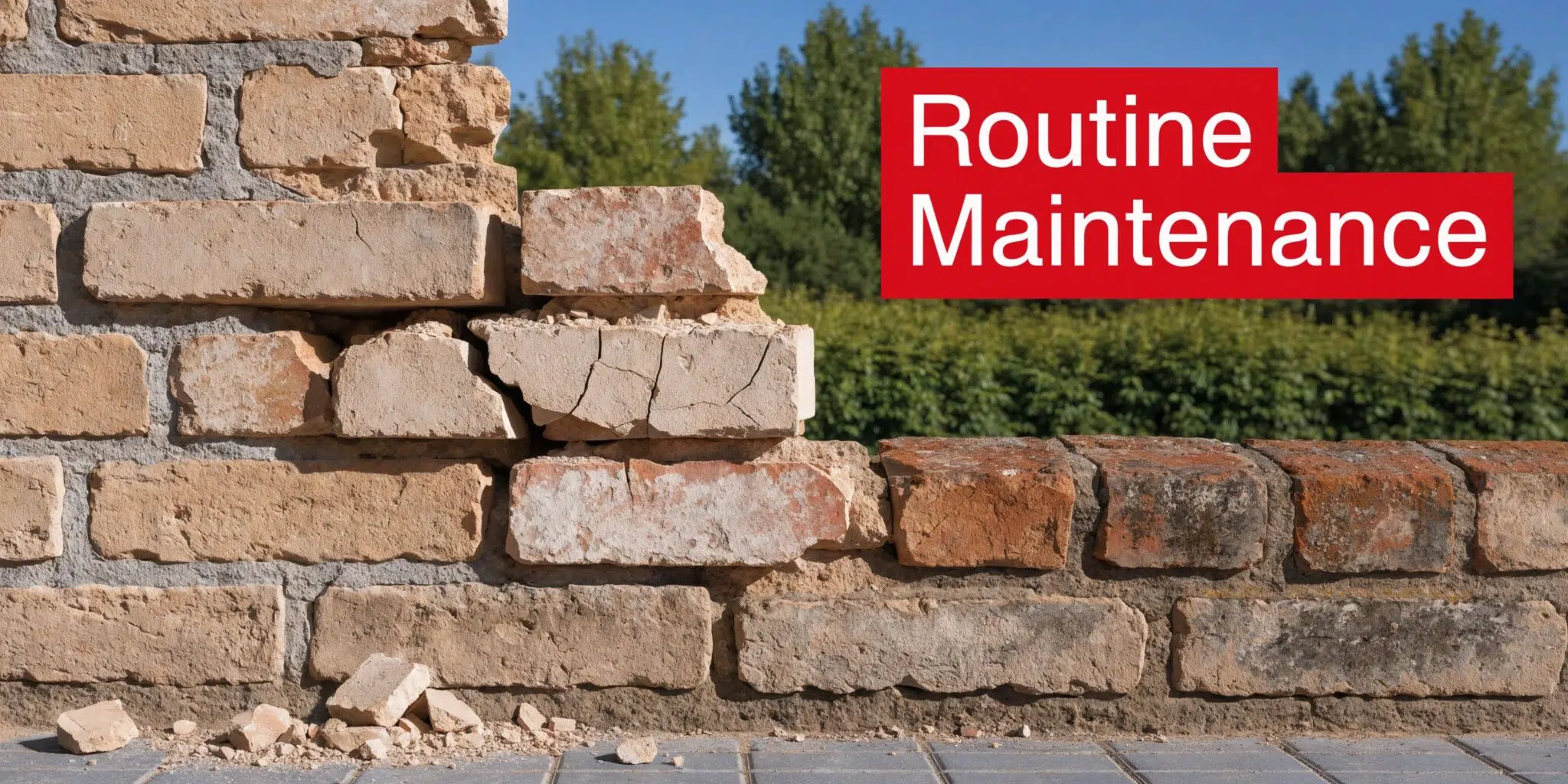
Think of tuckpointing like oil changes
A simple analogy helps.
You do not expect auto insurance to pay for an oil change, worn brake pads, or aging tires. Those are predictable ownership costs. Tuckpointing works the same way. Mortar joints age, weather breaks them down, and owners are expected to maintain them before bigger failures happen.
That is why the phrase wear and tear matters so much in insurance language.
Mortar does not usually fail all at once. It erodes slowly from weather exposure, water entry, temperature swings, and age. In Chicago, owners see this on chimneys, parapets, window sills, and long brick elevations where the wall has taken years of abuse.
What insurers are looking for
When an adjuster reviews a masonry claim, the first question is often not “How bad is it?” It is “What caused it?”
If the answer sounds like any of these, coverage is usually a problem:
- Aging mortar: The joints have been weakening over time.
- Freeze-thaw wear: Seasonal expansion and contraction opened the joints gradually.
- Deferred upkeep: The wall or chimney needed service earlier and the repair was postponed.
- Long-term moisture exposure: Water kept entering and the mortar broke down over multiple seasons.
By contrast, insurers are built to respond to a named peril or sudden accidental event.
Why this hits older Chicago masonry harder
Older brick buildings need regular inspection because mortar is a sacrificial material. It is supposed to wear before the brick does. That is good masonry design, but it also means tuckpointing is part of normal building stewardship.
For owners, the practical trade-off is straightforward:
| Situation | How insurers usually view it |
|---|---|
| Mortar joints crumbling over time | Maintenance |
| Wall needs repointing after years of weathering | Maintenance |
| Masonry damaged by a sudden accident or event | Potential claim |
| Preventive tuckpointing before leaks or loose brick develop | Owner expense |
Tuckpointing is usually the repair that prevents the insurance claim, not the repair that insurance pays for.
That is frustrating, but it is consistent with how most policies are written.
Exceptions That May Trigger Homeowners Insurance Coverage
The general rule is exclusion. The important exceptions come from sudden, direct damage.
For homeowners, the best way to think about this is simple. Insurance may respond when the masonry was fine before a specific event and damaged right after it. That is very different from joints that have been failing for years.
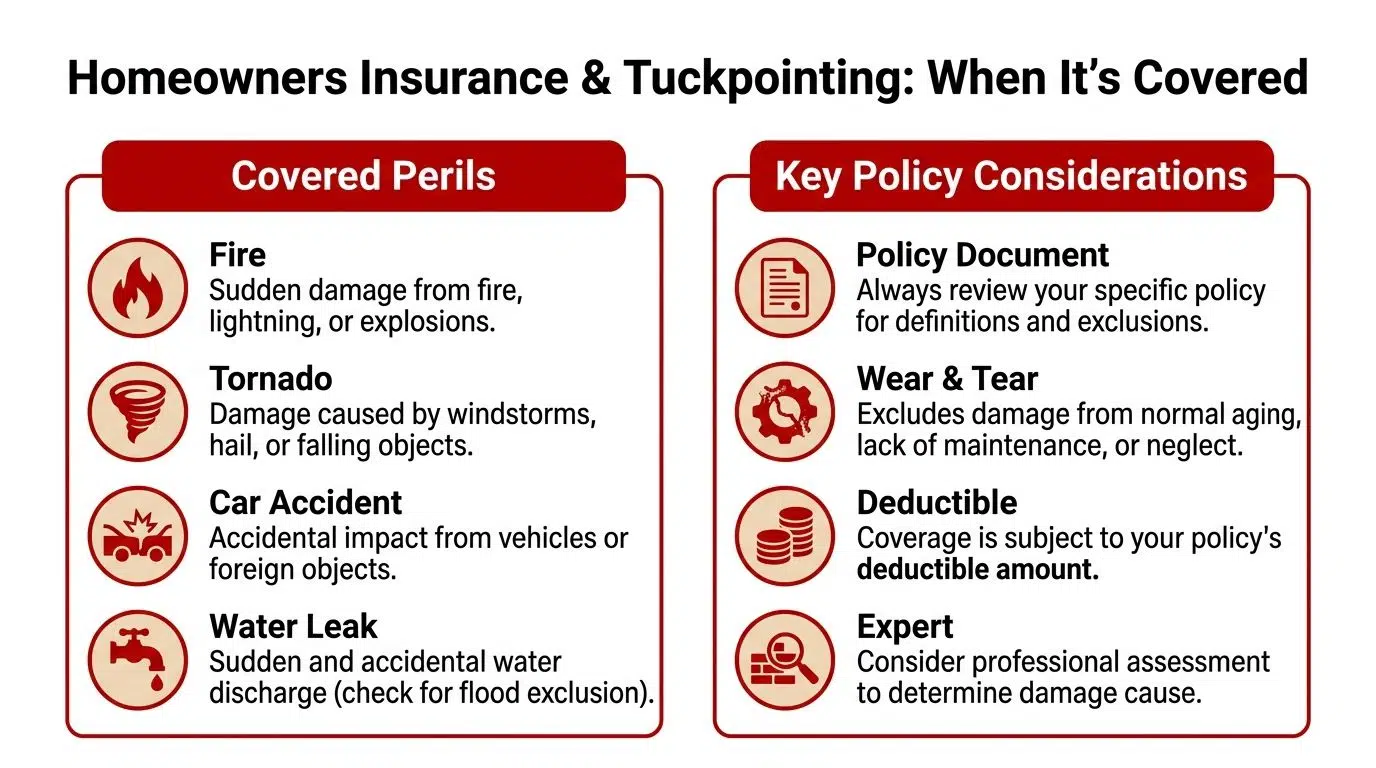
Covered events versus routine deterioration
According to Hudson Valley Chimney’s breakdown of chimney insurance coverage, policies typically cover only abrupt events such as lightning strikes or chimney fires, which together represent the top two insurable chimney damages. Storm damage from fallen trees or severe weather may qualify if documented as sudden, but routine tuckpointing does not.
That is the dividing line.
Here is the side-by-side view property owners need:
| More likely covered | Usually not covered |
|---|---|
| Fire damage to chimney or brick wall | Mortar erosion from age |
| Lightning strike that cracks chimney masonry | Open joints from seasonal exposure |
| Fallen tree impact on exterior brick | Long-term water entry |
| Sudden storm-related masonry damage with documentation | Delayed repairs and neglected upkeep |
| Vehicle impact into wall or facade | Preventive repointing |
What makes a claim stronger
A claim gets stronger when you can show timing, cause, and direct physical damage.
Examples that tend to make sense to an insurer:
- After a chimney fire: Brick and mortar were damaged during a single event.
- After a lightning strike: The chimney or cap assembly took a direct hit and cracking followed.
- After a tree impact: There is visible strike damage on a wall or chimney.
- After severe weather: A section of masonry failed immediately after the event, and the loss can be documented.
What does not work well is trying to package old deterioration as storm damage after the fact.
Adjusters see that often. If the mortar was already recessed, soft, or missing in multiple areas before the event, they may decide the storm exposed a pre-existing condition rather than caused the actual need for tuckpointing.
A practical homeowner check before filing
Before calling in a claim, ask these questions:
- Can I identify one clear event?
- Did the masonry damage appear right after that event?
- Do I have photos, video, or other proof?
- Is the visible damage limited to one impacted area, or does the whole chimney show age-related wear?
If you are trying to price the repair side before making that decision, this Chicago exterior brick repair cost guide helps frame what the out-of-pocket route can look like.
The stronger claim is not always the claim with the most damage. It is the claim with the clearest cause.
That is especially true with masonry.
Navigating Condo and HOA Masonry Coverage
Condo masonry claims are where confusion usually gets worse.
A unit owner sees deteriorated joints on an exterior wall and assumes the HOA master policy will handle it. The board assumes the issue belongs to an individual owner. Meanwhile the brick keeps taking on water.

The first question is not insurance
The first question is responsibility.
In a condo setting, you usually need to read three things together:
- The declaration
- The bylaws
- The insurance schedule for the association and the unit owner
Those documents decide whether the affected masonry is a common element, a limited common element, or part of the unit owner’s responsibility.
Exterior brick walls are often treated as common elements, but that does not automatically mean the master policy pays for tuckpointing. It may only mean the association is responsible for arranging and funding maintenance.
Where the gap usually appears
This is the part many owners miss. A master policy can cover the building envelope for certain losses and still exclude routine masonry maintenance.
That means two separate issues may both be true at once:
- The association is responsible for the wall.
- The association still has to pay out of operating funds or reserves because the work is maintenance.
According to Brick and Level’s discussion of masonry coverage questions, post-2025 Illinois HB 4871 mandates HOA disclosures of masonry coverage gaps, affecting many Chicagoland condos per recent Cook County data. For boards and unit owners, that matters because many disputes start with unclear assumptions about what the master policy covers.
How to sort it out without guessing
For condo owners and board members, the cleanest process is this:
Review the policy language with the property area in mind
Do not ask, “Is tuckpointing covered?” Ask, “Who is responsible for this exact wall, chimney, or parapet, and under what cause of loss?”
That gets better answers.
Match the damage to the governing documents
An exterior wall facing the street is often treated differently from a balcony wall, chimney chase, or exclusive-use element. The legal label matters.
Separate maintenance from sudden loss
If the mortar is worn out, the association may still own the problem but not have insurance coverage for it. If a storm or impact damaged the masonry, there may be a coverage path under the master policy.
Put the manager, board, and contractor in the same conversation
Many condo disputes drag on because each party is working from partial information. A contractor identifies the physical cause. The manager checks the governing documents. The broker or carrier interprets coverage.
On condo buildings, the repair decision gets easier when everyone is discussing the same wall section, the same cause, and the same policy language.
That discipline saves time and avoids circular blame.
Tuckpointing and Commercial Property Insurance
Commercial owners need to look at tuckpointing differently from homeowners.
The basic rule is still the same. Insurance does not want to pay for deferred maintenance. But commercial underwriting is more sensitive to building condition, inspection history, and visible risk.
That changes the financial logic.
Why maintenance affects insurability
A neglected parapet, a failing brick facade, or open joints on a warehouse wall can signal broader property management problems to an insurer. When underwriters see unresolved envelope issues, they may assume higher claim exposure from water intrusion, falling material, or structural deterioration.
That is why proactive masonry work can support better insurance outcomes even when the work itself is not covered.
According to this commercial masonry insurance article from Mortar City, for businesses, high-quality masonry via regular tuckpointing positions owners as low-risk, enabling premium reductions through documented inspections by certified pros, and carriers may cancel policies without them.
What works for commercial owners
The owners who handle this well usually do a few things consistently:
- Keep inspection records: They do not wait until renewal to figure out the building condition.
- Address small failures early: Open joints at a parapet are cheaper to handle before water gets behind the wall.
- Use qualified contractors: Documentation from a professional matters more than a verbal opinion.
- Track repair history by elevation or facade area: That makes future underwriting conversations easier.
What does not work
Two habits cause trouble.
The first is postponing visible masonry repairs while assuming the next policy renewal will go smoothly. The second is treating tuckpointing as cosmetic. On commercial property, insurers often see it as evidence of whether ownership is managing the building responsibly.
Facility managers and landlords should view tuckpointing as part of a broader risk-control file, alongside roof maintenance, drainage corrections, and facade inspections.
For commercial buildings, the strongest position is not “Can I get this covered?” It is “Can I prove this property is being maintained well enough that the insurer wants to keep it on the books?”
How to Document Damage and File a Claim
If you think masonry damage came from a covered event, documentation matters as much as the damage itself.
Many property owners weaken their own claim at this stage. They call the carrier before they have organized the basics, or they describe old deterioration in a way that makes the loss sound maintenance-related from the first phone call.
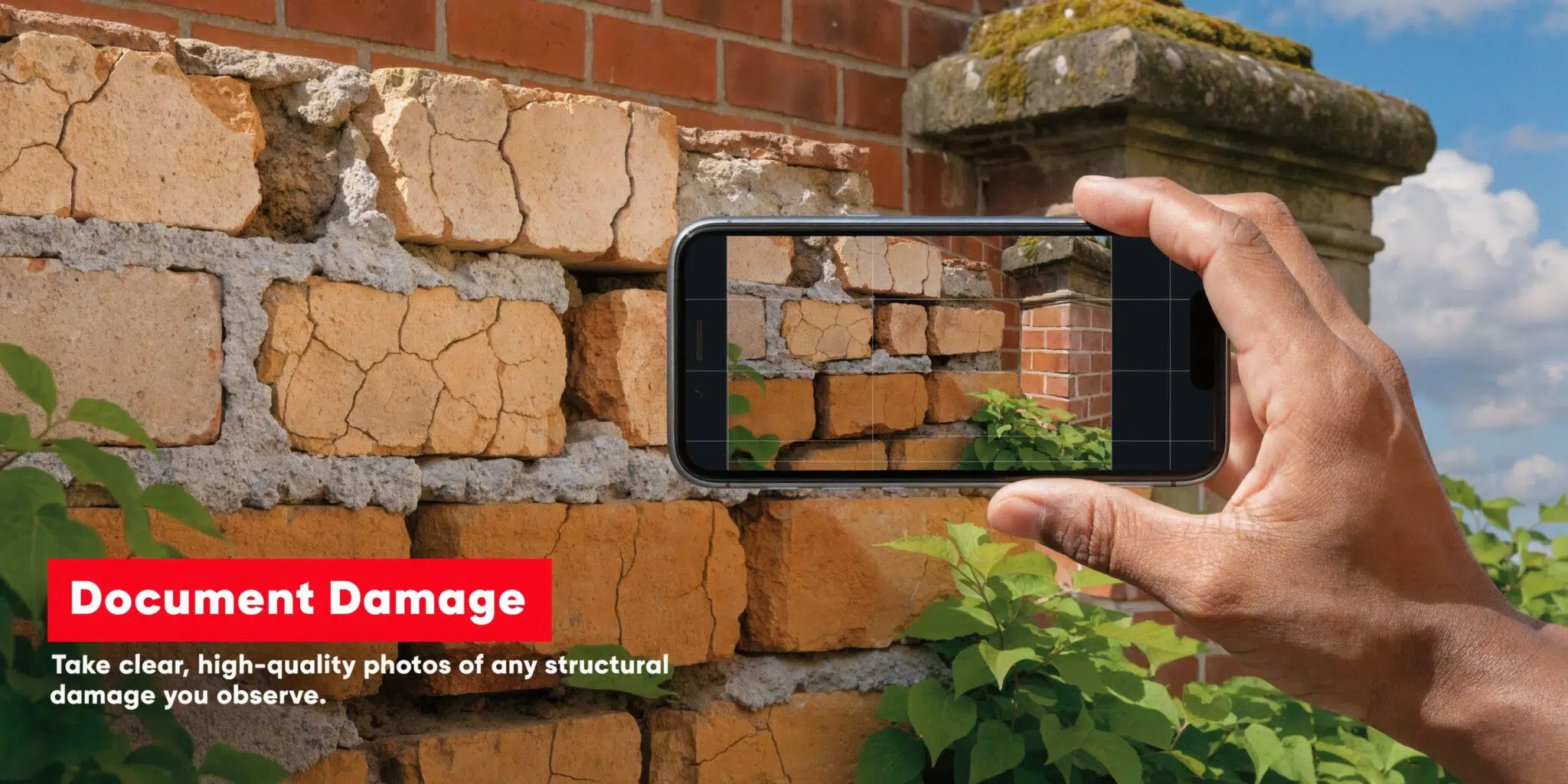
Start with proof of cause
The goal is to connect the masonry damage to one event.
Use your phone, but use it methodically.
Photograph the full area first
Capture the entire chimney, wall, parapet, or impacted elevation so the adjuster sees context.Then move in close
Take close-ups of cracked joints, displaced brick, impact marks, fire damage, or fresh separation.Record the surrounding evidence
If a tree hit the wall, photograph the tree. If debris is on the ground, photograph that too. If a cap or flashing component was displaced during the event, include it.Save timing records
Keep weather alerts, fire department reports, incident reports, or any time-stamped communication that helps show when the loss happened.
Get a contractor opinion focused on cause
A good masonry inspection for insurance is not just a repair estimate.
It should answer a narrower question: does the visible damage look like sudden event damage, long-term deterioration, or a mix of both?
That distinction matters because many claims fail when the building clearly has pre-existing wear in addition to a recent incident. The adjuster may agree an event happened but still deny most of the requested masonry work because much of it was already due.
If you need a cost baseline before deciding whether the claim is worth pursuing, this Chicago tuckpointing price guide for 2026 can help you compare likely repair scope against your deductible and risk tolerance.
Speak carefully with the adjuster
How you describe the damage matters.
Use factual language:
- The chimney was struck during a storm.
- The wall was damaged when a tree fell.
- Cracking appeared immediately after the fire event.
- The affected area was previously intact, and the damage was noticed right after the incident.
Avoid vague phrasing like “it has been getting worse” or “we have been meaning to fix it.” Even if that is partly true, that wording pushes the file toward maintenance.
Think before you file
This is the part owners often skip.
According to Angi’s discussion of insurance claims and foundation-type repairs, even successful tuckpointing claims can significantly raise premiums, and Chicagoland homeowners experience many freeze-thaw cycles annually. That means a claim can solve one short-term cost problem and create a longer-term insurance cost problem.
So before filing, weigh these issues:
| Question | Why it matters |
|---|---|
| Is the loss clearly tied to one event? | Weak causation leads to denial |
| How much repair cost is event-related? | Only part of the scope may qualify |
| Is the deductible close to the repair cost? | The claim may not be worth it |
| Could this claim affect future premiums? | Rate impact can outlast the repair |
| Does the building show older maintenance issues? | That can complicate review |
Filing a claim is not just a construction decision. It is an insurance strategy decision.
That is especially true in Chicago, where masonry gets tested hard and insurers pay close attention to building condition.
The Best Insurance Is Proactive Maintenance
If you are still asking is tuckpointing covered by insurance, the safest answer is this. Do not build your maintenance plan around getting insurance to pay for mortar work.
That approach usually fails.
The more reliable move is to inspect masonry regularly, repair joints before water gets in, and handle chimneys, parapets, and wall sections while the work is still manageable. Insurance is built for sudden losses. Building owners are responsible for stopping ordinary deterioration before it becomes structural trouble.
That is the fundamental trade-off.
You can wait, hope the damage qualifies as a covered event, and risk a denial. Or you can maintain the building on your schedule, protect the brick, and avoid the bigger chain reaction that starts when failed mortar lets water move deeper into the wall.
For Chicago property owners, proactive work is especially important because the local climate is hard on masonry and the building stock is full of aging brick structures. Small mortar failures do not stay small for long. They turn into chimney instability, parapet problems, interior leaks, and expensive brick replacement work.
Owners who want the longer view should treat tuckpointing as part of envelope preservation, not a one-off repair. This overview of the benefits of professional roofing and tuckpointing in Chicago is a useful reminder that masonry and roofing issues often travel together.
Expert Super Seal Roofing & Tuckpointing has served the Chicagoland area since 1972, and that kind of long local experience matters when you are dealing with older brick homes, condo buildings, commercial properties, and the insurance questions that come with them.
If your brickwork is showing signs of deterioration, do not wait for a major failure and a denied claim. Expert Super Seal Roofing & Tuckpointing provides free inspections and estimates for Chicago-area homes, condos, and commercial buildings, with the experience to spot what is maintenance, what is damage, and what needs attention now to keep your property safe, sound, and secure.