A lot of Chicago owners notice masonry problems the same way. A few hairline cracks near a window. A chalky white residue on brick after winter. Mortar joints that look a little deeper than they used to. Then one day a brick corner flakes off, a parapet starts shedding pieces, or water shows up inside where it never did before.
That is usually when masonry restoration chicago stops being an abstract maintenance item and becomes a live building problem. For a bungalow owner, it threatens curb appeal and interior dryness. For a condo board, it raises liability questions. For a commercial owner, it can interfere with tenants, compliance, and budget planning all at once.
Chicago buildings take a beating. Brick, stone, mortar, shelf angles, lintels, parapets, and sealants all sit in a climate that punishes weak details. Good restoration work is not just about making a wall look cleaner. It is about finding the actual failure, repairing it in the right sequence, and making sure the same problem does not come back next season.
Why Your Chicago Building Needs Attention Now
Most masonry failures do not start with a dramatic event. They develop gradually.
You see cracked mortar at a chimney shoulder. A few bricks look darker after rain and stay wet longer than the rest. The wall leaves dust on your hand. Those are early warnings that water is already moving through the assembly.
Small exterior clues usually mean a bigger moisture story
In Chicago, masonry rarely fails for just one reason. Water gets in, temperatures swing, steel expands, mortar weakens, and repairs done years ago may not match the original wall. By the time damage is visible from the sidewalk, the problem has often moved beyond a cosmetic fix.
Owners who wait tend to face more than repointing. They end up addressing displaced brick, rusted steel, parapet instability, or interior leakage that could have been limited with earlier intervention.
Practical takeaway: If you can already see spalling, open joints, step cracking, or recurring efflorescence, the wall is asking for diagnosis, not just patching.
This is a steady Chicago maintenance issue, not a rare one
The local demand for quality restoration work is consistent. Building permit records show that Masonry Restoration Inc. in Chicago completed at least 25 projects over the past 3 years, which reflects ongoing demand for masonry repair across aging brick, stone, and concrete buildings in the area (BuildZoom permit records for Masonry Restoration Inc.).
That matters because it tells owners something simple. You are not dealing with an unusual property defect. You are dealing with a routine Chicago building-envelope issue that requires trade-specific skill.
What action looks like
If your building shows signs of masonry wear, move quickly enough to control scope.
- Document active symptoms: Photograph cracks, leaks, staining, and displaced units.
- Check related systems: Roof edges, coping, flashing, and parapets often contribute to wall damage.
- Ask for cause-based recommendations: A proper proposal should explain why the wall failed, not just what will be replaced.
- Prepare before winter: Moisture problems become more expensive once freeze-thaw conditions lock in.
A useful starting point is this guide on whether your roof and masonry are ready for the harsh winter ahead. In Chicago, walls and roof edges almost always affect each other.
Understanding Chicago's Unique Masonry Challenges
Chicago masonry lives in a rough environment. The city gets over 50 freeze-thaw cycles annually, and water trapped in masonry can expand by up to 9% in volume, contributing to 20-30% faster deterioration in unsealed brickwork in Midwestern climates (Chicago masonry restoration discussion with freeze-thaw data).
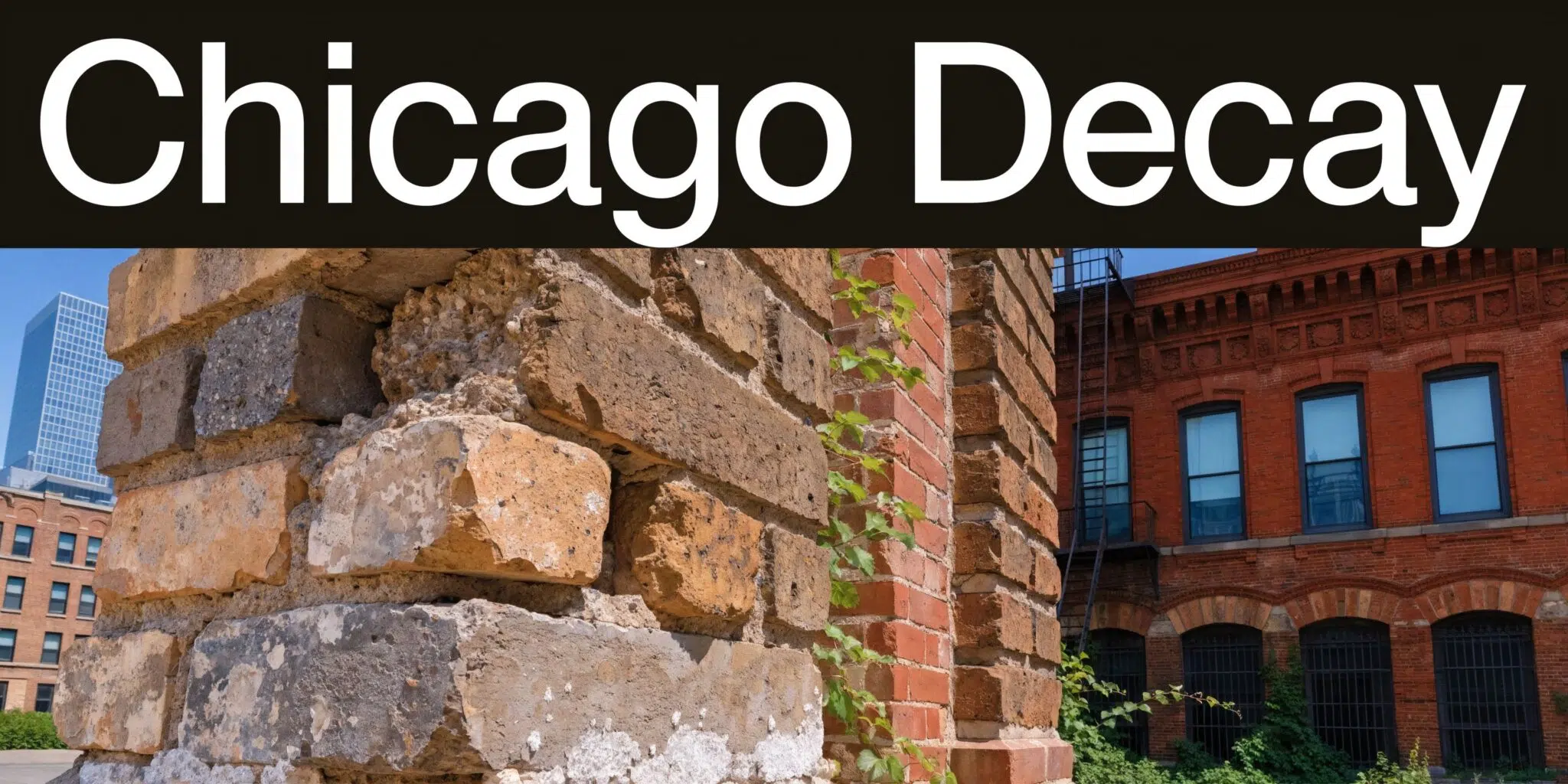
Water is a primary destructive factor
Think of a brick wall like a sponge with structure. It does not need a visible hole to take on water. Moisture enters through worn mortar joints, failed sealant lines, open coping seams, hairline cracks, and porous brick faces.
When temperatures drop, that moisture freezes and expands inside the wall. Then it thaws, moves deeper, and repeats the cycle. Over time, the face of the brick breaks away, mortar loosens, and the bond between units weakens.
That is why a wall can look mostly intact one season and start shedding material the next.
The damage pattern tells you where the wall is failing
Different symptoms usually point to different moisture paths.
Mortar loss and open joints
This is one of the first things owners notice. Mortar begins to recess, crack, or powder out. Once joints open up, the wall takes on water faster and damage spreads beyond the original area.
Poor repointing can make this worse. Mortar that is too hard, too dense, or poorly matched to the existing wall can force stress into the surrounding brick.
Spalling brick
Spalling is what owners call flaking, popping, or face loss. It often shows up near parapets, chimneys, sills, and lower wall sections where water collects or exits slowly.
Once the face is gone, the brick is no longer protecting itself well. Leaving spalled units in place usually leads to faster breakdown.
Rusting steel at lintels and shelf angles
Chicago buildings depend on embedded steel in many openings and facade sections. When water reaches that steel, rust develops and expands. The expansion pushes surrounding masonry apart.
That is when you see stair-step cracking over windows, displaced soldier courses, or horizontal movement in the facade. Owners often think the brick failed first. In many cases, hidden steel started the sequence.
Parapet distress
Parapets take weather from every direction. They are exposed, poorly protected on many older buildings, and often connected to roofing details that have aged out. Once coping joints fail or water enters from the top, parapets begin bowing, cracking, or dropping brick.
A lot of emergency masonry calls in Chicago start at the roofline.
Trade reality: If a contractor talks only about replacing visible brick without tracing how water entered the wall, you are not getting a full diagnosis.
Chicago buildings need system thinking
Good masonry restoration chicago work is never just about one material. Brick, mortar, steel, flashing, coping, sealants, drainage, and roof edges all interact. If one part fails, the others rarely stay healthy for long.
That is why owners benefit from understanding the building as an assembly, not a collection of isolated symptoms. This related overview on the benefits of professional roofing and tuckpointing in Chicago is useful because most wall failures are tied to edge conditions above them.
The Professional Masonry Restoration Process Explained
A proper masonry restoration job follows a sequence. Skipping steps creates callbacks. Doing steps out of order traps defects inside the wall.
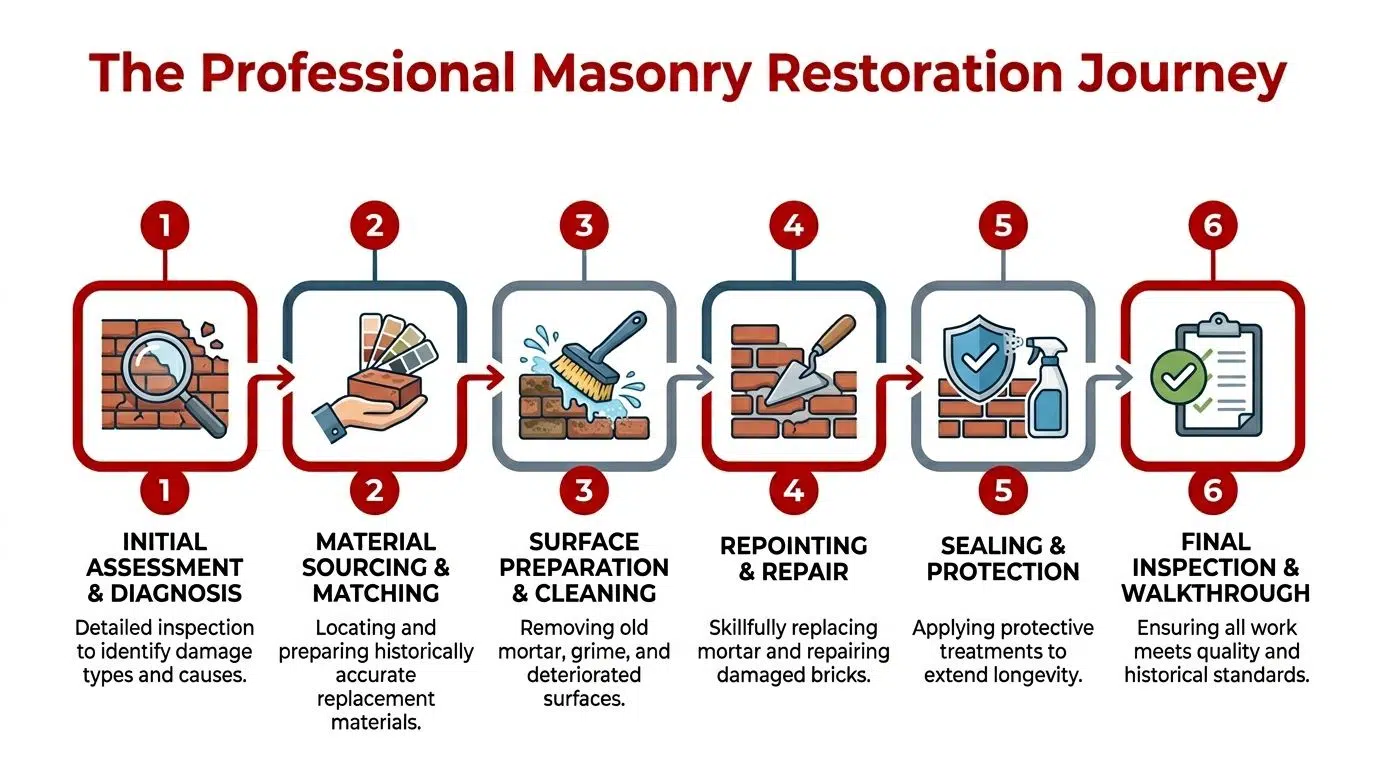
Assessment comes before pricing
The first serious task is diagnosis, not bidding.
A contractor should inspect wall elevations, corners, openings, parapets, and transitions where masonry meets roofing or metal. The point is to separate symptom from cause. A crack near a window might be failed mortar, corroded lintel steel, movement at the shelf angle, or a combination of those conditions.
For distressed facades, mapping matters. The crew needs to know which units are salvageable, which joints need repointing, where steel is bearing on masonry, and whether movement appears stable or active.
Cleaning and preparation decide repair quality
A lot of poor-looking projects fail before new mortar ever goes in.
Surfaces must be cleaned gently enough to preserve the masonry and thoroughly enough to expose unsound areas. On older brick, aggressive methods can scar the face, open pores, and shorten the life of the wall. Joint preparation also matters. Crews need to remove failed mortar to the proper depth and avoid breaking adjacent brick arrises.
Preparation usually includes:
- Selective removal of damaged material: Loose mortar, failed sealants, unstable brick, and debris have to come out cleanly.
- Joint raking with control: The crew should remove unsound mortar without widening joints unnecessarily.
- Masonry cleaning matched to the wall: Historic and softer units require more restraint than dense contemporary brick.
- Protection of adjacent elements: Windows, landscaping, roof membranes, and pedestrian areas all need planning before work starts.
Repointing is not just filling joints
Owners hear “tuckpointing” and often assume it is a cosmetic mortar refresh. In practice, it is structural maintenance when done correctly.
New mortar has to be compatible with the existing wall. Color matters, but hardness, vapor permeability, and bond matter more. If the new mix is too strong for an older wall, the brick can take the stress and fail first. That mistake shows up years later as spalling around otherwise intact joints.
A sound repointing scope also includes replacing brick that has already lost its face or structural integrity. Good crews blend these repairs into surrounding work rather than peppering the wall with mismatched units.
Structural repairs go beyond the surface
Some walls need reinforcement, not just replacement mortar.
One of the clearest examples is crack stitching. For distressed Chicago facades, this method uses helical stainless steel rods installed across cracks to counter shear forces. According to the Chicago workshop recap from RestoreWorks, crack stitching can restore 70-80% of tensile capacity and extend wall life by 30-50 years when done correctly (RestoreWorks masonry anchoring and stabilization recap).
That is why crack stitching outperforms a surface patch. A patch hides the line. A stitched repair helps the wall work again.
Common structural repair items include:
- Brick replacement for failed units that no longer shed water.
- Lintel repair or replacement where corroded steel is expanding into surrounding masonry.
- Shelf angle repair when steel support has deteriorated and movement is spreading.
- Crack stabilization for stable fractures that need internal reinforcement.
- Parapet rebuilding or resetting when roofline masonry has lost integrity.
What does not work: Smearing mortar over a crack, coating over active movement, or replacing a few loose bricks without addressing rusting steel behind them.
Waterproofing finishes the job
The final phase is protection.
Once the wall is repaired, crews may install or restore sealant joints, improve flashing transitions, and apply an appropriate water-repellent treatment where the wall calls for it. Waterproofing should never be used to disguise unresolved damage. It belongs at the end, after joints are sound and drainage paths are functioning.
This is also where a full-envelope contractor can be useful. One local option, Expert Super Seal Roofing & Tuckpointing, handles both roof-edge and masonry work, which can help when parapets, flashing, and brick deterioration overlap.
The closeout should be deliberate
The last step is not packing up scaffolding. It is confirming the repair.
A professional closeout includes a final inspection, punch-list corrections, and maintenance guidance. Owners should leave the project understanding what was repaired, which areas need monitoring, and where future water entry is most likely if routine upkeep is ignored.
Navigating Chicago Permits and Building Codes
Plenty of masonry jobs fail before the first brick comes out. The repair may be technically sound, but the permit path is incomplete, the inspection requirement was missed, or the scope did not account for the code triggers tied to the building type.
High-rise owners need to pay attention to shelf angles
Chicago code is especially important for condos, associations, and multi-story properties with aging facade support steel. The city requires shelf angle inspections every 10 years for buildings over 6 stories, and replacement is required if corrosion exceeds 25%. The same source notes that the 2025 IL Energy Efficiency Act offers 20-30% rebates for restorations using green sealants (Chicago shelf angle replacement and code overview).
Those are not minor details. They affect reserve planning, inspection schedules, and the order in which boards should tackle facade work.
The permit process affects schedule and scope
Owners often focus on repair cost and forget the administrative side until the project stalls. In practice, permit timing can influence mobilization, staging, occupant notices, and contractor availability.
A code-aware contractor helps with:
- Scope definition: The permit set has to reflect what is being repaired.
- Work classification: Cosmetic repointing, structural stabilization, and steel replacement do not get treated the same way.
- Access planning: Scaffolding, sidewalk protection, and site logistics can trigger added requirements.
- Inspection readiness: If the city or a consultant needs to review work in progress, the contractor has to sequence around that.
Compliance is also a risk-management decision
When facade components are failing, noncompliance is not just a paperwork issue. It raises the exposure for owners, managers, and boards if falling material injures someone or damages adjacent property.
That is one reason low bids are risky on code-sensitive work. A contractor who prices only visible repairs may leave the owner responsible for permit revisions, consultant coordination, or follow-up correction work after the wall is already open.
Owner rule: Ask every bidder who is pulling the permit, what inspections they expect, and whether the quoted scope includes code-triggered repairs if hidden conditions are found.
Incentives are worth reviewing before materials are locked in
Too many projects choose sealants and waterproofing products without checking whether they affect available rebates. If the building qualifies for a program tied to green materials, product selection should be part of the planning conversation early.
For property managers, that is where a well-run restoration project separates itself from a simple repair crew. Good execution means the wall is safe, the paperwork is in order, and the owner has not left money on the table.
Estimating Costs and Timelines for Your Project
A Chicago owner often starts with one question: what is the price per square foot? That number helps with early budgeting, but it does not tell you what the wall needs.
In masonry restoration chicago work, cost is driven by failure type, access, repair depth, and how much hidden damage shows up after the wall is opened. A small repointing area at grade is a very different job from a parapet repair on a six-story building with loose brick, rusting steel, and sidewalk protection below. Chicago’s freeze-thaw cycle is part of that equation. Water gets into failed joints, expands in winter, and turns a localized repair into broader replacement if the problem sits too long.
What pushes pricing up or down
The biggest cost shifts usually come from field conditions, not from the brick itself.
- Access and staging: Height, alley access, scaffold layout, swing stages, and pedestrian protection all affect labor hours and equipment cost.
- Repair depth: Surface tuckpointing costs less than brick replacement, lintel work, parapet rebuilding, or shelf-angle repairs.
- Material matching: Older Chicago buildings often need careful mortar selection and brick matching so the repair performs properly and does not stand out visually.
- Hidden conditions: Once crews remove loose units or open failed joints, they may find deteriorated backup masonry, cracked cotta, or steel expansion.
- Season and weather protection: Cold-weather work can require heat, enclosures, and more careful scheduling to protect mortar cure and sealant performance.
- Occupied-building coordination: Condos, apartments, schools, and commercial properties move slower because crews have to control dust, noise, entry access, and public safety.
If you are comparing proposals, this guide to exterior brick repair cost in Chicago helps you read the scope behind the price, which is usually where significant differences are.
Allowances matter more than owners expect
Two bids can look similar on the front page and be miles apart once work begins.
One contractor may carry a realistic allowance for brick replacement, steel repair, and access changes. Another may price only the visible mortar work and leave major variables for change orders. That is how a cheap number turns into an expensive project halfway through the job.
Ask what is included for exploratory opening, unit replacement, flashing repair, sealant joints, and cleanup. If the answer stays vague, the budget probably will not hold.
Timelines depend on sequencing, not just crew size
Owners often hear optimistic schedules. Chicago masonry does not reward optimism.
A small repair can move fast if access is simple and the failure is isolated. Larger facade work takes longer because the sequence is fixed. Investigation comes first. Materials have to be matched and ordered. Access equipment must be installed. Then the wall can be opened, repaired, pointed, cleaned, and reviewed in the right order. If hidden deterioration shows up, the schedule adjusts.
A practical timeline usually follows these phases:
- Site review and scope development
- Preconstruction planning and material selection
- Mobilization and access setup
- Repair and restoration work
- Punch list, final review, and demobilization
Weather can stall any one of those phases. Freeze-thaw conditions, wind off the lake, and rain delays are normal parts of Chicago masonry planning, not exceptions.
The best estimate is specific
A reliable budget ties cost to actual conditions on your building. It separates base scope from allowances, identifies likely hidden conditions, and gives a schedule with room for weather and access changes.
That level of detail protects owners. It also makes it easier to compare contractors on judgment, not just on price.
How to Select the Right Chicago Masonry Contractor
The cheapest masonry proposal is often the most expensive one after the wall opens up.
Chicago owners should hire for diagnosis, material judgment, code awareness, and execution discipline. If a contractor cannot explain why the wall failed, there is a good chance the repair will be shallow, mismatched, or incomplete.
What to verify before you sign
Start with the items that protect you legally and financially.
- Licensing: Confirm the company is properly licensed for the work it performs in Chicago.
- Insurance: Ask for proof of liability and workers’ compensation coverage.
- Bonding: On larger or more sensitive jobs, bonding adds another layer of owner protection.
- Local track record: Chicago masonry has its own weather, building stock, and code realities. Local experience matters.
A contractor should also be comfortable discussing chimney work, parapets, lintels, shelf angles, brick replacement, and waterproofing as connected systems when the building calls for it.
Questions that separate real masons from patch crews
Ask direct questions and listen for direct answers.
How will you match the mortar and brick
A serious contractor will talk about compatibility, not just color. If the answer is only aesthetic, keep asking.
What is causing the failure
“Loose mortar” is not a root cause. Water entry, steel expansion, failed coping, and trapped moisture are root causes.
Who handles permits and site protection
You want this settled before mobilization, not after debris netting is already up.
What happens if hidden damage shows up
Good contractors have a process for documenting concealed conditions and pricing additional work clearly.
Red flag: If a bidder promises a quick patch without discussing water entry, steel conditions, or material compatibility, the proposal is probably built to win the job, not solve the problem.
Bids should be comparable in scope, not just total
Owners get into trouble when they compare a thorough restoration proposal against a cosmetic repair quote as if they are the same service. They are not.
A useful review checklist:
- Detailed scope of removal and replacement
- Statement of material type or matching approach
- Access method and protection plan
- Permit responsibility
- Cleanup and final review
- Warranty terms in writing
The right contractor is not the one who talks the fastest. It is the one who leaves you with fewer unknowns.
Local Success Stories and What You Can Learn
A common Chicago scenario starts at the parapet. Winter opens the joints, spring drives water in, and by the time brick shows movement at the street, the wall has been failing for a while. Good restoration work fixes that chain of failure at the source instead of dressing up the surface.
One useful example is the 1892 Morrison Building. It shows what happens when a team treats an older Chicago facade as a water-management system, not just a historic exterior that needs better curb appeal.
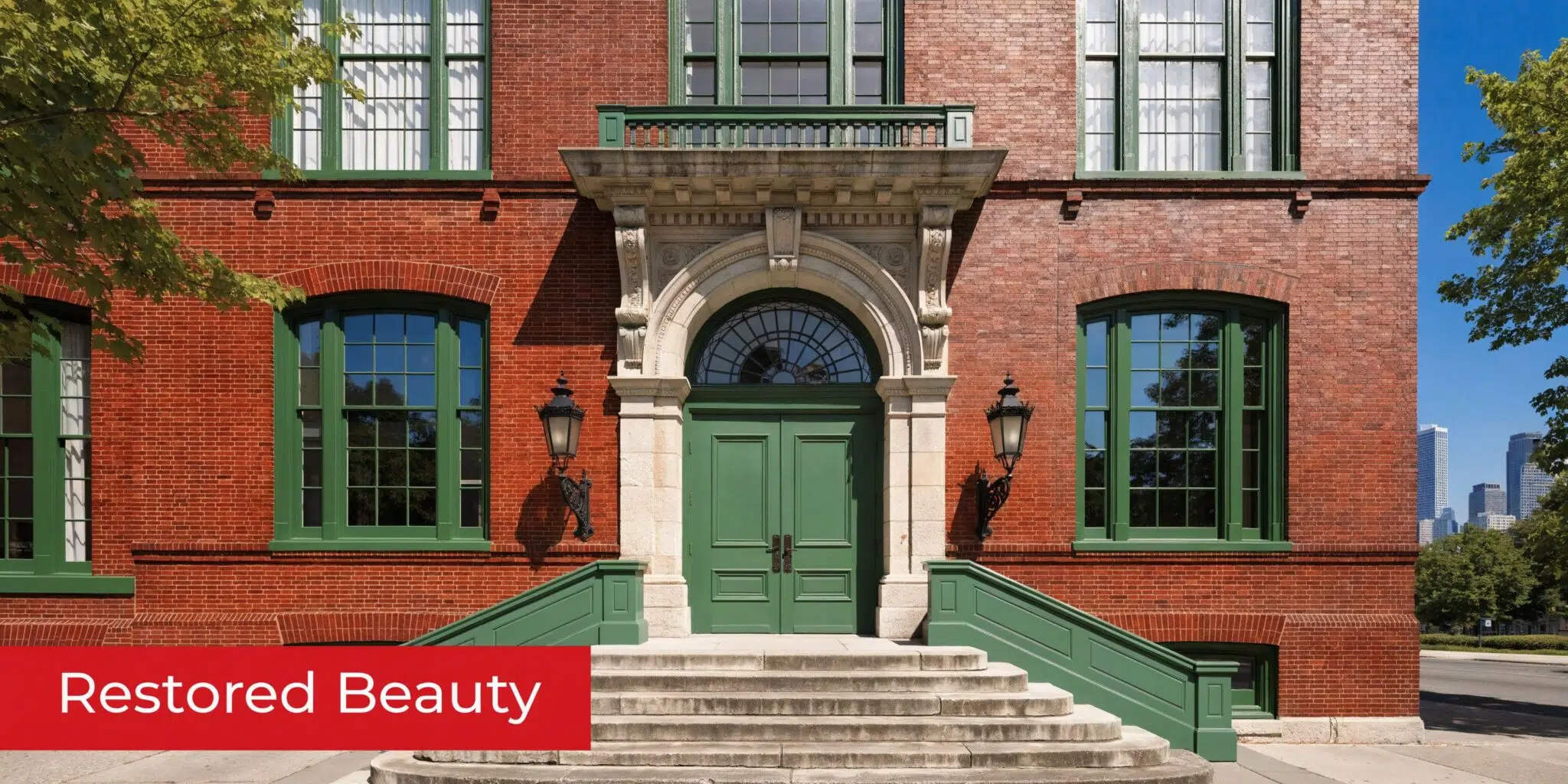
What the project was up against
The building had widespread facade deterioration and the kind of scope that forces hard decisions about sequencing, access, and material selection. On a historic Chicago property, those choices matter because one wrong repair can lock moisture into the wall and create a second round of failures a few winters later.
That is the part owners often miss. Chicago puts masonry through repeated freeze-thaw stress every year, so repair work has to do more than look clean at closeout. It has to release moisture properly, handle seasonal movement, and satisfy local code requirements at the same time.
Why the project stands out
The repair approach focused on preservation methods that fit the building. Low-pressure cleaning reduced the risk of damaging aged brick faces. Lime-based mortar was matched to the original work through testing, which is the right move when the existing masonry is softer than modern replacement materials.
The phased sequencing also deserves attention. On a dense Chicago site, crews often need to stabilize unsafe areas first, then work through facade repairs in an order that protects pedestrians, controls water entry, and keeps the permit process on track. That is not paperwork for its own sake. It affects safety, inspection approvals, and the long-term performance of the wall.
Lessons owners can take from it
A project like this usually confirms four things.
- Material compatibility decides how long the repair lasts. Mortar that is too hard can push stress into older brick and cause face spalling.
- Testing saves money later. It helps avoid mismatched mortar, improper cleaning methods, and repair specifications that fail in Chicago weather.
- Sequence affects results. Parapets, coping, flashing transitions, and steel-related repairs need to be handled in the right order or water finds its way back in.
- Historic work has code implications. Older buildings still need current safety and permit compliance, even when the goal is to preserve original character.
The practical lesson is straightforward. The best Chicago restoration jobs solve water entry, movement, and material compatibility together. That protects the building, keeps the repair compliant, and gives the owner a much better chance of avoiding another major masonry project before it should be necessary.
Frequently Asked Questions About Masonry Care
How often should masonry be inspected
Buildings should be looked at routinely, especially after winter and after major storms. Owners of older properties, parapet-heavy buildings, and multi-unit structures benefit from more disciplined inspection habits because small failures at the roofline or openings can grow quickly.
Is DIY tuckpointing a good idea
Usually, no.
The problem is not effort. It is compatibility and diagnosis. Many DIY repairs use mortar that is too hard, too dense, or poorly bonded to the existing wall. Owners also tend to repair the visible symptom and miss the moisture source behind it.
What is the difference between tuckpointing and masonry restoration
Tuckpointing is one repair method within a broader restoration scope. Masonry restoration can include mortar replacement, brick replacement, parapet rebuilding, crack stabilization, steel repair, cleaning, sealants, and waterproofing.
Can sealing fix a leaking wall by itself
Not if the wall already has open joints, failed flashing, cracked coping, displaced units, or rusting steel. Sealing works best after the wall has been repaired properly. It is protection, not a substitute for corrective work.
When should a crack be treated as urgent
A crack deserves prompt review when it keeps reopening, runs through multiple units, appears near a window or parapet, or comes with displacement, leakage, or loose material. Cracks tied to movement or steel expansion should not sit through another Chicago winter.
What should be in a masonry proposal
Look for a written scope, identified repair areas, material notes, access plan, permit responsibility, cleanup terms, and a process for handling concealed damage. A vague one-page estimate usually leaves too much unresolved.
If your building is showing open joints, spalling brick, parapet movement, or signs of water intrusion, Expert Super Seal Roofing & Tuckpointing can evaluate the masonry and related roof-edge conditions and provide a clear repair scope for residential, commercial, or multi-unit properties across Chicagoland.