You’re probably looking at two or three roofing proposals right now, and each one lists a different TPO option. One says 45 mil, another says 60 mil, and the more expensive bid pushes 80 mil. The problem is that all three can sound reasonable on paper, especially when every contractor says their recommendation is the right one.
That’s where a lot of Chicago building owners get stuck. They know TPO is a common flat-roof system, but they don’t know what they’re buying when the thickness changes, or whether the upgrade pays off on a building that has to deal with snow, rooftop service traffic, and big temperature swings.
TPO is not a fringe product. It holds nearly 50 percent of installed low-slope roofing in the United States, and a well-maintained TPO roof can last 15 to 30 years, with manufacturer warranties that range from 10 to 30 years according to GAF’s overview of TPO market position and longevity. So the material itself is proven. The question is which thickness makes sense for your building.
Choosing Your New TPO Roof
A property manager in Chicago usually doesn’t start this process thinking about membrane gauges or scrim. They start with a leak history, a capital budget, and a proposal sheet full of line items that don’t mean much unless someone translates them into real-world consequences.
That’s why tpo roofing thickness matters more than most owners expect. It isn’t just a spec-sheet detail. It affects how the roof handles service traffic, punctures, weathering, and how soon you’ll be dealing with repairs or replacement again.
If you’re still sorting out whether TPO is the right system in the first place, this overview of TPO benefits for Chicago flat roofs gives useful background. But once TPO is on the table, the thickness decision is where the investment gets real.
Why thickness decisions get confusing
Roofing proposals often reduce the choice to a simple message. Cheaper is thinner. Better is thicker. That’s not wrong, but it’s incomplete.
A low-traffic rear commercial roof over a small retail space doesn’t need the same membrane strategy as a condo building with regular HVAC access. A warehouse with a straightforward layout doesn’t face the same wear pattern as a multi-unit property where maintenance crews are constantly walking paths to equipment.
Practical rule: The right membrane thickness depends on how the roof will be used, how it will be attached, and how much punishment it will take in Chicago weather.
What owners usually want to know
Most building owners ask some version of the same three questions:
- What’s the price jump? They want to know what extra cost comes with moving from 45 to 60, or from 60 to 80.
- What does that extra money buy? Better puncture resistance, longer weathering life, and more margin for error are the practical answers.
- Where does overspending start? That depends on the building. Paying for 80 mil on a lightly used roof may be smart, or it may be unnecessary if the system design and usage don’t support it.
The mistake is treating every flat roof like the same roof. In Chicago, they aren’t.
What TPO Thickness Actually Measures
TPO thickness is a physical measurement, not a marketing label. One mil equals one-thousandth of an inch, so 45 mil means 0.045 inch, 60 mil means 0.060 inch, and 80 mil means 0.080 inch. That sounds simple, but on a Chicago roof, those small differences affect how much abuse the membrane can take before you start paying for repairs.
A good comparison is paper stock. Regular printer paper and heavy cardstock can both cover the same area, but they do not handle scuffing, bending, or repeated handling the same way. TPO works the same way on a roof. More thickness gives the membrane more material to wear through before the system is exposed.

The number many proposals gloss over
Nominal thickness matters, but it is not the whole story. The more useful durability detail is the thickness over scrim.
The scrim is the reinforcing fabric inside the membrane. The material above that fabric is the top wear surface taking UV exposure, foot traffic, wind-driven grit, and seasonal movement. Duro-Last’s TPO membrane product data sheet lists top ply over scrim as a key performance detail, and it shows how a 60 mil membrane can include a substantial wear layer above the reinforcement.
That matters in the field. Two membranes can carry the same headline thickness and still give you different long-term performance if the wear layer is built differently.
Why this matters more in Chicago
Chicago roofs do not fail on paper. They fail under service traffic, ponding stress, flashing movement, and winter expansion and contraction. A membrane with more usable wear surface gives the roof more margin before surface wear turns into a leak call.
That is one reason roof life is not just about the mil number on the proposal. It is also about how the membrane is built, how it is attached, and how the roof is used over time. Building owners comparing options should also review how long a TPO roof lasts under real service conditions, because the wear layer and the installation quality both affect that outcome.
The top layer is the part that gets sacrificed first. Once it wears down, the roof has less room for foot traffic, dropped tools, and Chicago weather.
What to ask before you approve a bid
A proposal should answer more than one question. Start with these:
- What is the thickness over scrim? This gets closer to the membrane’s real wear surface.
- Which manufacturer and product line are being quoted? Not every 60 mil sheet is built the same way.
- How will the membrane be attached? Fully adhered, mechanically attached, and induction-welded systems put different stresses on the sheet.
- How much roof traffic should this building expect? A quiet storage building and a busy commercial roof with regular HVAC service do not need the same margin.
Those questions help separate a low number from a smart specification.
Comparing TPO Thickness 45 vs 60 vs 80 Mil
A Chicago owner usually asks this question after seeing a proposal jump by a few thousand dollars just from changing the membrane thickness. That price jump matters. So does what the roof has to put up with after the first winter.
The right answer depends on how the building is used, how much traffic the roof sees, and how much risk you want to carry later. In this market, the decision is rarely just "thicker is better." Chicago freeze-thaw cycles, service traffic, and repair costs change the return you get from 45, 60, or 80 mil.
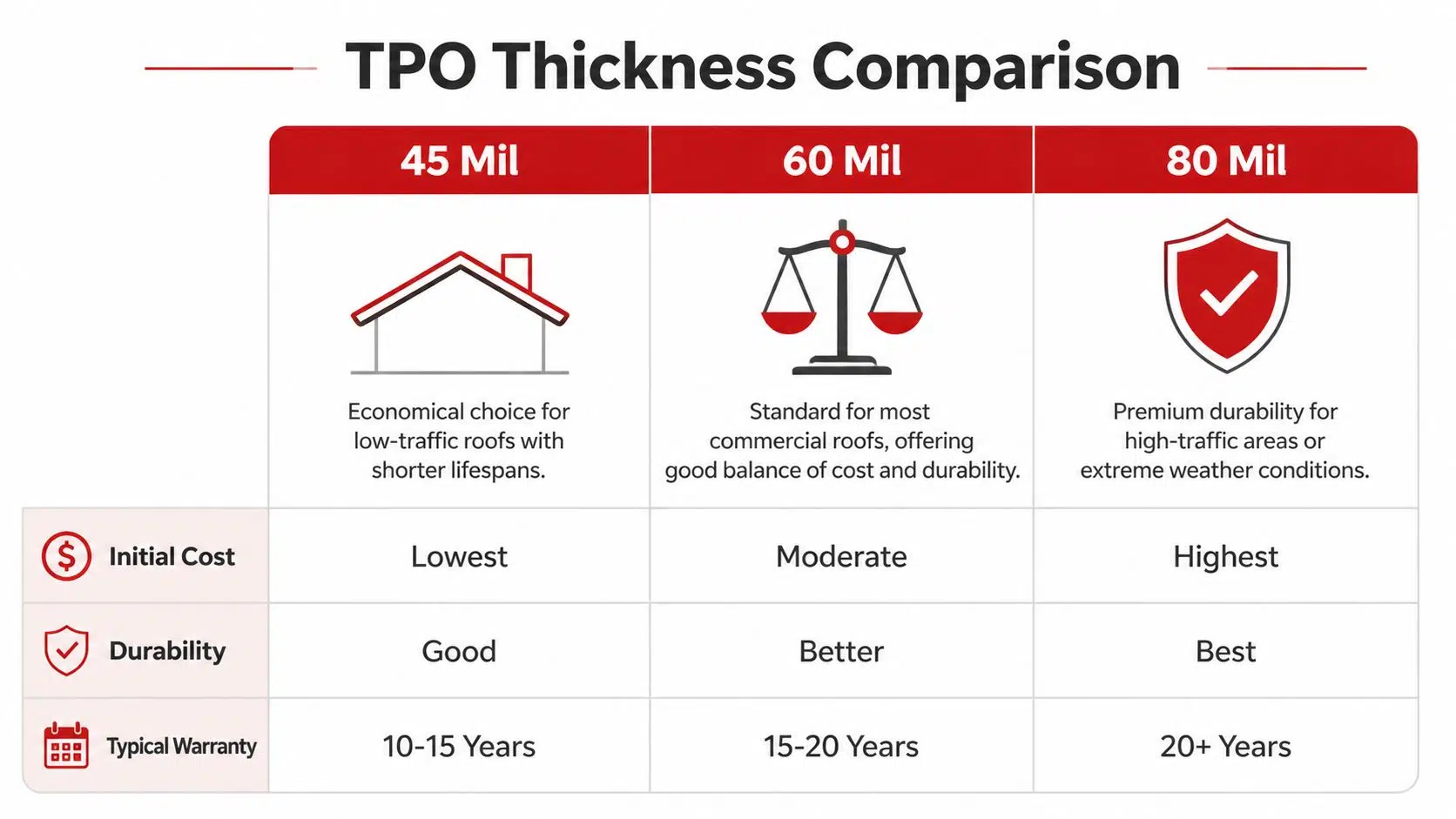
TPO Thickness Comparison 45 vs 60 vs 80 Mil
| Attribute | 45 Mil TPO | 60 Mil TPO (Industry Standard) | 80 Mil TPO |
|---|---|---|---|
| Typical installed cost | Lower initial cost | Mid-range cost | Highest initial cost |
| Best fit | Budget-sensitive, light-use roofs | Most commercial buildings | High-traffic or abuse-prone roofs |
| Durability profile | Least margin for wear and punctures | Balanced cost and protection | Highest puncture and wear resistance |
| Service life outlook | Shorter under demanding conditions | Strong middle-ground choice | Longer runway on hard-use roofs |
| Traffic tolerance | Lower | Better | Best |
| Chicago use case | Selective use only | Common default | Often justified on demanding buildings |
45 mil TPO
Forty-five mil is a budget membrane. It has a place, but that place is narrower in Chicago than owners want to hear.
It can work on smaller buildings with limited roof traffic, fewer penetrations, and a clear plan to keep people off the roof unless service is necessary. If the budget is tight and the exposure is modest, 45 mil can be a reasonable specification.
The trade-off is simple. You have less material to absorb wear, less forgiveness when a tech drops a tool, and less reserve when winter movement and rooftop activity start adding up year after year. On a quiet roof, that may be acceptable. On an active commercial roof, it often turns into repair calls sooner than expected.
60 mil TPO
Sixty mil is the common choice for a reason. It usually gives owners the best balance between installed cost and long-term durability.
For many Chicago commercial properties, this is the point where the roof stops feeling stripped down and starts feeling properly specified. Office buildings, condo associations, retail centers, and many warehouses do well with 60 mil if the rest of the assembly is designed and installed correctly.
Owners who want a better sense of long-term expectations should review how long a TPO roof lasts under real service conditions. In practice, 60 mil is often the thickness that avoids false savings without pushing the project into a premium spec the building may not need.
80 mil TPO
Eighty mil is the upgrade you buy because the roof has work to do.
It makes sense on buildings with frequent HVAC service, crowded rooftop equipment, regular maintenance traffic, or a history of punctures and abuse. Hospitals, large retail boxes, food facilities, and busy multifamily buildings often fit that description. On those roofs, the extra membrane thickness is not just a nicer number on paper. It gives the system more tolerance for traffic, weathering, and mistakes.
That matters in Chicago, where one small problem can turn into a bigger one after snow, ice, standing water, and repeated freeze-thaw movement work on the same weak spot.
If crews treat the roof like part of the mechanical room, 80 mil usually pays for itself more convincingly than 45 mil ever will.
Where owners usually see the return
The comparison goes beyond material price. It is what you spend over time to maintain the roof, protect the building, and delay replacement.
A lower-cost membrane can still be the right call on a low-demand building. But if the roof sees regular traffic or repeated weather stress, the cheaper option often carries more risk than savings. In Chicago, labor is not cheap, emergency leak response is not cheap, and interior damage from one failure can wipe out the savings from choosing the thinnest sheet.
Here is the practical read:
- Choose 45 mil for low-traffic roofs where budget control is the main driver and the building has a modest risk profile.
- Choose 60 mil for the broad middle of Chicago commercial roofing projects where cost and durability both matter.
- Choose 80 mil when the roof supports heavy service traffic, dense equipment, higher puncture exposure, or an owner who wants more service life and fewer compromises.
Matching Thickness to Your Roofs Installation and Use
The membrane doesn’t work alone. The way the roof is installed changes how the sheet handles stress, and that affects what thickness makes sense.
A lot of owners compare only the material line on a proposal. That misses a major part of the decision. A 60 mil membrane in one attachment method may be a solid fit, while the same thickness in another setup may be the minimum you’d want.
Fully adhered roofs
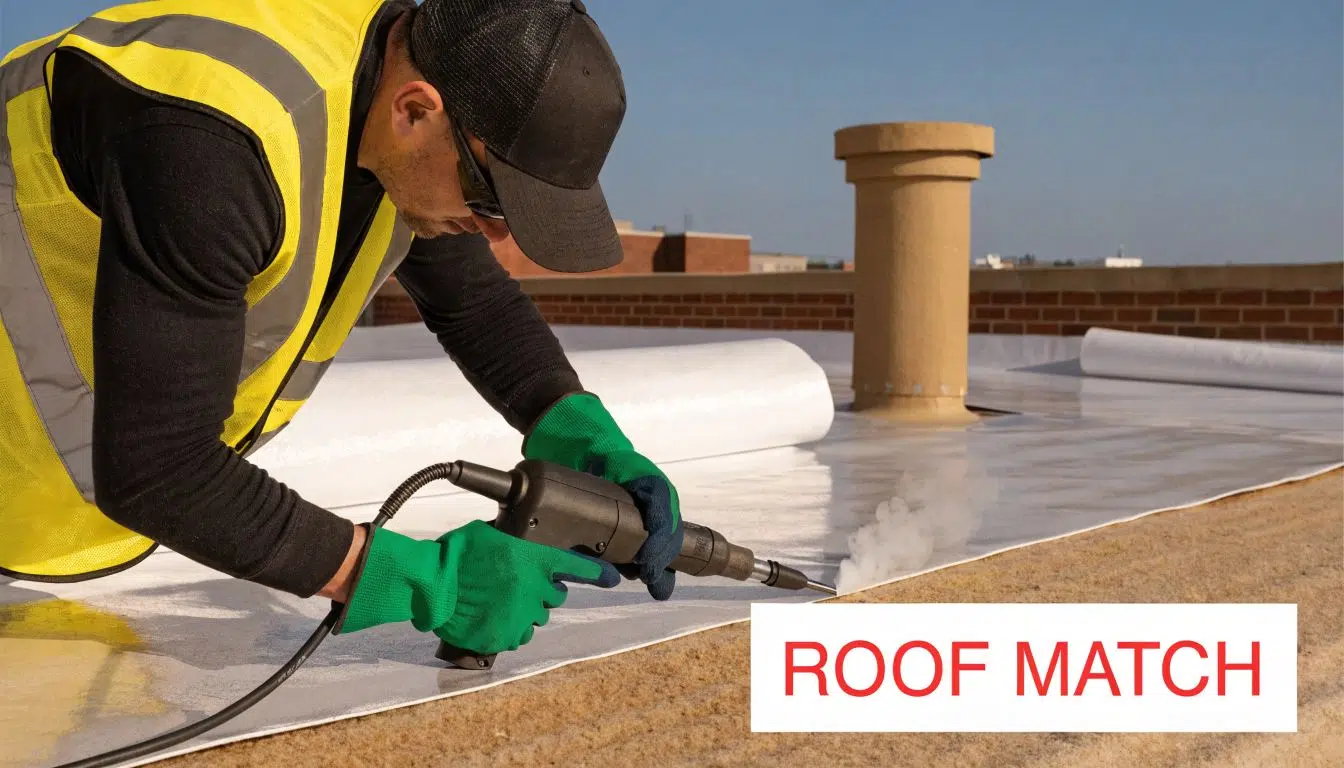
In a fully adhered system, adhesive secures the membrane across the substrate so the load is distributed more evenly. According to IKO’s explanation of TPO roofing systems, 60 mil products may suffice for fully adhered applications where load distribution is uniform.
That makes sense in practice. When the membrane is supported continuously, you don’t get the same concentration of stress at individual fastener points.
A fully adhered roof often pairs well with 60 mil when the roof isn’t unusually abusive. It gives a strong middle-ground setup for many commercial properties and multi-unit buildings.
Mechanically fastened roofs
Mechanically fastened systems create a different stress pattern. Fasteners and plates anchor the membrane, and those points become part of the roof’s stress map.
The same IKO guidance notes that mechanically fastened systems benefit from 60 to 80 mil thickness because the thicker membrane helps distribute localized stress from fasteners and reduces puncture vulnerability during installation and maintenance access.
That’s a critical point. On a mechanically attached roof, going too thin is like putting lighter fabric over hardware that pulls harder in service. The system can still work, but it leaves less room for movement, traffic, and wear.
How roof use changes the answer
Even with the same attachment method, usage can push the recommendation up or down. A roof over a simple storage space behaves differently than one loaded with service equipment.
Here’s how contractors usually sort the decision in the field:
Light-use roofs
Smaller buildings with minimal service traffic and limited rooftop equipment may be fine with a conservative system design centered around 60 mil, or 45 mil in select budget-driven situations.Service-heavy roofs
If technicians are up there regularly for HVAC, electrical, or telecom work, the membrane needs more toughness. That usually points toward 80 mil, especially if the roof has crowded equipment zones.Puncture-prone conditions
Roofs with frequent maintenance, sharp-edged components, staging activity, or debris risk benefit from added membrane thickness because accidental damage happens faster than most owners think.
A roof doesn’t fail on paper. It fails where people walk, where equipment sits, and where installation details carry stress every day.
Maintenance should influence the original thickness choice
Owners often separate replacement from maintenance, but they’re connected. If you already know the building will have regular rooftop traffic, you should build for that from the start instead of relying on careful behavior that never lasts.
A realistic maintenance plan includes inspections, drain clearing, and attention after storms. If your building will follow that kind of program, this TPO roof maintenance guide helps frame what ongoing care looks like. But the best maintenance plan in the world won’t turn an underbuilt membrane into a heavy-duty one.
Why Chicago Weather Demands a Tougher Roof
National roofing advice tends to flatten the map. It talks about “harsh climates” as if they’re all the same. They aren’t, and Chicago proves it every year.
This market puts flat roofs through repeated expansion and contraction. A membrane can be dealing with deep winter cold, then summer heat, then shoulder-season swings that keep the roof moving back and forth. Seams, penetrations, and high-stress areas feel that movement long before an owner sees interior damage.

Freeze-thaw is the local issue owners underestimate
According to this discussion of the gap in TPO thickness guidance for freeze-thaw climates, Chicago experiences temperature swings from -20°F winters to 95°F summers, and those swings create repeated expansion-contraction stress. That same source points out an important blind spot. Generic guidance says thicker membranes handle harsh weather better, but it often doesn’t quantify how different thicknesses endure Midwest freeze-thaw cycles over time.
That gap matters. Building owners in Chicago still have to make the decision even when national content doesn’t fully answer the local question.
Why a thicker membrane often makes more sense here
In practice, Chicago pushes owners toward a more defensive mindset. If a roof is going on a building that will see regular traffic, winter conditions, and years of thermal movement, stepping up from the thinnest option is often a smarter long-term call.
A good 60 mil system can absolutely be the right roof here. But there are many Chicago buildings where 80 mil is easier to justify than it would be in a milder market because the roof has to handle both use and climate stress.
That doesn’t mean “always buy the thickest membrane available.” It means don’t apply a warm-climate or generic national recommendation to a Midwest flat roof without thinking through what the building will face.
What works and what usually doesn’t
The roofs that tend to hold up best in this region are the ones built with realistic expectations. Owners choose a membrane thickness that matches service traffic, stress points, and local weather, then pair it with quality installation and regular upkeep.
What usually doesn’t work is chasing the lowest bid on a building that already has rooftop activity and exposure. That decision can look smart on contract day and look shortsighted after a few winters of movement, service calls, and surface wear.
Chicago doesn’t give flat roofs an easy life. Thickness is part of how you buy durability before you need repairs.
Get the Right TPO Roof with Expert Super Seal
Choosing the right tpo roofing thickness isn’t about buying the thickest sheet and calling it a day. It comes down to four practical factors. The membrane itself, the thickness over scrim, the way the system is attached, and how the roof will be used on a Chicago building.
For some properties, 45 mil can still be a budget-conscious fit. For many commercial roofs, 60 mil is the balanced choice that makes the most sense. For roofs with heavier traffic, higher puncture risk, or tougher exposure, 80 mil often earns its higher price by giving the owner more protection and more service life.
The local climate makes that decision more important. Chicago roofs don’t just sit there. They move, freeze, bake, and get walked on. That’s why the right recommendation should never come from a generic chart alone.
A solid contractor should look at the building, the traffic pattern, the attachment method, and the risk areas before recommending a thickness. That’s how you end up with a roof that fits the property instead of a roof that fit the bid form alone.
If you want a recommendation based on your actual building, Expert Super Seal Roofing & Tuckpointing can help. Their Chicago-area team has been serving local properties since 1972, and they understand how flat roofs perform in this climate. Schedule a free, no-obligation estimate to review your roof’s layout, traffic, installation options, and budget, then get a clear recommendation on the most cost-effective TPO system for your property.