When you see a water stain spreading on a ceiling tile or find a puddle forming in the middle of your warehouse floor, that sinking feeling is quickly followed by one big question: "How much is this going to cost?"
It's the first thing every facility manager needs to know. Budgeting for a warehouse roof repair isn't just about plugging a leak; it's about protecting your inventory, keeping your operations running, and making a smart financial decision.
Your Quick Guide to Warehouse Roof Repair Costs
The honest answer is that warehouse roof repair costs can land anywhere from $7 to $25 per square foot. The reason for that huge range comes down to the roofing system you have and just how bad the problem is. A simple patch on a TPO roof is one thing; extensive repairs on a complex, older metal roof are a completely different ballgame.
Think of it like this: a small, isolated leak is like patching a tire. It's targeted, relatively quick, and won't break the bank. But when you have widespread issues—maybe after a major hailstorm or years of neglect—you’re looking at something more like an engine overhaul. It’s a bigger investment of time, skill, and money to fix the underlying problems and get things running smoothly again.
Gauging Your Initial Budget
So, how do you get a rough idea of what you’re in for? The single biggest factor is the scale of the damage. A few popped seams are a world away from a membrane that's been torn up across hundreds of square feet.
While the global roofing market is a massive $316.27 billion industry, what really matters to you are the local numbers. For the 42.56% of commercial buildings with flat roofs, we've seen average repair costs settle between $15 and $25 per square foot for more significant jobs. On a 20,000 sq ft roof, a major restoration project to fix widespread leaks—not a full replacement—could run anywhere from $300,000 to $500,000. A huge chunk of that, often 40-60%, is for the specialized labor. You can explore more data on these market trends to see the bigger picture.
Key Insight: Never underestimate the cost of labor—or its value. Anyone can smear tar on a leak. It takes a true professional to properly weld a TPO seam or flash a pipe so it lasts for years. That expertise is what you’re really paying for.
To give you a better starting point for your budget, here are some typical repair scenarios we see all the time.
Quick Estimate Warehouse Roof Repair Costs 2026
This table breaks down some common repair jobs to help you get a ballpark idea of the potential costs.
| Repair Type | Typical Size | Estimated Cost Range |
|---|---|---|
| Minor Leak Patch (Single-Ply) | 100 sq. ft. | $700 – $1,800 |
| Seam & Flashing Repair | 250 linear feet | $2,500 – $6,000 |
| Moderate Membrane Damage | 1,000 sq. ft. | $9,000 – $16,000 |
| Major Restoration Section | 5,000 sq. ft. | $45,000 – $110,000+ |
Of course, these are just estimates. The real cost will depend on the specifics of your building, but this should help you frame the conversation. As we dig deeper, you’ll see how things like insulation, building height, and your specific roof material can shift these numbers.
How Your Roofing System Drives Repair Costs
When you get a quote for a warehouse roof repair, the biggest variable by far is the type of roof you have. Think of it like this: the cost to fix a dent in a steel-bodied truck is completely different from repairing the carbon fiber body of a race car. The materials and the skills needed are worlds apart. It's the exact same story with commercial roofs.
The material covering your facility—whether it's a single-ply membrane, a built-up asphalt system, or metal panels—dictates the entire repair process. It determines the materials we use, the techniques we apply, and the time it takes to do the job right. Let's break down the most common systems and what you can expect when it's time for a fix.
TPO (Thermoplastic Olefin) Roofing Repairs
TPO has become incredibly popular for a reason. It's an energy-efficient single-ply membrane, usually bright white to reflect the sun's heat. When we repair TPO, we're almost always dealing with punctures, storm damage, or failing seams. The fix involves heat-welding a new piece of TPO directly to the existing roof.
- Minor Repair Costs: For a simple puncture or a small seam issue, you’re typically looking at $7 to $12 per square foot.
- Major Repair Costs: If the damage covers a larger area and requires us to cut out and replace entire sections, the cost rises to $12 to $18 per square foot.
The success of a TPO repair lives and dies by the quality of the weld. A perfect, professional weld molecularly fuses the patch to the roof, making it one solid piece. A bad weld is just a temporary band-aid waiting to fail.
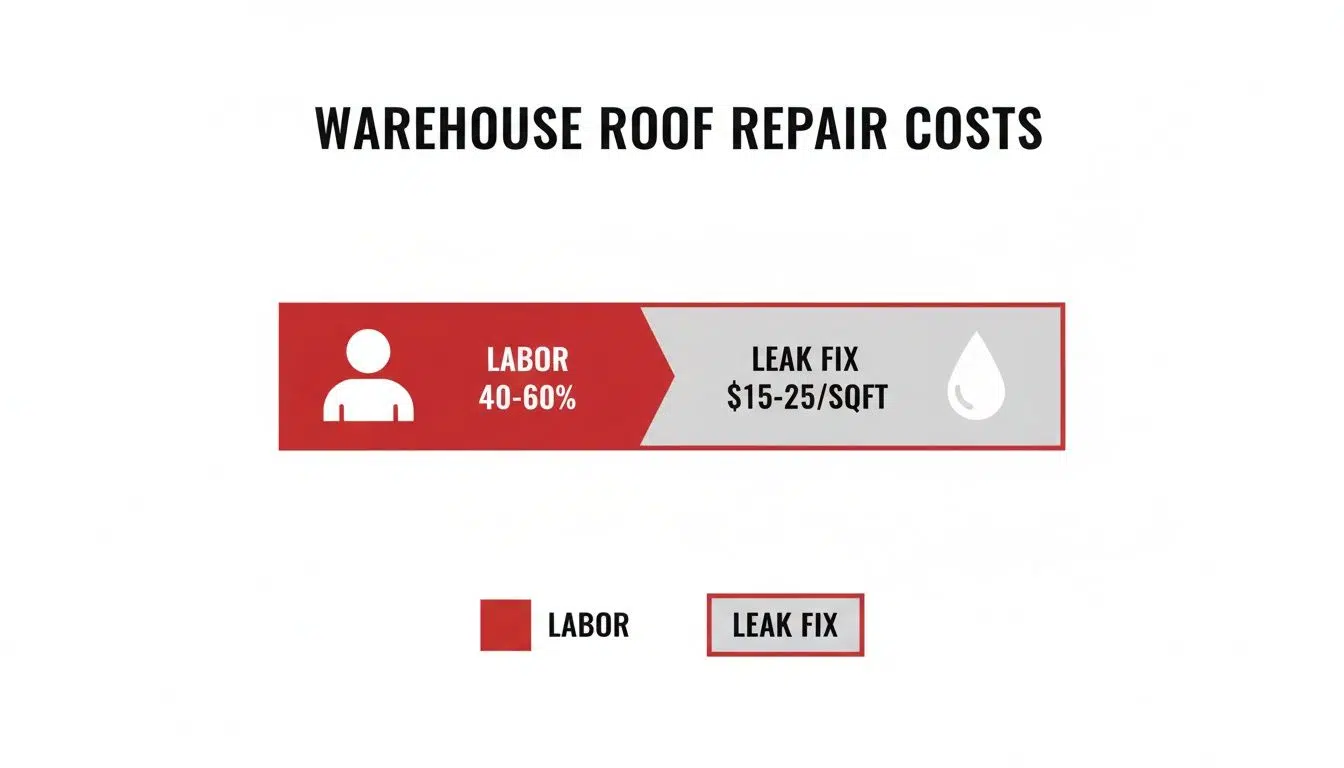
As you can see, labor is the dominant expense in any repair project, often making up 40-60% of the total bill. This underscores the importance of having an efficient, highly skilled crew on your roof to minimize time and maximize quality.
EPDM (Ethylene Propylene Diene Monomer) Roofing Repairs
EPDM is the classic "rubber roof." It's a dark, incredibly durable single-ply membrane known for its long-term resilience against weathering and temperature swings. Unlike TPO's welded seams, EPDM is joined together using specialized primers, adhesives, and seam tapes.
Repairing EPDM is a process that demands absolute precision. The surface has to be perfectly clean before a patch is applied, as any contamination will compromise the adhesive bond and lead to failure. You can dive deeper into this material's strengths in our guide on the resilience of EPDM roofs for Chicagoland buildings.
A Pro's Perspective: When we fix a puncture on an EPDM roof, it’s a multi-step chemical process. We cut a rounded patch (no sharp corners to peel up), apply a primer to both the patch and the roof, wait for it to "flash off," and then meticulously press the patch into place with a steel roller to guarantee a flawless, watertight bond.
Warehouse Roof Repair Cost Per Square Foot by System Type
To help you budget, we've put together a quick-reference table comparing repair costs for the most common commercial roofing systems. Keep in mind these are 2026 estimates, and factors like roof access and the extent of underlying damage can influence the final price.
| Roof System | Minor Repair Cost / Sq. Ft. | Major Repair / Restoration Cost / Sq. Ft. | Key Considerations |
|---|---|---|---|
| TPO | $7 – $12 | $12 – $18 | Requires specialized heat-welding equipment and technique. |
| EPDM | $8 – $14 | $13 – $20 | Demands meticulous surface prep; adhesive-based repairs are sensitive to contaminants. |
| Modified Bitumen | $10 – $17 | $15 – $22 | Labor-intensive and often requires torch application, which carries fire risk. |
| Metal | $9 – $16 | $15 – $25+ | Costs vary widely; simple fastener fixes are cheap, but panel replacement is expensive. |
As the numbers show, more complex, labor-intensive systems like Modified Bitumen tend to have a higher entry point for repairs, while issues with common single-ply membranes can often be addressed more economically if caught early.
Modified Bitumen and Metal Roofing Repairs
Modified Bitumen is a workhorse system—essentially asphalt reinforced with rubber or plastic modifiers to create a tough, multi-layered roof. Repairs can be messy and require a high level of skill, especially when using a torch to weld patches. The layered construction can also make it trickier to pinpoint the exact entry point of a leak.
Metal roofs are in a class of their own for durability, but they aren't invincible. We typically see problems with failing fasteners where the rubber washers have degraded, panels that have started to rust, or seams that have been pulled apart by thermal expansion.
- Modified Bitumen Repairs: Expect to pay between $10 to $17 per square foot, largely driven by the intensive labor and safety precautions for torch-down work.
- Metal Roof Repairs: The cost range here is huge. Replacing a few dozen fasteners is a minor job, but if we have to source and replace a custom-colored, rusted-out panel, the cost can easily hit $15 to $25 per square foot or more.
Ultimately, knowing your roof type is the first and most critical step in planning for a repair. It sets the stage for everything that follows, from the tools we bring to the site to the final number on your invoice.
Beyond the Square Footage: What's Really Driving Your Repair Bill?
When you get a professional quote for a warehouse roof repair, the cost of the new membrane or coating is just the starting point. Think of that as the baseline. What really determines the final price are the variables that are unique to your specific building and the extent of the damage.
We’ve seen it firsthand in the industry: costs are climbing. In fact, warehouse roof repair prices have more than doubled over the past decade. It makes sense when you consider that warehouses now make up a massive 36% of the entire commercial real estate market.
Here in Chicago, we have our own special challenge: the lake effect. The relentless winds and harsh weather coming off Lake Michigan put incredible stress on large, flat roofs. This often adds a 15% premium to repair costs, and after a big storm, it's not uncommon for us to see insurance claims averaging $15,000 to $40,000 per facility. These roofing industry trends show why a generic, one-size-fits-all estimate just doesn’t cut it.
A thorough quote isn't just about patching a hole. It's about diagnosing the entire problem to deliver a repair that will actually last.
Roof Size and Complexity
Okay, this one seems simple: a bigger repair area costs more. A 5,000-square-foot section will obviously be more expensive than a 500-square-foot patch. But it's the complexity within that area that really impacts the labor hours.
Imagine we're repairing 1,000 square feet on two different roofs. The first is a wide-open, clean rectangle. The second is cluttered with HVAC units, exhaust vents, plumbing stacks, and skylights. That second job will cost significantly more. Why? Because every single one of those "penetrations" has to be meticulously cut around, waterproofed, and sealed by hand. It’s highly skilled, time-consuming work.
Think of it this way: Repairing a simple roof is like painting a blank, empty wall. You can move fast and efficiently. A complex roof is like painting a room full of windows, outlets, and detailed trim. The careful prep and cut-in work takes far more time and precision than the actual rolling.
Structural Integrity and Insulation Condition
What’s happening underneath the roofing membrane is often more important than the membrane itself. When we show up to a leak, the first question we ask is, "How long has this been going on?" A brand-new leak might be a simple fix. But a slow leak that's been ignored for months—or years—is a much bigger problem.
Wet Insulation: Once commercial roof insulation gets wet, it’s finished. It offers zero thermal protection (R-value) and quickly becomes a breeding ground for mold and mildew. Saturated insulation must be cut out and replaced, which adds significant labor and material costs.
Deck Damage: If moisture gets past the insulation, it starts to attack the structural roof deck—the steel or wood that forms the foundation of your roof system. Rusted metal or rotted wood is a serious safety hazard. Repairing or replacing sections of the deck is a major structural job that can dramatically increase the scope and cost of the project.
Simply patching over these underlying issues is malpractice, in our opinion. A reputable contractor will always inspect for and insist on fixing these deeper problems. It's the only way to ensure the repair is safe and permanent.
Site Access and Safety Requirements
How easy is it for our crews and equipment to get to your roof? This logistical detail has a surprisingly big impact on the final bill.
A single-story building with a large, open lot for staging materials is the best-case scenario. A five-story warehouse wedged between two other buildings in a dense part of the city is another story entirely.
Height & Access: Taller buildings often require renting a crane or a material lift just to get our tools and supplies onto the roof. This alone can add thousands of dollars to a project. If the site is tight, we might have to load materials by hand, which adds a lot of non-productive labor hours to the clock.
Safety Protocols: Safety isn't optional. Every commercial roofing job requires a strict safety plan, from fall-arrest systems to perimeter flagging. The more complex the site—with multiple levels, difficult access points, or ongoing business operations below—the more elaborate and costly the safety setup becomes.
These are the factors that separate a quick, back-of-the-napkin guess from a serious, professional proposal. When a quote details the condition of your insulation, the integrity of your deck, and the logistics of site access, it shows the contractor has done their homework and truly understands what it will take to protect your building for the long haul.
Navigating Chicago Weather and Local Roofing Costs
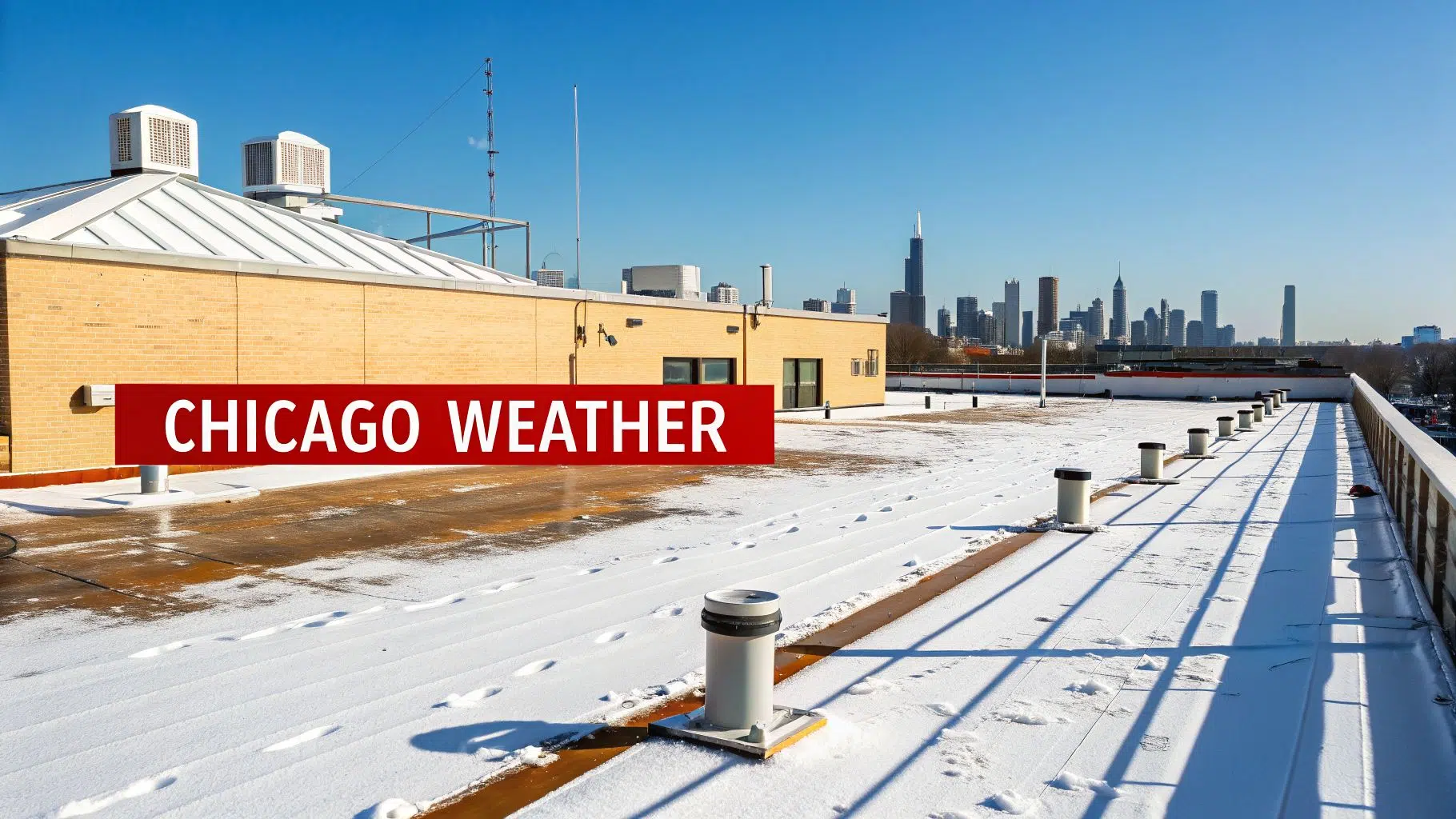
Let's be clear: roofing a warehouse in Chicago is a different ballgame. Your building isn't just facing four seasons; it’s battling a unique, punishing climate shaped by Lake Michigan. This isn't your average cold winter—it's a specific brand of weather that puts an incredible amount of stress on large, flat commercial roofs.
The notorious "lake effect" can dump several inches of heavy, wet snow in what feels like the blink of an eye. All that weight piles up, putting a massive strain on your roof’s structural supports. Then come the freeze-thaw cycles, which are a roofer’s nightmare. This is how you get ice dams—thick, stubborn ridges of ice forming at your roof’s edge, completely blocking any hope of proper drainage.
The True Cost of Snow and Ice
Once drainage is blocked, that melting snow and ice has nowhere to go. It pools, it backs up, and it finds its way under your roofing membrane. This is one of the biggest culprits behind winter leaks, leading directly to soaked insulation and a rotting roof deck. The sheer weight of snow and ice alone poses a direct threat to your building's structural integrity.
This is exactly why proactive winter services aren't a luxury in Chicago; they're essential risk management.
- Emergency Snow Removal: Clearing heavy snow loads is about more than just cleaning up. It prevents your roof from hitting its maximum load-bearing capacity, which is the last line of defense against a potential collapse.
- Ice Dam Mitigation: Safely removing ice dams is critical. It reopens drainage paths and stops water from being forced into your building.
Ignoring this seasonal threat can quickly turn a manageable maintenance issue into a catastrophic failure. We break down this specific danger in our guide on the importance of rooftop snow removal for flat roofs.
The Chicago Premium on Labor and Logistics
Beyond the brutal weather, simply operating in the Chicagoland area adds specific costs to any warehouse roof repair cost. These are economic realities on the ground that every reputable contractor has to factor into their quotes.
Local Knowledge Is Key: A roofer who doesn't get Chicago's logistical challenges will either lowball the bid and cut corners later, or they'll overcharge to cover their own learning curve. Your best defense against inflated costs is partnering with a true local expert who deals with this every single day.
Working in a dense urban and suburban landscape creates hurdles that directly impact your project's bottom line.
Key Local Cost Factors:
- Regional Labor Rates: The cost of living and high demand mean that skilled, professional roofers in the Chicago metro area command a higher wage than in many other parts of the country.
- Disposal Fees: Hauling away and disposing of tons of old roofing material at local landfills is a significant—and often overlooked—project expense.
- Complex Permitting: Every municipality, from the city proper to suburbs like Naperville or Schaumburg, has its own maze of permitting rules, inspection schedules, and code enforcement.
A seasoned local contractor already has the relationships and the system to navigate this red tape efficiently. That familiarity means your project avoids costly delays and surprise code violations. This regional expertise is an invaluable asset that protects your investment and ensures your new roof is truly built for Chicago.
How Proactive Maintenance Lowers Your Long-Term Costs
When you're running a massive industrial facility, it's tempting to adopt an "if it ain't broke, don't fix it" mentality. But when it comes to your roof, that's one of the costliest mistakes you can make. Waiting for a leak to show up on your warehouse floor is like waiting for your car’s engine to seize before getting an oil change—the damage that follows is always far more expensive and disruptive than the routine service you skipped.
The smart money is on proactive maintenance. This isn't just about patching holes; it’s a strategic game plan to get the absolute maximum life out of your roof and catch tiny issues before they spiral into catastrophic failures. Think about it this way: a well-maintained roof can see its service life extended by as much as 50%. We’ve seen it time and again—a 20-year roof easily becomes a 30-year asset, protecting the massive investment you’ve already made.
What Does Proactive Maintenance Actually Involve?
A real maintenance program isn't a one-and-done visit. It's a regular cycle of hands-on inspection and care, where a trained professional gets up on your roof to methodically check every single component for the slightest signs of wear and tear.
This is where the real value lies. For a deeper look into the specifics, our comprehensive guide to flat roof maintenance breaks down the entire process.
A typical maintenance visit from one of our crews includes:
- Debris Removal: We clear away all the leaves, dirt, and random trash that trap moisture against your roof's surface and clog up your drainage system.
- Drain and Scupper Cleaning: We make sure every drain, scupper, and gutter is flowing freely. Ponding water is the number one enemy of a flat roof, and this simple step is your first line of defense.
- Minor Sealant and Caulking Touch-Ups: We hunt for and seal small cracks around pipes, vents, and skylights before they can ever let a drop of water in.
- Flashing Inspection: The flashings around your HVAC units, parapet walls, and other rooftop structures are the most vulnerable points. We inspect them meticulously for any signs of separation or damage.
- Membrane Surface Scan: We walk the entire roof field, looking for early indicators of trouble like blisters, punctures, or seams that are starting to pull apart. These are the quick, inexpensive fixes that prevent huge headaches later.
Each of these small, deliberate actions is about systematically eliminating risk before it can impact your operations.
The Financial Case for Consistent Care
The return you get on proactive maintenance is almost hard to believe until you see the numbers. Finding and resealing a failing pipe flashing during a routine inspection might cost you a few hundred dollars. Simple.
But if that same flashing goes unnoticed? It can create a slow, persistent leak that saturates thousands of square feet of insulation, rusts the structural steel deck underneath, and turns that simple fix into a $50,000+ replacement project.
The ROI of Maintenance: For every $1 you invest in a proactive roof maintenance plan, you can expect to save up to $4 in what would have been future emergency repairs and premature replacement costs.
This is about more than just avoiding a high warehouse roof repair cost. It’s about preventing operational downtime, protecting millions of dollars in inventory from water damage, and keeping your team safe. A small, predictable maintenance line item in your budget is the best insurance policy you can buy against a massive, unexpected, and business-crippling expense.
Your Checklist for Choosing the Right Chicago Contractor
Let's be direct: the single biggest factor influencing your final warehouse roof repair cost—and whether that repair actually lasts—is the contractor you hire. A poor choice can lead to sloppy work, safety nightmares, and having to pay for the same repair twice. The right partner gets it done correctly, safely, and permanently.
Finding a pro shouldn't feel like a shot in the dark. With over 99,000 roofing companies out there, you need a reliable way to vet them. This checklist is built from years of experience in the field and will help you ask the right questions to find a dependable Chicago-area expert you can trust with your facility.
Verifying the Essentials
Before you even start talking about your roof's specific issues, you need to confirm these non-negotiables. Any professional outfit will have this information ready to go. If a contractor gets cagey or can't produce these documents, that’s a huge red flag. End the conversation there.
- Illinois State Roofing License: Ask to see their active license number. Illinois has specific requirements for commercial roofing, and this proves they’ve met the state’s standards for knowledge and practice.
- Proof of Insurance: You need a certificate of insurance showing both general liability and worker's compensation. This isn't just a formality; it protects you and your business from liability if an accident or property damage happens on your site.
- Bonding: Think of a surety bond as another layer of financial protection for you. It’s a guarantee that the contractor will fulfill their end of the contract. If they don't, the bond ensures you're compensated.
Gauging Local Experience and Expertise
Once you've cleared the basics, it's time to dig a little deeper. You're not just looking for any roofer; you're looking for a local expert. A company with decades of experience in the Chicagoland area brings a ton of practical knowledge about our specific codes, weather, and logistical headaches.
Key Takeaway: Experience is everything. A roofer who has spent years fixing warehouses in Chicago already knows how to handle lake effect snow, navigate city permitting, and choose materials that hold up to our brutal freeze-thaw cycles. That's not just a skill—it's a critical advantage that saves you time and money.
Put them to the test with a few specific questions:
- System-Specific Proof: Can they show you case studies or give you references for projects with your exact roof type (TPO, EPDM, Metal, etc.)?
- Emergency Availability: What happens when a storm hits on a Saturday? Ask if they offer 24/7/365 emergency services. When water is pouring into your warehouse, you can't afford to wait until Monday morning.
- Local Project Portfolio: Ask about warehouse projects they've done nearby, whether it's in Chicago proper or out in the suburbs like Naperville or Aurora.
By running through this checklist, you can confidently weed out the unqualified bidders and find a true partner. Choosing a contractor with a solid local reputation, the right credentials, and proven expertise is the best investment you can make for the long-term health of your facility.
Your Questions Answered: What to Expect During a Warehouse Roof Repair
Even after you've looked at the numbers, some practical questions always pop up. It's completely normal. Getting straight answers to these common concerns is the final piece of the puzzle, helping you feel confident about the project ahead. Here are the questions we hear most often from facility managers just like you.
How Long Will This Repair Actually Take?
Honestly, it depends. The timeline for any roof repair comes down to the scope of the job and, most importantly, the weather.
A simple fix, like patching a small puncture on a flat roof with easy access, might only take our crew a few hours. We can get in, get it done, and be out of your hair. But for a major restoration project—we're talking thousands of square feet, removing old membrane, replacing wet insulation, and doing detailed work around a dozen HVAC units—you could be looking at several days or even a full week.
Weather is the big variable, especially here in Chicago. The adhesives and sealants we use have strict temperature and moisture limits to cure properly. A surprise rainstorm or a sudden cold snap can put us on pause. It might be frustrating, but we’d rather wait and do it right than rush a repair that won't last.
Am I Going to Void My Roof's Warranty?
This is a big one, and the answer comes down to one thing: who does the work. Most warranties for systems like TPO or EPDM are very clear that only a certified installer can touch the roof. If you hire a random roofer or try a DIY patch, you will almost certainly void your warranty instantly.
It’s like taking your new car to a certified dealership mechanic versus letting your cousin mess with the engine in his garage. The manufacturer will honor the work of the certified pro, but they’re off the hook if an unapproved person makes a mistake.
To protect your warranty, you have to use a contractor who is officially certified by the manufacturer of your specific roofing system. This is your guarantee they're using the right materials and methods. Always ask to see their certification—a reputable roofer will have it ready.
Should I Repair the Roof or Just Replace the Whole Thing?
Choosing between a major repair and a full replacement is one of the toughest financial calls a facility manager has to make. While every roof has its own story, we have a practical rule of thumb that helps guide the conversation.
We call it the 40-50% rule. If the total warehouse roof repair cost is creeping up to 40% or more of what a full replacement would cost, it's probably time to start fresh. Sinking that kind of money into an aging roof is often throwing good money after bad.
Other signs also point toward replacement. Is your roof already past its prime? Are the problems widespread—affecting more than 25-30% of the surface—rather than just a few isolated spots? If so, a replacement is almost always the smarter long-term investment.
When you need clarity and a plan you can count on, it pays to talk to local experts. For over 50 years, Expert Super Seal Roofing & Tuckpointing has given Chicago-area businesses honest advice and durable roof solutions. Contact us today for a free, no-obligation estimate and let's figure out the best path forward for your facility.