
You usually end up looking into membrane roofing when something has already gone wrong. A ceiling stain shows up after a hard rain. Snow sits on the roof a little too long. Ice builds at the edge, then water finds a weak spot around a flashing, drain, or seam. In Chicago, that’s how flat-roof problems announce themselves.
Most property owners don’t start by asking for a membrane roof. They ask why their flat roof keeps leaking, why patched areas fail again, or whether they should keep repairing an old tar roof. If that sounds familiar, you’re already in the right category. For a flat or low-slope building in this region, a membrane system is often the roof type that makes the most practical sense.
What Is a Membrane Roof and Why Is It on Your Building
A membrane roof is a waterproof layer, sometimes single-ply and sometimes multi-ply, installed over a flat or low-slope roof to keep water out. Common membrane materials include TPO, EPDM, and PVC, and these systems are built for the kind of rooflines you see all over Chicago on bungalows, two-flats, condo buildings, retail strips, warehouses, and industrial properties.
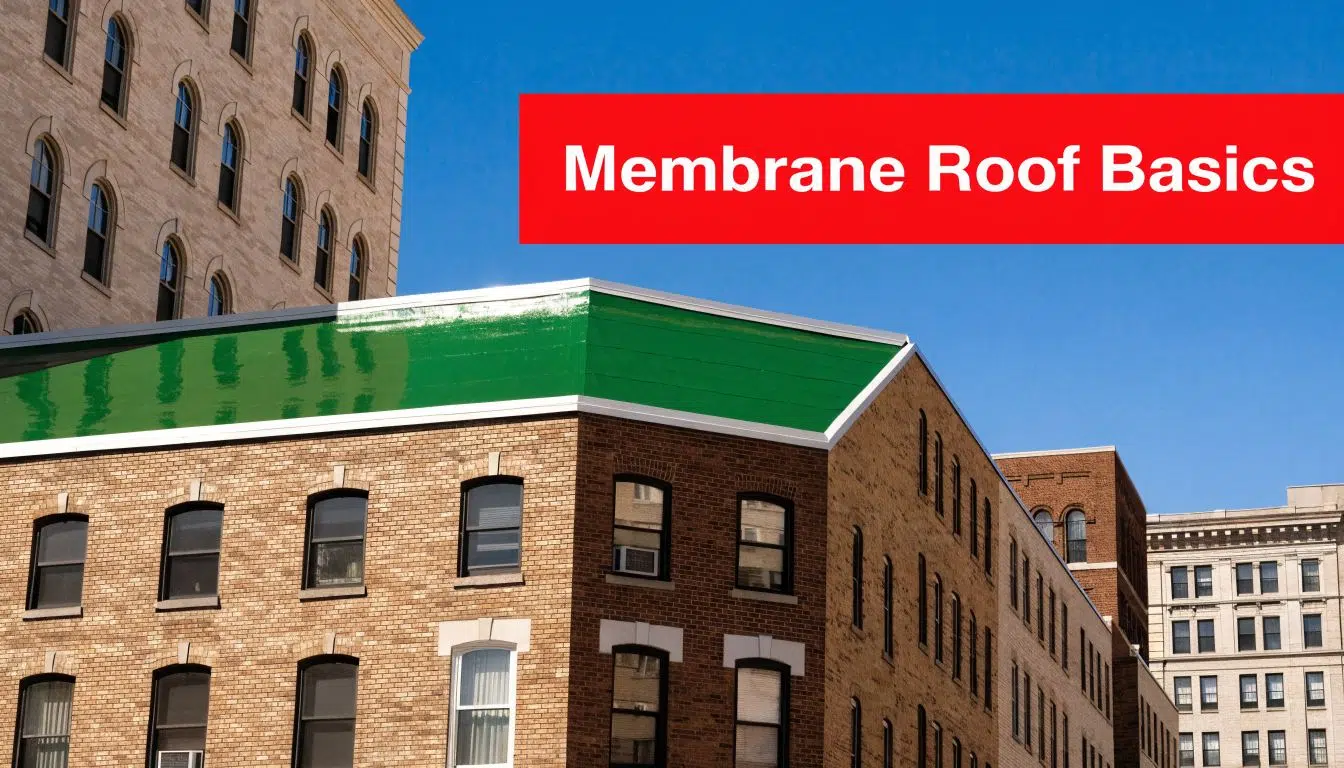
If you’ve got a steep shingle roof, water sheds fast. A flat or low-slope roof doesn’t work that way. It has to manage slower drainage, standing moisture risks, snow load, and repeated freeze-thaw movement. That’s why these roofs need a continuous waterproofing surface instead of a roofing system that depends mainly on gravity and overlap.
Why flat Chicago roofs need a different approach
Older flat roofs often relied on built-up layers, asphalt-based systems, or patchwork repairs done over time. Those systems can still perform, but many property owners eventually reach the point where they want a cleaner, more controlled waterproofing layer with fewer weak points. That’s where membrane roofing comes in.
It's like a raincoat for the building. Not a blanket thrown over the structure, but a fitted waterproof skin that wraps the roof field, penetrations, curbs, parapet transitions, and drains. If it’s designed and installed correctly, it forms one working system instead of a collection of patched problem areas.
A flat roof doesn’t fail just because it’s flat. It fails when water gets time, entry points, and repeat exposure.
Membrane roofing is also not a niche product anymore. The global roofing membranes market was valued at USD 10.87 billion in 2026 and is projected to reach USD 13.86 billion by 2031, and commercial facilities captured nearly 40% of the market, according to Mordor Intelligence’s roofing membranes market analysis. That lines up with what you see on the ground across Chicagoland. Flat and low-slope buildings depend on these systems because they fit the building type.
What the membrane is actually doing
A membrane roof has one main job. Keep liquid water from entering the building.
It also has to do that while handling:
- Thermal movement: Chicago roofs expand and contract constantly.
- Penetrations: HVAC units, vents, skylights, and curbs create vulnerable details.
- Wind exposure: Corners and edges take abuse.
- Maintenance traffic: Service techs walk these roofs year-round.
If you’re asking what is a membrane roof in plain language, the shortest honest answer is this: it’s the roofing system most flat and low-slope buildings use because those buildings need a durable, continuous waterproof barrier, not just a covering.
Exploring the Big Three TPO EPDM and PVC
A Chicago flat roof in January deals with more than rain. It deals with snow load, ice at the drains, freeze-thaw movement around seams, and service calls when rooftop equipment still needs attention in bad weather. That is why the choice usually comes down to three single-ply membranes. TPO, EPDM, and PVC.
All three are used on low-slope roofs. All three can protect a building well if the system is designed and installed correctly. The difference is how each material handles movement, abuse, detailing, and cost over time.
TPO as the reflective, heat-welded option
TPO is a thermoplastic membrane, usually chosen for its reflective surface and heat-welded seams. On a Chicago commercial roof, those welded seams matter because repeated expansion and contraction will test every joint year after year. A properly welded seam generally gives owners more confidence than a field full of glued laps.
TPO is often a practical fit for owners who want a cleaner-looking system and care about solar reflectivity. That said, TPO quality can vary by manufacturer and product line, and that is not a small detail. On roofs that see standing water, drifting snow, and long winters, product selection and installer skill matter just as much as the membrane name on the proposal.
If you want more detail on where it fits locally, this guide on the benefits of TPO roofing for Chicago flat roofs gives a Chicago-specific breakdown.
EPDM as the forgiving rubber option
EPDM is a synthetic rubber membrane with a long track record on low-slope buildings. Contractors still use it because it stays flexible in cold weather, and that matters in a city where winter can punish a roof for months. On older buildings with lots of penetrations or irregular layouts, EPDM can also be easier to work with than stiffer sheet materials.
Its trade-off is straightforward. EPDM is proven and often budget-friendly, but its seams are typically taped or adhered rather than heat-welded. That does not make it a weak system. It does mean seam workmanship, drainage design, and maintenance discipline carry a lot of weight, especially after hard freeze-thaw cycles.
Owners who want the lowest upfront material cost often ask about EPDM first. Owners who hate the idea of seam maintenance sometimes look harder at TPO or PVC.
PVC as the tougher specialty option
PVC is also a thermoplastic membrane, but it usually enters the conversation when the roof has to handle more than weather. Buildings with restaurant exhaust, chemical exposure, or heavier service demands often justify the extra cost.
PVC also uses heat-welded seams, which is a real advantage on roofs that see ice, ponding risk, and regular foot traffic. In practice, PVC is often the material you consider when failure would be expensive or when the rooftop environment is rough enough that a standard budget choice may not hold up as well.
That higher performance usually comes with a higher price. According to a membrane roofing cost comparison from RubyHome, TPO typically runs about $5 to $6 per square foot, while PVC often falls around $6 to $9.50 per square foot. Those numbers are only part of the decision, but they frame the discussion quickly.
The practical takeaway
Strip away the acronyms and the choices look like this:
- TPO: Good fit for owners who want reflectivity and welded seams at a mid-range cost.
- EPDM: Reliable rubber membrane with strong cold-weather flexibility and a long field history.
- PVC: Higher-cost option that earns its keep on roofs exposed to grease, chemicals, or harder use.
On Chicago buildings, I would not choose from a brochure alone. I would look at drainage, parapet details, rooftop traffic, the number of penetrations, and how the roof will behave after ten rounds of freeze and thaw. The best membrane is the one that fits the building and survives the weather it gets.
How TPO EPDM and PVC Compare on Your Roof
A Chicago roof gets tested in January, not in a product brochure. Snow sits. Ice builds along drains and edges. Then a thaw sends water across the surface, followed by another hard freeze that punishes weak seams, sloppy flashing, and poor drainage design.
That is the lens I use when comparing TPO, EPDM, and PVC.
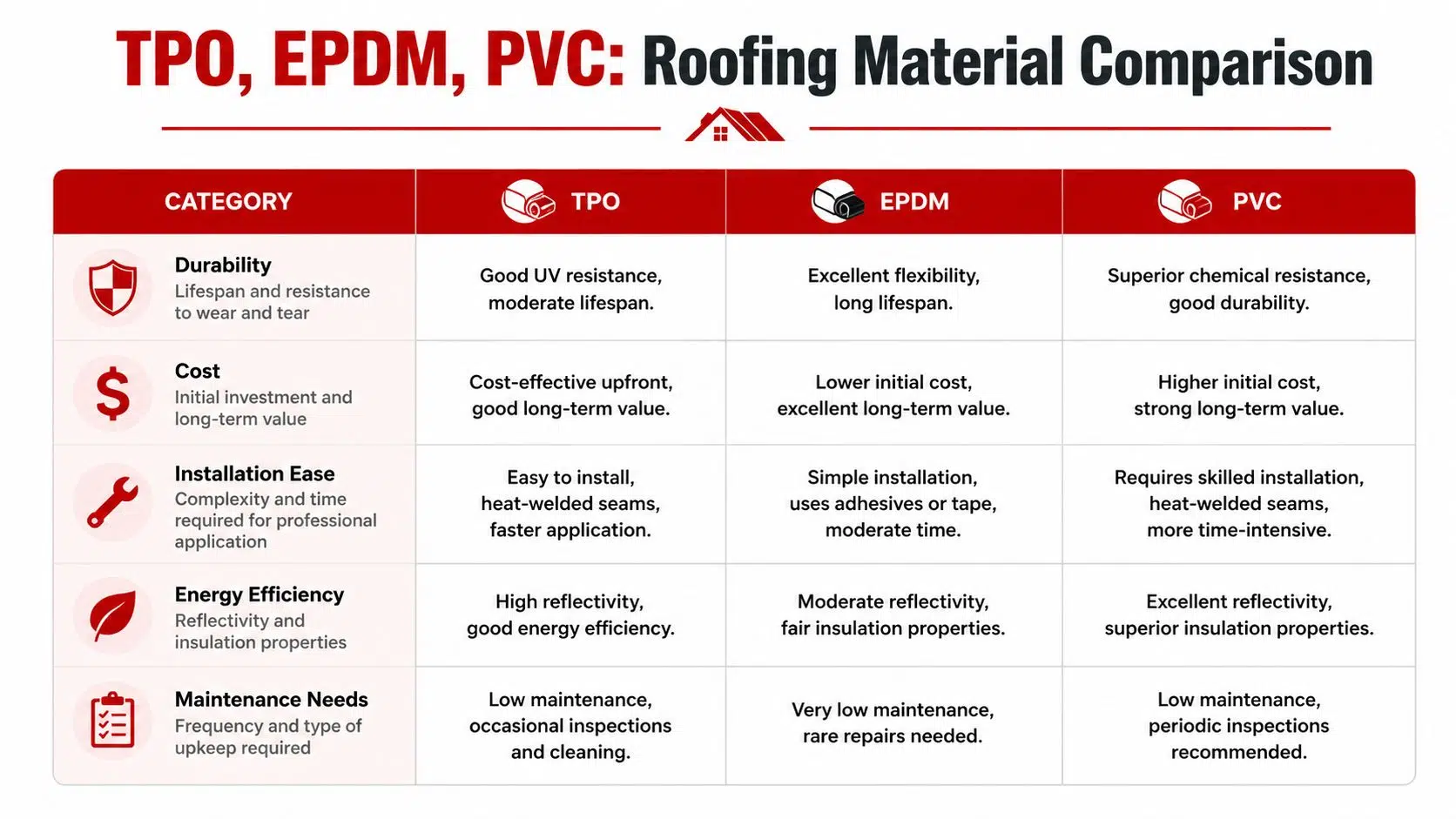
Membrane Roofing Comparison TPO vs. EPDM vs. PVC
| Feature | TPO (Thermoplastic Olefin) | EPDM (Ethylene Propylene Diene Monomer) | PVC (Polyvinyl Chloride) |
|---|---|---|---|
| Core identity | Reflective thermoplastic single-ply membrane | Synthetic rubber single-ply membrane | Thermoplastic single-ply membrane built for tougher rooftop conditions |
| Cost range | Mid-range | Often lower-cost than other single-ply options | Higher-cost option |
| Seams | Heat-welded | Typically taped or adhesive-based, depending on system | Heat-welded |
| Cold-weather behavior | Can perform well, but seam quality and installation discipline matter | Known for flexibility in cold conditions | Handles demanding conditions well when properly specified |
| Typical fit | Owners who want reflectivity and welded seams without moving to PVC pricing | Owners who want a proven membrane with strong cold-weather performance | Buildings with grease, chemicals, heavier traffic, or a harsher rooftop environment |
| Chicago trade-off | Good balance of cost and performance, but details cannot be casual | Strong value and winter flexibility, though seams deserve close attention | Higher upfront cost, but often worth it where rooftop abuse or standing water risk is higher |
Property owners usually ask a fair question. Which one holds up best?
The practical answer depends on what is happening on that roof. A clean warehouse roof with limited foot traffic is a different job from a mixed-use building with multiple penetrations, service contractors walking the roof, and drainage that already struggles after a heavy snow. Material choice has to match use, not just budget.
Where each membrane tends to win
TPO often lands in the middle for cost and performance. It gives you welded seams and a reflective surface, which many owners like for energy reasons. On Chicago buildings, I pay close attention to the installer’s seam work, edge securement, and flashing details, because winter movement exposes weak workmanship fast.
EPDM has a long track record for a reason. It stays flexible in cold weather, and that matters during freeze-thaw cycles when the roof system is constantly expanding and contracting. If budget is tight and the building does not need chemical resistance or a highly reflective surface, EPDM is often a serious contender.
PVC usually costs more, but there are roofs where the extra money makes sense on day one. Restaurants, buildings with grease exhaust, roofs with more maintenance traffic, and properties where a leak would disrupt tenants or operations often justify PVC. Its welded seams are a strong point in rough conditions.
What actually decides the outcome
Membrane type matters. Roof design and installation matter just as much.
On Chicago properties, I look at these issues before I recommend one membrane over another:
- Drainage quality. Snowmelt and refreezing put extra stress on low spots and slow drains.
- Number of penetrations. Every pipe, curb, and unit support adds flashing work, and flashing is where weak installs show up first.
- Rooftop traffic. Service techs shorten roof life if the membrane is not a good fit for regular foot traffic.
- Parapets and edge details. Wind, drifting snow, and ice buildup punish these areas.
- Building use. A school, warehouse, restaurant, and condo building do not ask the same things from a roof.
A lot of failures that owners blame on "bad TPO" or "bad EPDM" started with poor detailing, bad drainage, or crews treating seam work like routine labor. The field membrane can look fine while the corners, transitions, and penetrations are already setting up the next leak.
The membrane sheet gets the attention. The roof stays dry or leaks at the seams, flashings, corners, and drain details.
The practical way to compare them
For a budget-conscious owner, EPDM often stays in the conversation because it gives proven performance without pushing the price as high as PVC.
For an owner who wants welded seams and a modern single-ply system, TPO is often the middle-ground choice.
For a roof that takes abuse, sees grease exposure, or carries a bigger cost if it fails, PVC often earns the extra upfront spend.
On a Chicago building, the right question is not which membrane sounds best on paper. The right question is which system fits the building, the drainage, the traffic, the details, and ten winters of snow, thaw, refreeze, and wind.
How a Membrane Roof Is Installed
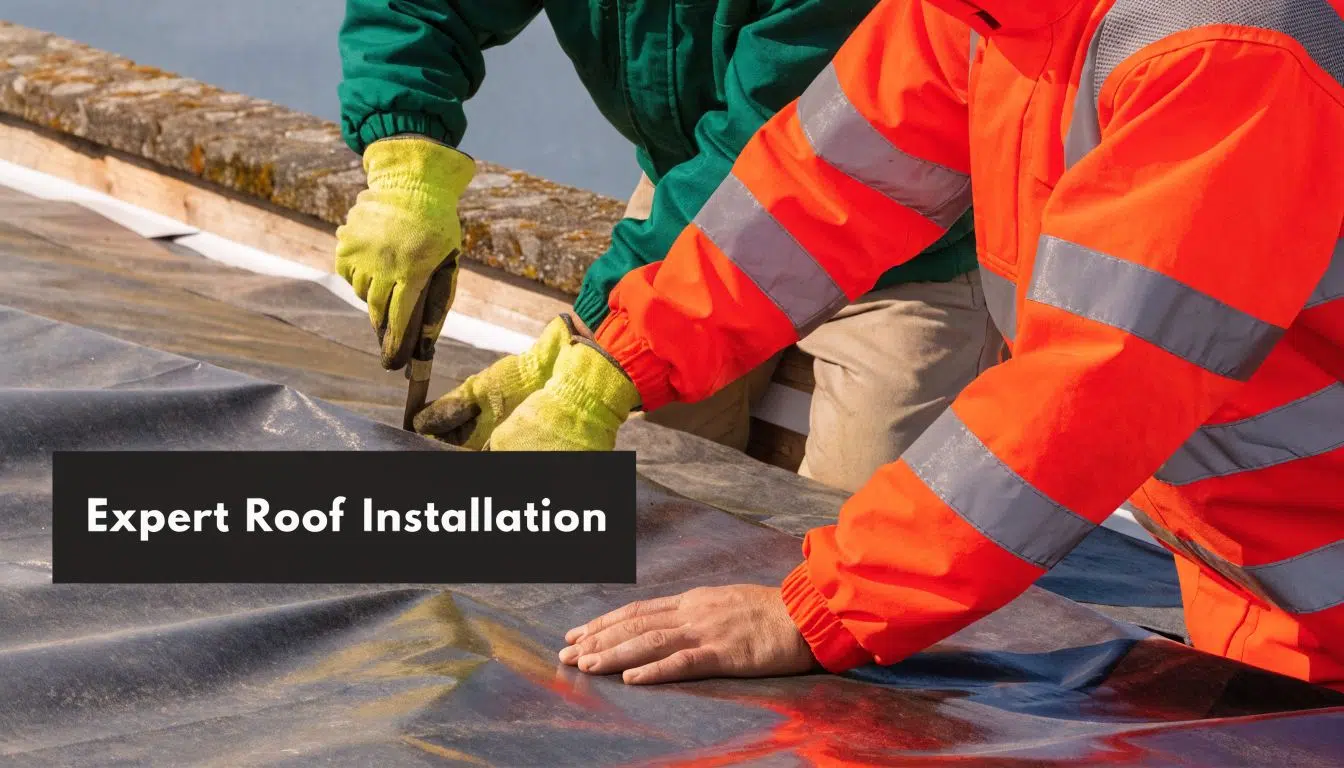
Property owners don’t need a DIY lesson. They do need to know what competent membrane roof installation looks like, because that’s where good systems separate from expensive problems.
The three main attachment methods
A membrane roof is usually installed one of three ways.
Fully adhered
The membrane is bonded to the substrate with adhesive. This method can give a clean, uniform attachment and is often preferred where appearance, uplift performance, or specific system design calls for it. It also depends heavily on surface prep. If the substrate is dirty, wet, uneven, or poorly repaired, that problem doesn’t disappear under adhesive.
Mechanically attached
The membrane is fastened with screws and plates in a designed pattern, then seams cover and secure the attachment zones. This method is common on commercial work and can be efficient, but fastening patterns, perimeter treatment, and seam execution have to be right.
Ballasted
The membrane is laid in place and held down with ballast such as gravel or pavers. This approach has its place, but it isn’t right for every structure, and the roof has to be designed to carry the load.
The seam is the whole game
On TPO and PVC roofs, seam welding is one of the biggest advantages. Done right, it creates a bond that turns separate sheets into one continuous waterproofing surface. Done poorly, it leaves the building one storm away from a callback.
That’s why standards matter. Carlisle SynTec’s overview of ASTM standards for roofing membranes notes that professional installation is governed by standards such as ASTM D6878 for TPO, and that premium membranes must achieve a breaking strength of 200 lbf per inch to withstand wind uplift forces exceeding 120 mph. In Chicago, that isn’t theoretical. Gusty exposure at corners and parapets punishes weak attachment and poor seams.
What quality workmanship looks like
A proper installation usually includes attention to details owners never see from the ground:
- Clean substrate prep: Wet or unstable surfaces cause trouble later.
- Tight flashing work: Curbs, penetrations, and wall transitions are leak zones.
- Deliberate drain layout: A good membrane can’t fix bad water management by itself.
- Manufacturer-specific seam work: Not generic, not improvised.
- Final inspection: The roof should be checked as a system, not just as sheets laid on a deck.
Watch how a contractor talks about seams and flashings. If they treat those as side details, keep looking.
The membrane itself matters. The install matters more.
Protecting Your Investment Lifespan and Maintenance
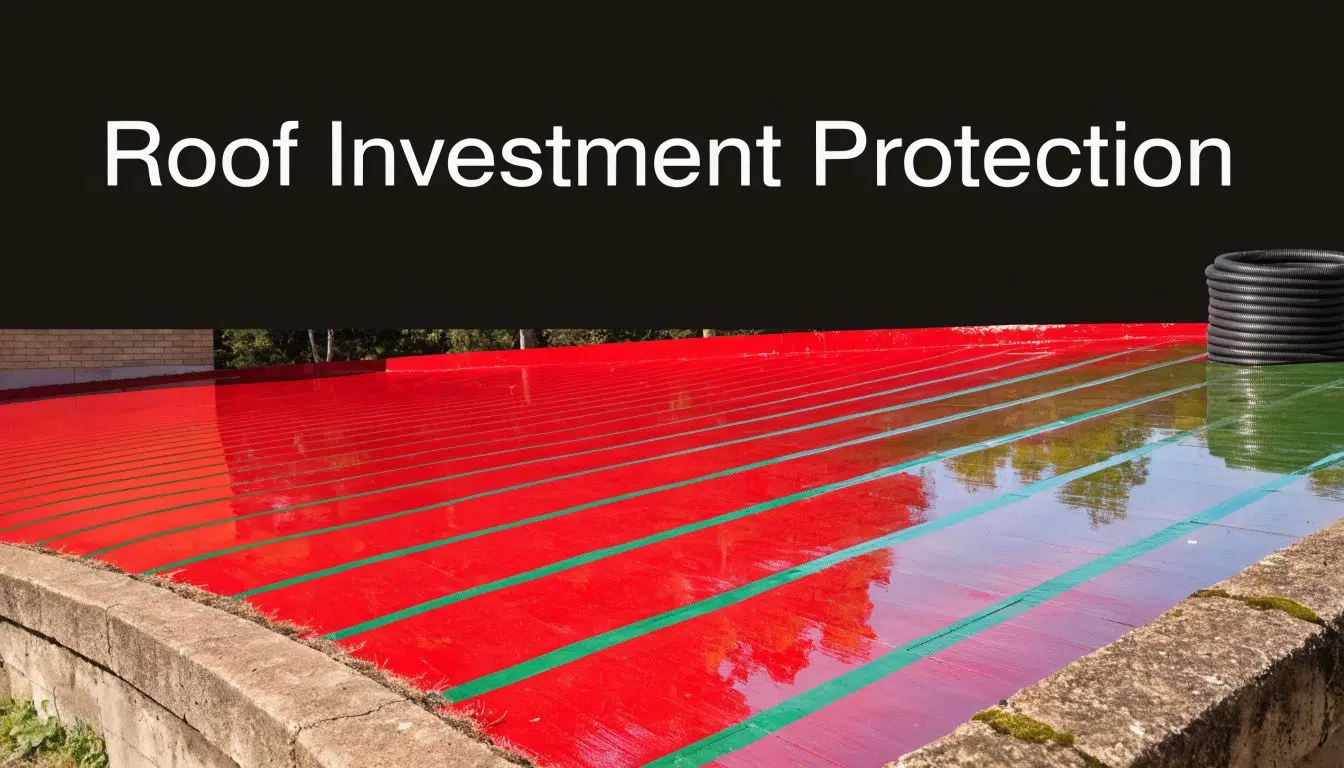
A membrane roof is not maintenance-free. It’s lower drama than many older flat-roof systems when it’s installed correctly, but it still needs regular attention. Most emergency leaks start as small issues that no one caught early.
What owners should check
You don’t need to become a roofer. You do need a basic eye for warning signs.
A practical maintenance routine includes:
- Clear drains and scuppers: Flat roofs fail faster when water has nowhere to go.
- Look after storms: Wind can loosen edge metal, flashing details, or rooftop accessories.
- Check seams and transitions: Separation usually starts at details, not in the middle of the field.
- Watch ponding areas: Repeated standing water tells you drainage needs attention.
- Limit uncontrolled foot traffic: HVAC service crews can do plenty of damage without meaning to.
The signs that deserve a service call
Some issues can wait for a scheduled inspection. Others shouldn’t.
Call a roofer when you see:
- Open seams or lifting edges
- Cracks at flashing points
- Repeated interior staining in the same location
- Soft spots underfoot
- Debris buildup that keeps returning around drains
For owners trying to understand expected service life on thermoplastic systems, this page on how long a TPO roof lasts helps frame what affects longevity in practice. Lifespan is never just about the membrane label. Drainage, installation quality, traffic, and maintenance all matter.
What usually shortens roof life
Chicago roofs don’t wear out from one dramatic event. They usually wear out from repetition.
Snow sits. Ice forms. Temperatures swing. A drain clogs. Water backs up. Someone patches a detail instead of fixing the underlying problem. Then another winter finishes what the shortcut started.
That’s why maintenance should be boring and regular. The owners who get the most out of membrane roofing are usually the ones who inspect after major weather, document changes, and repair small issues before moisture reaches insulation or decking.
A flat roof rarely gives one warning. It gives several. The expensive part is ignoring them.
Choosing a Membrane Roof for Chicago Weather
National roofing advice often falls short. A membrane roof in Phoenix, Atlanta, and Chicago doesn’t live the same life. Chicago roofs deal with snow load, ice, drifting, freeze-thaw movement, clogged drains from winter debris, and spring moisture that tests every weak detail.
Why Chicago changes the decision
On a Chicago flat roof, winter doesn’t just sit on the surface. It works the roof over. Snow melts during brief warm periods, water moves toward drains or edges, temperatures drop again, and that moisture freezes. The cycle repeats. Flashings, seams, penetrations, and perimeter details take the beating.
That’s why material flexibility, attachment method, drainage design, and insulation strategy matter so much here. A roof that looks fine in mild weather can turn into a problem roof after enough freeze-thaw cycles.
The overlooked option called PMR
One assembly more owners should hear about is Protected Membrane Roofing, often called PMR. In this setup, the insulation sits above the waterproof membrane instead of below it. That flips the conventional assembly and protects the membrane from direct thermal shock.
According to the UFGS guidance for protected membrane roofing, placing insulation above the membrane in a PMR can extend service life to 40+ years and can cut energy use by 10-20% compared to conventional roofs. In Chicago conditions, that’s worth serious attention because freeze-thaw exposure is one of the quiet killers of low-slope roofs.
Where PMR makes sense and where it doesn’t
PMR isn’t the answer for every building. It tends to make the most sense when the owner is looking long-term and the project can support the assembly design, ballast or paver approach, and drainage planning that come with it.
It’s worth asking about when you have:
- A building that sees hard winter exposure
- A roof deck that needs durable long-term protection
- Plans for walkable surfaces, pavers, or amenity use
- A replacement project where life-cycle performance matters more than the lowest first number
It may be less attractive when the project is driven strictly by lowest upfront cost or when the roof conditions don’t support the assembly well.
In Chicago, the smartest roof choice isn’t always the most common one. It’s the one designed for repeated freezing, thawing, and rooftop abuse.
If a contractor only talks about basic TPO, EPDM, or PVC choices and never brings up how insulation placement affects winter performance, you’re probably getting a generic roof conversation instead of a Chicago roof conversation.
Finding the Right Contractor for Your Chicago Property
A lot of Chicago roof problems start with a bid that looked fine on paper. Then January hits, snow sits at the drains, ice forms along parapet walls, and the first warm-up pushes water into a seam or flashing detail that was never handled right.
That is why contractor selection matters as much as membrane selection. A crew can install TPO, EPDM, or PVC and still leave you with a roof that struggles through two winters because they treated a Chicago flat roof like a generic low-slope job.
Start by asking about real local failure points, not just brand names and warranty terms. A good contractor should be able to explain how they handle ponding areas, drain strainers, edge securement, parapet flashing, rooftop equipment curbs, and snow-related stress at transitions. They should also be clear about who is doing the work, who is checking the seams, and what happens if wet insulation or bad decking turns up after tear-off.
Ask direct questions:
- Why is this membrane the right fit for this building and this exposure?
- How will you address drainage if snowmelt backs up at the low spots?
- What details are changing at parapets, penetrations, and roof edges?
- How do you inspect seams and flashing before the job is closed up?
- What warranty applies, and what owner actions can void it?
- What similar Chicago buildings have you roofed?
Price still matters. It just should not be the only filter. If you want a baseline before you collect proposals, this guide on new roof cost in Chicago helps you compare bids with a little more context.
One strong sign of local knowledge is whether the contractor can explain cold-weather roof behavior without talking in circles. They should be comfortable discussing freeze-thaw movement, ice at blocked drains, the effect of repeated snow load, and when a protected membrane assembly deserves a serious look. As noted earlier, PMR is not for every building, but a contractor who never brings it up on the right type of project may be giving you a standard sales pitch instead of a building-specific recommendation.
Expert Super Seal Roofing & Tuckpointing is one Chicago contractor that works on flat-roof systems including TPO and EPDM, along with repair, replacement, and related building-envelope work. More important than the company name is the standard you hold any bidder to. Choose the contractor who can explain the assembly, the failure risks, and the trade-offs in plain language before the first roll of membrane goes on the roof.