A TPO roof typically lasts 15 to 30 years, and in Chicago the biggest variables are membrane thickness and proper installation that can handle freeze-thaw cycles, snow, and ponding water. If you want the roof to land near the high end of that range, material choice, seam quality, drainage, and maintenance all have to be right from day one.
If you’re managing a flat roof in Chicago, you’re probably not asking this question out of curiosity. You’re asking because winter just put your building through another beating, an HVAC tech has been walking the roof all year, or you’re trying to decide whether to budget for repairs now or replacement later.
That’s the right way to think about it. A TPO roof doesn’t fail on a calendar. It ages based on what was installed, how well it was welded, how water moves off the roof, and how the system holds up through Chicago snow, ice, wind, and summer heat. For property managers, condo boards, landlords, and commercial owners, the practical question isn’t only how long does tpo roof last. The better question is how long your specific TPO roof is likely to last under local conditions.
The Real Lifespan of a TPO Roof
A Chicago building owner usually notices the roof when something changes. Maybe a seam starts to curl near a drain. Maybe the top floor reports staining after a thaw. Maybe the roof still looks decent from the hatch, but you know it’s no longer young and another hard winter is coming.
The direct answer is simple. TPO roofs typically last 15 to 30 years, and replacement costs in the Chicago area generally range from $5 to $12 per square foot according to Advanced Builds on average TPO roof lifespan and replacement cost.
That range is wide for a reason. TPO isn’t a single outcome. A lightly built membrane on a roof with poor drainage and sloppy seams won’t age like a thicker membrane installed correctly and maintained consistently.
Why the range is so wide
Two roofs can be the same age and be in very different condition. One still has tight seams, clean field membrane, and controlled rooftop traffic. The other already shows punctures near service paths, stress at penetrations, and chronic standing water after storms.
That’s why a lifespan estimate always has to be tied to real conditions on the roof:
- Material choice matters: Thin utility-grade systems don’t absorb abuse the same way heavier membranes do.
- Craftsmanship matters: Heat-welded seams, flashing details, and attachment methods decide whether the system stays watertight through seasonal movement.
- Maintenance matters: Debris, blocked drains, and ignored punctures shorten service life fast on a flat roof.
Practical rule: A TPO roof reaches the upper end of its lifespan when the installer, the membrane, and the maintenance plan all match the building.
What property managers should take from this
Treat lifespan as something you can influence. If your roof is newer, the goal is to protect it from avoidable damage. If it’s mid-life, the goal is to catch problems while they’re still repairable. If it’s older, the goal is to make an honest call before repeated patching costs more than a planned replacement.
In Chicago, roofs rarely get extra credit for neglect. They get exposed. Snowmelt finds low spots. Freeze-thaw cycles work on weak seams. Service crews create wear patterns around units and access points. A TPO roof can be a strong long-term system, but it earns that reputation only when the roof assembly is built and managed properly.
Key Factors That Determine TPO Roof Longevity
A lot of owners hear one lifespan number and assume all TPO roofs are basically the same. They aren’t. Think of membrane thickness like tire selection on a work truck. You can buy the cheaper option and still get moving, but that doesn’t mean it’s the right choice for rough conditions, repeated use, or a long service interval.
Membrane thickness changes the outcome
The clearest trade-off is thickness. A standard 45-mil TPO membrane offers a 15 to 20 year life, while an 80-mil membrane can extend service life to over 25 to 30 years, with a 33 to 100 percent improvement in durability and resistance to puncture or thermal stress according to Premier Group on TPO membrane thickness and lifespan.
For Chicago properties, this matters more than many buyers want to admit. Roofs here deal with mechanical traffic, snow removal activity, fast temperature shifts, and low-slope water movement. That environment punishes underbuilt systems.
| Thickness | Average Lifespan | Relative Cost | Best For |
|---|---|---|---|
| 45 mil | 15 to 20 years | Lower | Utility roofs, lighter-duty applications, tighter upfront budgets |
| 60 mil | Around the middle of the typical range | Moderate | Many standard commercial flat roofs |
| 80 mil | Over 25 to 30 years | Higher | High-traffic roofs, roofs with mechanical units, harsher exposure, owners prioritizing long-term durability |
A thicker sheet won't fix bad workmanship. But when two roofs are installed well, the heavier membrane gives you more margin against punctures, wear, and stress.
Installation quality is the day that matters most
Most long-term roof problems start with details that looked small on install day. Seams weren't welded consistently. Flashings around penetrations were rushed. The substrate wasn't ready. Edge details were treated like accessories instead of primary leak points.
On TPO, the seams are everything. If the field membrane is solid but the seams are weak, Chicago weather will find it. Freeze-thaw movement puts pressure on every transition. Wind loads test corners and perimeters. Once water gets into a vulnerable area, the system starts aging from a condition it was never meant to tolerate.
A roof with average material and excellent installation usually outperforms a roof with premium material and careless detailing.
UV, rooftop traffic, and drainage all work together
Chicago isn't Arizona, but sun still matters. So does reflected heat, dirt buildup, and rooftop activity. Add in leaves, clogged drains, and snowmelt, and small problems become persistent ones.
Three conditions show up over and over on roofs that age badly:
- Uncontrolled traffic: HVAC crews and vendors use the shortest path, not the safest one. Without walk pads, that traffic leaves scuffs, punctures, and seam stress.
- Dirty surfaces: Dirt doesn't just make the roof look neglected. It can hold moisture and heat, especially around drains and low areas.
- Water that sits too long: Flat roofs don't need perfect dryness. They do need drainage that works properly.
What works and what doesn't
What works is simple, even if it isn't always cheap. Specify the right membrane. Demand tight welding and clean flashing details. Protect service routes. Keep drains open. Fix small damage while it’s still small.
What doesn't work is choosing based on initial bid alone, then expecting the roof to survive Chicago weather for decades without a plan. TPO rewards discipline. It doesn't reward shortcuts.
How to Maximize Your TPO Roofs Service Life
A TPO roof lasts longer when someone takes ownership of the boring stuff. Most failures don't begin with a dramatic blow-off. They start with a clogged drain, a split seam near a unit curb, or repeated traffic in the same unprotected lane.
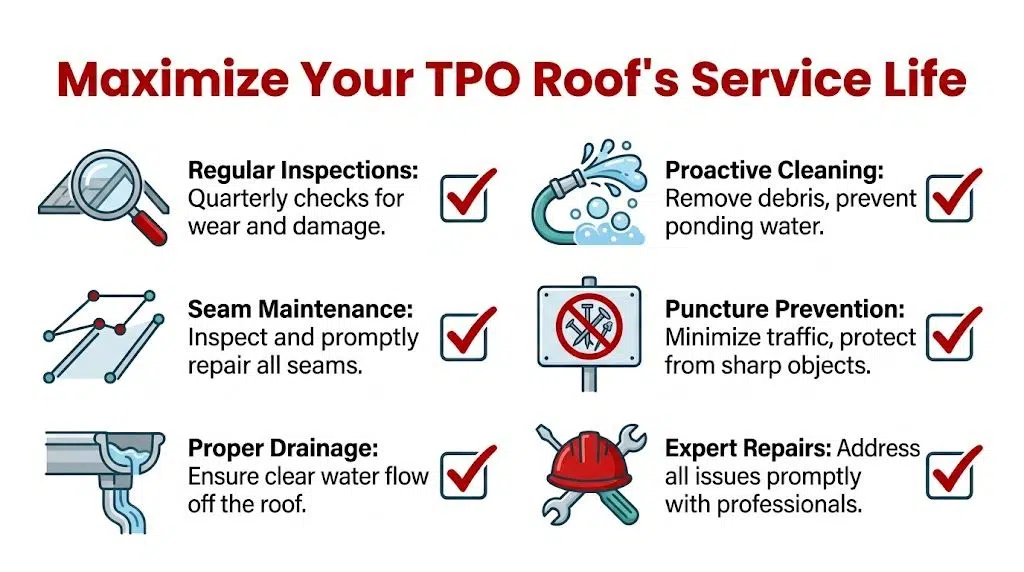
This visual sums up the maintenance habits that keep a roof in service longer.
A solid maintenance routine doesn't have to be complicated. It has to be consistent. For Chicago properties, a useful starting point is this flat roof maintenance guide for Chicago properties, especially if you're coordinating vendors, tenants, and seasonal service calls.
The maintenance checklist that actually matters
- Inspect after winter and before winter: Chicago roofs take damage during freeze-thaw periods, snow accumulation, and spring thaw. A seasonal inspection catches seam stress, punctures, and drainage issues before they turn into leaks.
- Keep drains and scuppers clear: Water is less forgiving on a flat roof than on a steep-slope system. If drains clog, the membrane stays under stress longer and weak areas show up sooner.
- Control access routes: Put walk pads where HVAC technicians and maintenance crews travel. If people are servicing rooftop equipment, assume the same areas will get used repeatedly.
- Repair punctures early: A small puncture in the field membrane is manageable. A small puncture that lets water travel into the assembly becomes a bigger and more expensive problem.
- Watch the seams: TPO depends on seam integrity. If an edge starts to lift or a detail around a penetration looks suspect, don't leave it for the next budget cycle.
- Remove debris regularly: Leaves, branches, trash, and rooftop dirt trap moisture and slow drainage. They also hide defects during casual walk-throughs.
What a good service plan looks like
A good plan is specific to the building. A condo roof with moderate foot traffic doesn't need the same attention as an industrial roof loaded with equipment and vendor visits. The point is to make maintenance routine enough that defects get caught while they are still isolated.
On-site habit: If a technician, superintendent, or engineer notices a new mark, tear, loose flashing edge, or soft spot underfoot, document it the same day and get it checked.
The owners who get longer life out of TPO usually do two things well. They don't postpone small repairs, and they don't let the roof become everyone's work platform without protection. That discipline is what pushes a system toward the upper end of its useful life.
Warning Signs Your TPO Roof Needs Attention
Most TPO roofs give warning before they fail badly. The trouble is that many owners don't get on the roof until interior damage forces the issue. By then, what could have been a targeted repair may already involve wet insulation, repeated leak paths, or broader seam failure.
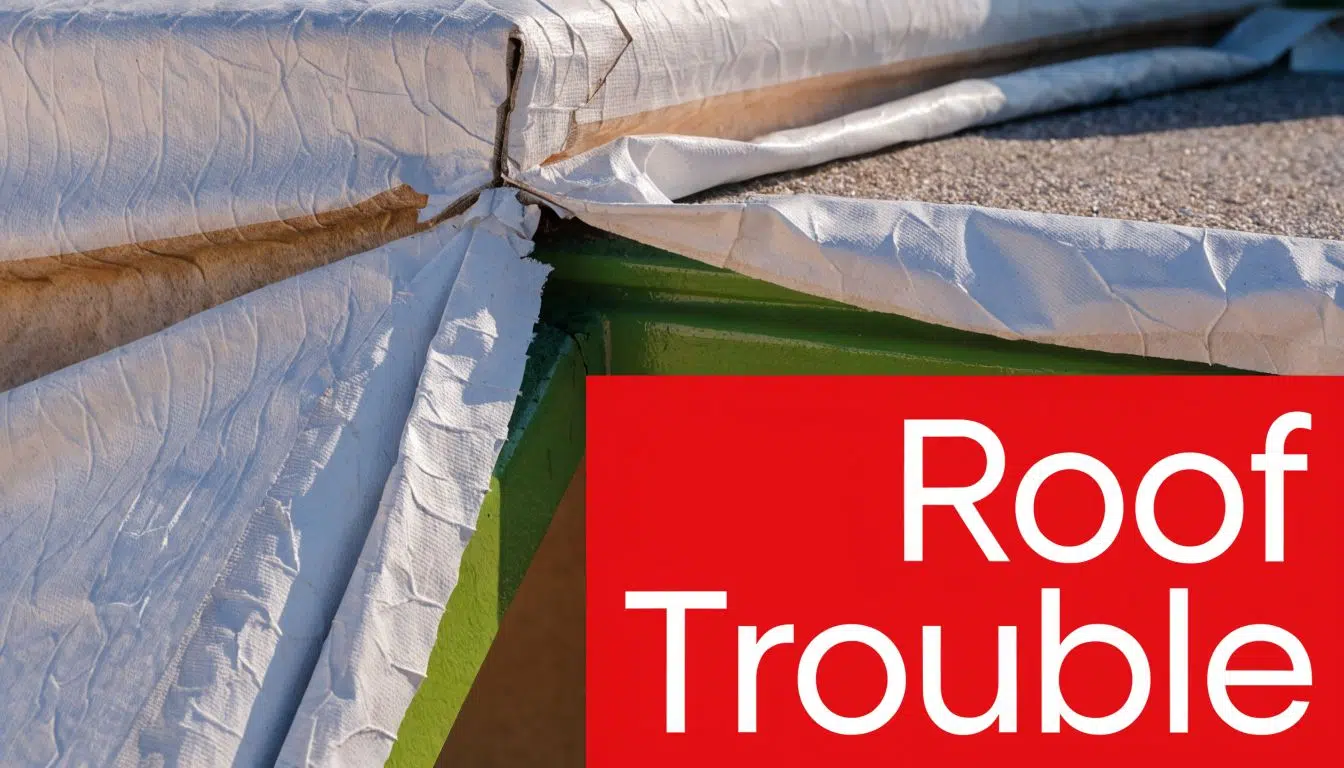
This is the kind of damage pattern that shouldn't wait.
Seams that look tired or separated
A healthy seam should look secure and consistent. Trouble starts when seams appear split, peeled, lifted, or uneven at transitions. On a Chicago roof, weak seams often show themselves after winter movement or after standing water has stressed the same area repeatedly.
If you see seam changes around penetrations, corners, or drain areas, treat that as a roofing issue, not a cosmetic one.
Punctures, tears, and worn traffic paths
Dropped tools, service carts, sharp debris, and repeated foot traffic all leave a pattern. You'll often see wear near rooftop units, hatches, ladders, and common walk routes. TPO can handle use, but it doesn't like uncontrolled use.
Watch for these field conditions:
- Small cuts or punctures: Often found near equipment service areas.
- Surface abrasion: Repeated scuffing that thins or weakens the membrane.
- Membrane pull at corners or edges: A sign the roof is under stress where it can least afford it.
Bubbling, blistering, or trapped moisture signs
A flat roof should look stable. Raised areas, bubbles, or odd surface movement can indicate trapped moisture or bond issues below the membrane. These symptoms don't always mean full replacement, but they do mean the roof needs a professional review.
If the roof surface looks uneven in places where it used to lie flat, don't wait for the next rain to find out what changed.
Interior clues that point back to the roof
Many property managers first hear about roof trouble from tenants or maintenance staff inside the building. Ceiling stains, moisture around top-floor walls, and unexplained dampness after storms or snowmelt all deserve attention. The roof isn't always the only source, but it needs to be ruled in or out quickly.
The biggest mistake here is treating each symptom as isolated. One stained ceiling tile might be a flashing issue. Several recurring reports in the same weather pattern usually mean the roof is already telling you something more serious.
Why Chicago Weather Demands a Smarter TPO Strategy
Generic roofing advice breaks down fast in Chicago. A system that performs fine in a mild climate can struggle here if it wasn't built with local weather in mind. Owners don't need a roof that looks good on paper. They need one that survives repeated winter stress, spring drainage issues, summer heat, and year-round rooftop use.
Temperature swings expose bad work
Installation quality is the single biggest variable in long-term performance, especially in climates with extreme temperature swings like Chicago's, from below -20°F to over 90°F, where improper seam welding or ponding water can cut a roof's lifespan in half according to JobNimbus on TPO performance and installation quality.
That’s the part many national articles skip. In Chicago, the weather doesn't politely test one part of the roof at a time. It cycles the whole assembly through expansion, contraction, freezing, thawing, snow load, and drainage stress. Weak workmanship gets exposed faster here.
Snowmelt and ponding aren't minor issues
Heavy snow isn't only a winter concern. Significant trouble often shows up during the melt. Water moves toward drains, low spots, and problem areas that may have looked harmless when the roof was dry. If drainage is poor or debris is blocking flow, the membrane sits under prolonged stress.
That’s why a Chicago TPO strategy has to include:
- Reliable drainage paths: Drains and scuppers have to move meltwater off the roof efficiently.
- Protected service routes: Snow removal and mechanical access can be hard on a membrane.
- Attention to details at transitions: Curbs, flashings, corners, and edges take repeated seasonal movement.
Local conditions change material decisions
Chicago roofs also deal with wind, rooftop equipment, dirty urban runoff, and summer heat reflecting off surrounding surfaces. Those conditions are a strong argument for avoiding the lightest possible specification on buildings that see regular traffic or have known drainage challenges.
For owners comparing systems, this overview of the benefits of TPO roofing for Chicago flat roofs is useful because it frames TPO around local building conditions instead of generic national averages.
Chicago doesn't usually destroy roofs all at once. It works on the weak details until they finally open up.
A smarter TPO strategy in this market means building for stress, not for ideal conditions. That’s how you keep minor weaknesses from turning into recurring leak calls.
Planning for TPO Repair and Replacement
At some point, every owner moves from maintenance questions to budgeting questions. The goal isn't to avoid replacement forever. The goal is to make the repair versus replace decision before the roof starts making it for you.
This planning work is easier when you separate warranties, current condition, and likely remaining service life.

Understand what the warranty does and doesn't do
A manufacturer warranty and a workmanship warranty are not the same thing. The manufacturer side generally addresses the roofing material under covered terms. The workmanship side addresses how the contractor installed it. Owners sometimes assume any leak means "the roof is under warranty," but the actual answer depends on what failed and why.
On premium systems, warranties can be substantial. With over 4 billion square feet installed, TPO's reliability is well documented, premium grades can project a service life of over 35 years, and leading manufacturers like GAF offer warranties up to 30 years for high-grade installations according to Moser Roofing Solutions on TPO lifespan and premium warranty ranges.
That doesn't mean every roof will perform like a premium system. It means the ceiling is high when the specification and installation support it.
When repair still makes sense
Repair is usually the better call when the problem is limited and the rest of the roof still has life left. A few punctures, a localized seam issue, or isolated flashing trouble can often be handled without replacing the field membrane.
Repair tends to make sense when:
- The issue is contained: Damage is limited to a specific area.
- The roof still feels stable overall: No broad pattern of deterioration is showing up.
- You need time for capital planning: A targeted repair can buy time if it effectively solves the current problem.
When replacement becomes the smarter spend
Replacement becomes the better decision when repairs start stacking up without changing the trajectory of the roof. If leaks recur, seams fail in multiple locations, or water has moved deeper into the assembly, patching may only delay a larger cost.
For budgeting, Chicago owners should know that a full TPO replacement generally falls into a meaningful per-square-foot investment range, and a useful place to start is this breakdown of commercial TPO roof cost in Chicago.
Spending less this quarter isn't savings if the same roof keeps generating emergency calls, tenant disruption, and interior damage.
The best replacement plans are deliberate. They account for current roof condition, building use, traffic level, equipment layout, and whether the next system should be specified heavier than the last one.
Protect Your Investment with Expert TPO Solutions
A TPO roof can be a short-lived expense or a durable long-term asset. In Chicago, the difference usually comes down to specification, installation discipline, drainage, and routine upkeep. The broad answer to how long does tpo roof last is still 15 to 30 years, but the roofs that reach the better end of that range are rarely there by accident.
Property managers and building owners get the best results when they look at the roof as a system, not just a membrane. Thickness matters. Seam quality matters. Drainage matters. Traffic control matters. Chicago weather makes all of those choices more important, not less.
If your roof is already installed, the practical next step is to assess its current condition. If you're planning a replacement, the priority is to match the membrane and details to the actual stress your building sees. That’s especially true for condos, commercial buildings, industrial properties, and any roof carrying regular mechanical service traffic.
The good news is that TPO remains one of the better flat-roof options for Chicago when it's chosen and installed correctly. It can deliver strong service life, manageable maintenance, and clear budgeting paths. But it only pays off when the roof is built for local conditions and monitored before small defects become expensive ones.
If you want a clear read on your roof’s remaining life, Expert Super Seal Roofing & Tuckpointing can inspect the system, identify weak seams, drainage problems, punctures, and aging details, and give you an honest repair-or-replacement recommendation. The company has served Chicagoland since 1972, and that local experience matters when you're trying to get the most from a TPO roof through Chicago winters, snowmelt, and year-round flat roof traffic.