If your Chicago home has an asphalt shingle roof that’s 20 years old, it’s at or beyond the reliable service life for the most common roofing material here. In practical terms, that means it needs immediate professional inspection, because standard 3-tab shingles in Chicago typically last 15 to 20 years, while architectural shingles usually land around 22 to 28 years.
A lot of homeowners run into this question the same way. They buy a house and the seller says the roof still has “some life left.” Or their insurance company starts asking for photos, an inspection report, or proof of repairs. Or they walk outside after a hard winter and notice curled shingle edges, granules in the gutters, or a stain that wasn’t on the ceiling last season.
In a milder climate, a roof at this age might still be hanging on. In Chicago, age hits harder. Snow sits. Ice dams form. Temperatures swing. Wind works the edges and corners. That’s why is a 20 year old roof too old in Chicago has a different answer here than it does in many other places.
For the roof covering most homes in this region, yes, 20 years is a critical threshold. Premium materials can last longer. Metal and slate are different conversations. But for the roof system most Chicago homeowners have, the 20-year mark is when you stop assuming and start verifying.
Is Your 20 Year Old Roof a Ticking Time Bomb
A 20-year-old roof isn’t automatically a disaster. But on an asphalt shingle roof in Chicago, it is a high-risk age.
That matters if you own the home, manage a condo building, or oversee a rental property. The question isn’t just whether the roof is leaking today. The question is whether the system can still handle the next freeze, the next wind event, and the next cycle of melting and refreezing without opening up weak spots.
What age means in Chicago
Roof age has to be judged by local weather, not by the longest number printed in a brochure. Chicago roofing data shows that asphalt shingles don’t live the same life here that they do in calmer regions. According to Chicago roof lifespan data for local conditions, standard 3-tab asphalt shingles last 15 to 20 years in Chicago, while architectural shingles last 22 to 28 years.
That puts a 20-year-old roof in the danger zone right away.
If it’s 3-tab, it may already be at the end. If it’s architectural, it might still be standing, but that doesn’t mean it’s reliable. There’s a big difference between “still on the house” and “still protecting the house well.”
Practical rule: A roof doesn’t have to be actively leaking to be old enough for replacement planning.
What usually goes wrong at this age
By year 20, the problems tend to be broad, not isolated. You stop seeing one missing shingle after a storm and start seeing material fatigue across whole slopes.
Common age-related issues include:
- Brittle shingles: The material loses flexibility and cracks during temperature swings.
- Granule loss: The protective surface wears off, leaving the shingle exposed.
- Lifted tabs and curling edges: Wind gets under them more easily.
- Hidden moisture entry: Small failures around flashing, valleys, and penetrations start showing up inside.
A younger roof with one repairable issue is one thing. An older roof with multiple weak points is another.
What a smart owner does next
Don’t guess from the driveway. Don’t wait for a ceiling stain to make the decision for you.
If your roof is at this age, treat it the same way you’d treat an old boiler before winter. You inspect it before failure, not after. That’s the practical move, especially in Chicago.
Why Chicago Weather Is Your Roofs Worst Enemy
Chicago doesn’t age roofs gently. It works them over season after season.
The biggest reason a 20-year-old roof becomes risky here is simple. Our weather doesn’t just sit on top of a roof. It gets into tiny openings, expands them, and keeps repeating the cycle until small wear becomes a real leak path.
Snow and ice dams do damage you often can’t see
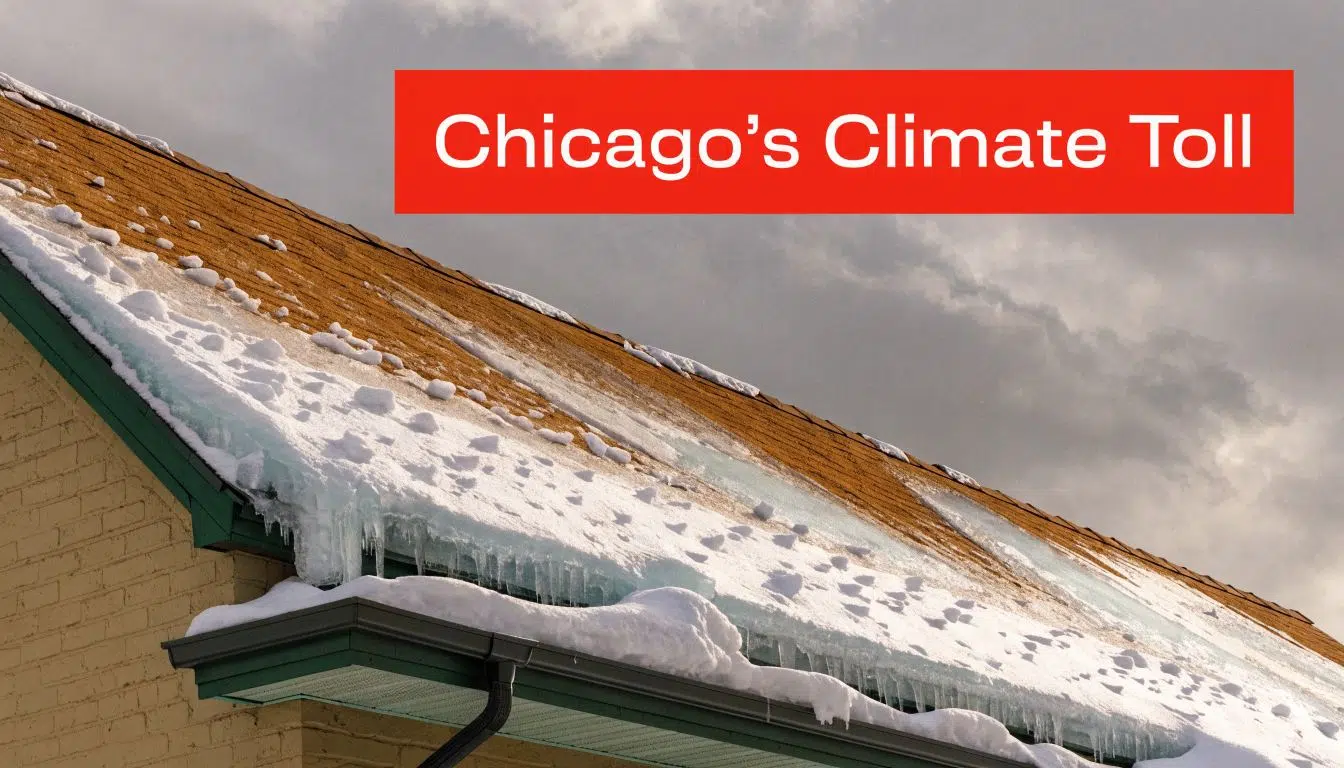
Chicago winters bring 36 inches of annual snowfall and frequent freeze-thaw cycles, which accelerate roof deterioration far beyond national averages, as noted in the verified local climate guidance provided for this topic.
Ice dams are one of the worst offenders. Snow melts on the warmer upper roof, runs down toward the cold eaves, and refreezes. That ridge of ice blocks drainage. Water then backs up under shingles that were designed to shed water downhill, not hold a shallow pond.
It's like water getting behind a raincoat zipper. The zipper still looks closed from the outside, but moisture has already found the weak point.
A roof can look decent from the street and still be taking on water under the shingles after an ice dam cycle.
Freeze-thaw acts like a slow demolition tool
Water gets into small cracks around shingles, flashing edges, nail penetrations, and masonry joints. Then temperatures drop. That water freezes, expands, and widens the opening. The next thaw lets in a little more water. The next freeze opens it further.
Over many winters, that process works like a tiny jackhammer.
Older shingles suffer the most because they’re already less flexible. Once the oils in the shingle age out and the surface loses granules, the material can’t absorb movement the way it used to. Instead of bending, it splits.
Wind and hail finish what winter starts
Chicago roofs don’t just fight cold. They also fight uplift and impact.
Wind works on lifted shingle tabs, ridge lines, and exposed edges. Hail knocks off granules and bruises the mat underneath. On an aging roof, that’s often the difference between “holding on” and “failing.”
Insurance companies know this. The verified guidance for this topic states that insurers in Illinois are increasingly scrutinizing roofs over 15 years old, often denying or heavily depreciating claims tied to wear and tear worsened by winter conditions. That means an old roof creates two risks at once. It raises the chance of damage, and it can complicate the claim after the damage happens.
Expected Lifespan for Different Roofing Materials in Chicago
Not every 20-year-old roof is in the same condition. The material matters.
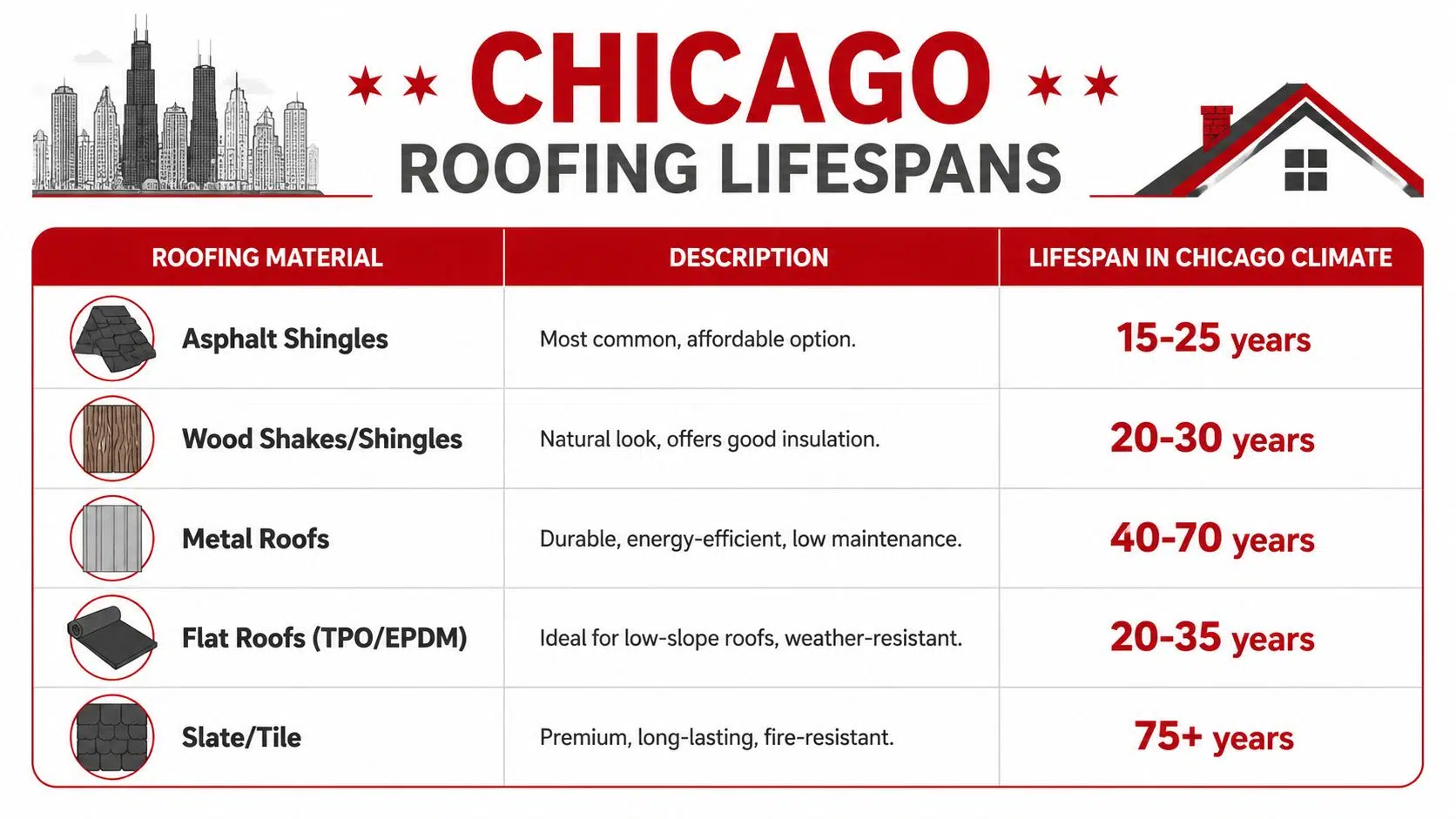
Still, most Chicago homeowners are dealing with asphalt, not slate or standing seam metal. Verified contractor data says asphalt covers over 80% of Chicago homes, and that’s why the 20-year mark matters so much in real-world conversations about replacement timing. Local contractor observations also show that while manufacturers may advertise longer timelines, standard shingles often fail by 15 to 20 years and architectural shingles usually top out around 20 to 30 years in Chicago, while metal may last 30 to 50 years and slate can last over 60 years, according to Chicago contractor observations on roofing material lifespan.
Chicago roof lifespan comparison
| Roofing Material | Realistic Chicago Lifespan | National Average Lifespan | Key Chicago Vulnerability |
|---|---|---|---|
| Standard 3-tab asphalt shingles | 15 to 20 years | Longer manufacturer claims are common, but local performance is shorter | Freeze-thaw wear, wind lift, granule loss |
| Architectural asphalt shingles | 20 to 30 years | Longer manufacturer claims are common, but local performance is shorter | Hail impact, thermal movement, aging seal strips |
| Metal roofing | 30 to 50 years | Often marketed with longer national expectations | Expansion and contraction, flashing details |
| Slate roofing | Over 60 years | Often much longer in ideal conditions | Weight, specialized repair needs, flashing integrity |
| Flat roofing systems such as TPO or EPDM | Varies by installation, drainage, maintenance, and inspection history | Varies widely | Ponding water, seam fatigue, drainage issues |
What the table means in practice
If you have a shingle roof and it’s 20 years old, you’re no longer in the “monitor it and hope” category. You’re in the “inspect it and budget with clear eyes” category.
That’s especially true if the roof has already had scattered repairs. A patch on one slope doesn’t reverse age on the rest of the system. It just buys time in one area.
For homeowners who want a broader local baseline, this guide on how long a roof should last in Chicago is a useful companion read.
Flat roofs need a different conversation
On condos, mixed-use properties, and commercial buildings, age shows up differently. Flat roofs don’t shed water like steep-slope shingle systems. They depend on membrane integrity, drainage, seams, and details around parapet walls and penetrations.
A flat roof at 20 years old might not show dramatic curling or missing tabs from the ground. Instead, the warning signs are ponding, seam stress, soft insulation below the membrane, and moisture intrusion at wall transitions. Those issues can stay hidden for a while, then turn into interior damage fast.
A Homeowners Checklist for Roof Warning Signs
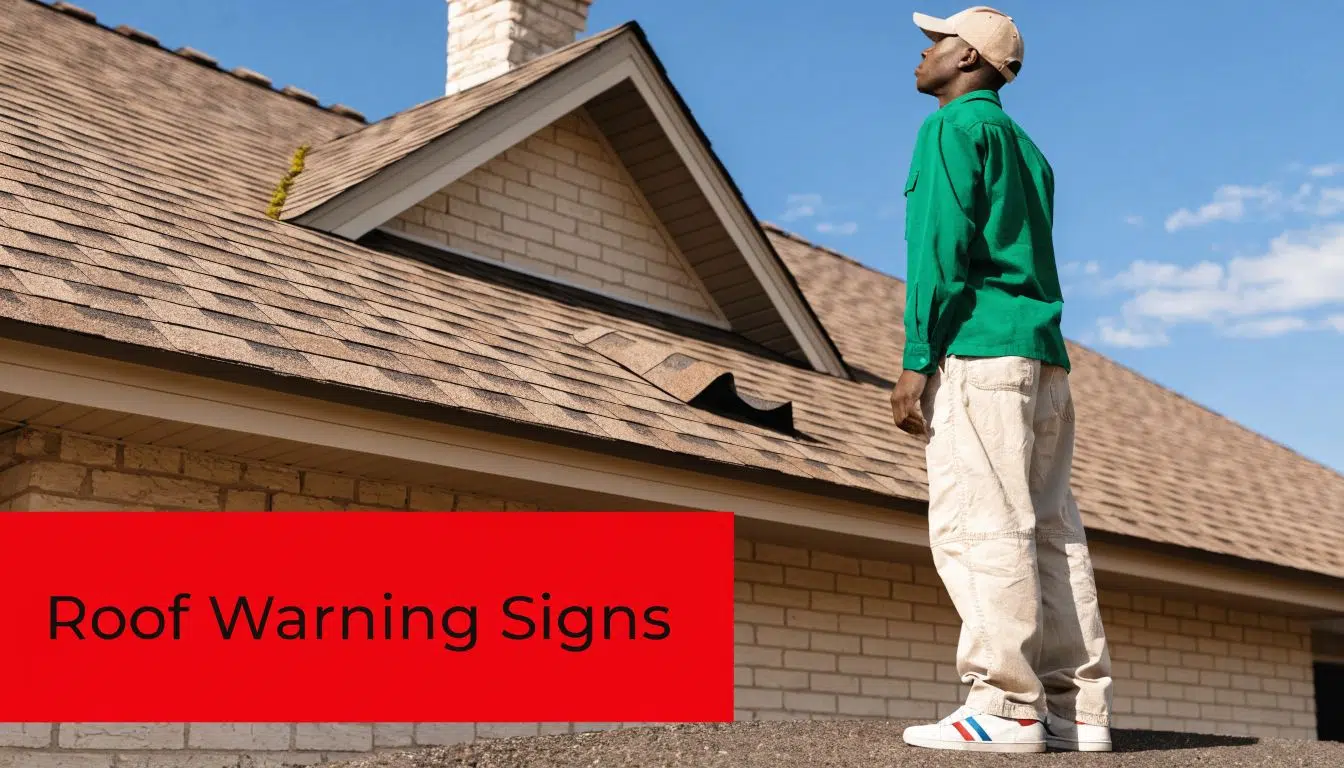
You don’t need to get on a ladder to spot many of the warning signs on an aging roof. In fact, you shouldn’t. A safe ground-level check and a quick look inside the attic or top floor often tell you plenty.
What you can spot from the ground
Walk the perimeter of the house and look at each slope from a few angles.
- Curled or clawed shingles: The edges turn up or the middle lifts. That usually means the shingles are aging out and losing flexibility.
- Cracked, missing, or slipped shingles: These leave direct openings for water and wind.
- Dark bare patches: That can mean the granules have worn off and the shingle is exposed.
- Sagging roof lines: A roof plane should read straight. A dip or belly suggests trouble below the surface.
- Debris in gutters: If you see shingle granules collecting like coarse black sand, the roof is shedding its protective layer.
What to check inside the house
A lot of roof failures announce themselves indoors first.
Look for:
- Ceiling stains: Especially after snowmelt or rain driven by wind.
- Peeling paint near exterior walls: Moisture often shows up here before a major drip starts.
- Attic dampness or staining on wood: Check the underside of the roof deck if it’s accessible.
- Musty smells on the top floor: Slow moisture problems often smell before they drip.
If a leak appears only during certain wind directions or after snowmelt, don’t assume it’s minor. Those are often the hardest leaks to trace and the easiest to underestimate.
What needs a professional inspection
Some failures hide in places homeowners can’t safely or reliably assess:
- Flashing around chimneys, vents, and skylights
- Valleys where two roof slopes meet
- Seams and terminations on flat roofs
- Parapet wall and masonry-to-roof transitions
If you’re seeing multiple warning signs, or the roof is already near the end of its expected life, it’s time to move past a visual guess. A more detailed list of aging symptoms appears in these signs you need a new roof.
Deciding Between a Major Repair and a Full Replacement
A lot of owners spend money the wrong way.
A repair makes sense when the damage is isolated and the roof still has real service life left. A few shingles blew off in a recent storm. A pipe boot failed. Flashing at one chimney pulled loose. Those are repair conversations.
A 20-year-old roof with widespread wear is different. That’s not one injury. That’s old age across the system.
When repair still makes sense
Repair is usually reasonable if the roof is otherwise sound and the problem is limited to one area.
Examples include:
- Recent storm damage on one section
- A single flashing failure
- A local puncture on a flat roof
- One isolated leak with a clear cause
In those cases, targeted work can be the right move.
When replacement is the smarter spend
If the shingles are brittle across multiple slopes, the granules are washing out, and you’ve got repeated leak history, repairs become short-term patches on long-term failure.
That’s like replacing one rotten stair tread when the whole staircase is loose. You may quiet one problem, but you haven’t restored safe performance.
For condo boards and property managers, the stakes are even higher. The verified guidance for this topic states that Chicago building code amendments effective in 2026 will mandate recertifications for flat roofs over 15 years old, and failure to comply can void insurance. It also notes a high rate of claim denials for uninspected older flat roofs. On those properties, delaying replacement isn’t just a maintenance choice. It’s a risk-management decision.
Field advice: If age-related wear shows up in several places at once, replacement usually costs less in the long run than stacking repair invoices on a roof that’s already spent.
The insurance angle matters
Older roofs often trigger harder questions from carriers. If the roof is already worn out before the storm, you may not get the clean claim outcome you were hoping for afterward.
That’s one reason documentation matters. A professional inspection gives you a current condition record. One option for that kind of evaluation is Expert Super Seal Roofing & Tuckpointing, which provides roof inspections and free estimates in the Chicagoland area. Whether you use them or another licensed contractor, the key is getting a real condition assessment before the next emergency.
Your Next Steps for an Aging Chicago Roof
Once a roof reaches this age, the worst move is doing nothing because it hasn’t leaked badly enough yet. Chicago roofs often give subtle warnings before they give expensive ones.
Step one, do a safe visual check
Start from the ground. Walk the property. Take clear phone photos of anything that looks off, especially lifted shingles, dark roof patches, sagging lines, gutter granules, and any stains inside the top floor.
Don’t try to confirm the problem by climbing up. Older roofs can be fragile, and steep slopes get slick fast.
Step two, gather your paperwork
Find out when the roof was installed, what material is on the home, and whether there have been prior repairs. If you own a condo or rental building, pull maintenance records and any older inspection notes.
This matters for budget planning, but it also matters if insurance starts asking questions. If replacement ends up being the right answer, many owners also want to know what payment options look like. This overview of roof financing options in Chicago can help frame that part of the decision.
Step three, get a local inspection before the next weather swing
A Chicago roof should be judged by someone who understands local failure patterns. Ice dam wear, parapet transitions, flat roof drainage issues, and winter-related leak paths don’t always show up in a generic checklist.
A good inspection should tell you three things clearly:
- What condition the roof is in right now
- Whether repair is still sensible or replacement is due
- What related components also need attention, such as flashing, vents, coping, masonry transitions, or drainage details
That’s how you get peace of mind. Not from guessing. From knowing.
Common Questions About 20 Year Old Roofs
Will my insurance pay to replace my old roof
Sometimes, but age alone doesn’t create coverage.
Insurance usually looks more favorably at sudden storm damage than long-term wear. If the roof is old and deteriorated, the carrier may argue that the condition existed before the weather event. That’s why older Chicago roofs often run into claim friction. A current inspection report and photo documentation help a lot.
If I only have one leak, can’t I just repair it
Maybe. It depends on why that leak happened.
One leak on a younger roof can be a straightforward repair. One leak on a 20-year-old roof may just be the first place the system finally showed its age. Water often enters in one spot and appears somewhere else, so the visible stain isn’t always the full story. If the roof has broad age-related wear, fixing one opening doesn’t restore the rest of the surface.
Are all 20-year-old roofs too old in Chicago
No. Material, maintenance, ventilation, installation quality, and repair history all matter.
But for asphalt shingles, which are the most common roofing material on Chicago homes, the 20-year mark is a serious threshold. At that age, the roof should no longer be treated as routine background maintenance. It should be treated as an asset that needs a professional decision.
If your roof is around the 20-year mark and you want a straight answer, Expert Super Seal Roofing & Tuckpointing can inspect the roof, document the condition, and explain whether repair still makes sense or whether replacement is the safer call. They’ve served Chicagoland since 1972 and handle residential, multi-unit, commercial, and industrial roofing, along with the masonry and waterproofing details that often affect how Chicago roofs fail.