You're probably doing what a lot of Chicago property owners do. You search for a roofer, find a company with strong ratings, see polished branding, and think, “This looks promising.” Then you notice the company is based in Texas, not Illinois, and the hesitation starts.
That hesitation is healthy.
A roof isn't a generic purchase, especially in Chicago. The right contractor has to understand flat roofs over multi-unit buildings, parapet walls that hold water where they shouldn't, brick movement after winter, and what happens when snow melt refreezes at the edge of a roofline. A company can be reputable and still be the wrong fit for your property.
First choice roofing and construction is a good example of why careful vetting matters. On paper, it checks several boxes. But if you own or manage a building in Chicago, the fundamental question isn't whether they're a legitimate contractor. It's whether an out-of-state contractor is the right match for your building, your code requirements, your weather exposure, and your long-term service needs.
Evaluating Contractors for Your Chicago Property
A Chicago owner in Roscoe Village, Jefferson Park, or Oak Lawn usually starts with the same filter. Are they insured? Do they have good reviews? Can they handle the roof type? That's fine for a first pass, but it's not enough for a final decision.
The problem shows up after the estimate. A contractor may know shingles, TPO, metal, or leak repair. That still doesn't tell you whether they understand local drainage details, common masonry failure points, or the permit realities that come with working on Chicago buildings. Those issues affect the job before the first tear-off starts and long after the crew leaves.
Why online reputation isn't the whole story
A strong rating can tell you a company satisfies customers in its home market. It doesn't automatically tell you how that company performs on buildings with Chicago-specific conditions. A roof in Houston and a roof in Chicago can fail for very different reasons.
In practice, I look at three things before I care much about reviews:
- Building match: Has the contractor worked on structures like yours, not just roofs like yours?
- Climate match: Do their recommendations reflect freeze-thaw cycles, snow retention, and ice backup risk?
- Service match: Can they handle the roof and the related envelope work, especially masonry details that often drive repeat leaks?
Practical rule: A contractor should make sense for your address, not just for your search results.
The first question to ask
When an out-of-state name comes up, ask a simple question: what would make them the better choice than a contractor rooted in this market?
Sometimes there's a good answer. Sometimes there isn't. But that question forces the discussion away from ratings and toward execution.
That's the frame I'd use with first choice roofing and construction. Treat them as a real contractor worth evaluating. Then test whether their strengths line up with the demands of a Chicago property.
Who Is First Choice Roofing and Construction
First choice roofing and construction is not a fly-by-night operation. Based on available company information, it was founded in 2008 and is headquartered in Tomball, Texas, serving markets that include Greater Houston, Austin, and San Antonio. It also holds an A+ BBB rating and won the Angie's List Superior Service Award in 2012, 2013, and 2014, according to this business profile on Prospeo.
Those are legitimate credibility signals. They suggest a company that has been around for years, built a recognizable brand, and maintained a visible presence in its market.
What the company appears to do well
The company presents itself as a full-service contractor for residential and commercial work. Its profile includes roof inspections, repairs, replacements, remodeling, new construction, and tenant buildouts. That breadth matters because it usually means the contractor has experience coordinating multiple scopes and handling more than basic patch work.
A broad service list can be useful for owners with mixed portfolios. If you manage single-family properties in one place and commercial buildings in another, that kind of operational range can be attractive.
Where the evaluation gets more specific
Chicago owners should focus less on whether first choice roofing and construction is credible, and more on where that credibility was built. Their reputation was built in Texas markets, with Texas labor conditions, Texas weather exposures, and Texas project types.
That distinction matters. Contractors tend to get very good at solving the problems they see every week. A Texas-based company may be excellent at selecting systems for heat, UV exposure, hail, and wind. That doesn't automatically translate to expertise in Chicago's older masonry building stock, winter leak patterns, or neighborhood-specific permit expectations.
A quick comparison helps:
| Evaluation point | What First Choice clearly shows | What a Chicago owner still needs to verify |
|---|---|---|
| Company history | Established business with a long operating history | Local track record in Chicago-area neighborhoods |
| Ratings and awards | Strong consumer-facing reputation in its home market | Recent local references for similar buildings |
| Service range | Residential, commercial, and renovation capabilities | Ability to tie roofing work to masonry and envelope issues |
| Geographic focus | Strong Texas presence | Day-to-day familiarity with Chicago conditions |
A contractor can be reputable and still be out of position for your project. Those are two different judgments.
That's the fairest way to view first choice roofing and construction. They appear to be a real and established Texas contractor. For a Chicago property owner, that's only the start of the review, not the end.
Matching Services to Chicago Building Needs
A service list can look complete and still leave major gaps for a Chicago building. That's why I never evaluate a roofer by asking only, “Do they do roofing?” I ask, “Do they solve the whole failure chain?”
First choice roofing and construction offers residential roofing, commercial roofing, renovation work, inspections, repairs, and replacements. That's a solid list. But on Chicago buildings, the roof is often only one part of the problem.
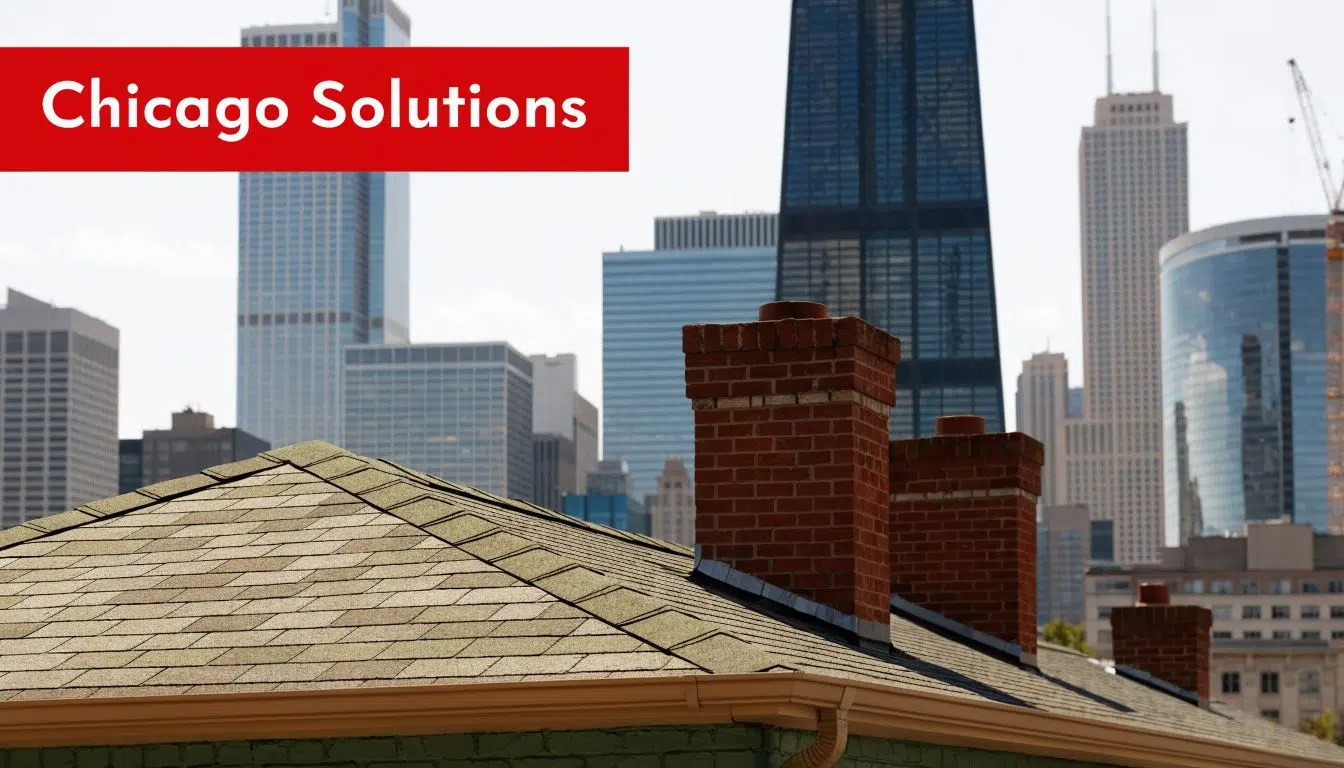
Texas roofing strengths don't automatically solve Chicago failures
First Choice emphasizes products and systems suited to Texas weather. It highlights certified installation and materials like KasselWood Steel Shingles, with a focus on Class 4 hail resistance and high wind uplift ratings for intense UV exposure and thermal cycling, as described on the 1st Choice Roofs website.
That tells me they understand weather-driven roofing performance in a hot, storm-prone climate. It does not tell me how they approach ice damming at the eaves of a Chicago home, membrane edge details on a flat roof after repeated freeze-thaw cycles, or water intrusion that starts at a parapet cap and shows up as an interior ceiling stain.
Those are different problems.
For low-slope systems in Chicago, material selection also needs to match ponding risk, rooftop equipment traffic, drainage design, and winter maintenance realities. If you're comparing membranes for a commercial or multifamily building, a practical starting point is reviewing flat roofing material options for Chicago buildings.
Chicago roofs often come with masonry work attached
Many non-local evaluations fall short in this regard. On Chicago buildings, especially older homes, two-flats, courtyard buildings, and mixed-use properties, roofing and masonry are tied together.
Common examples include:
- Parapet wall trouble: Water enters at coping joints, failed caps, or open mortar joints and gets blamed on the roof.
- Chimney deterioration: A roof replacement that ignores chimney crown damage or failing brick will leave leaks unresolved.
- Lintel and wall movement: Masonry displacement can affect flashing lines and water entry points.
- Tuckpointing needs: Roof edge and wall transitions often need masonry repair at the same time to stop recurring leaks.
A roofer who only touches roofing may fix the top layer while leaving the adjacent failure in place. That's how owners end up paying for two jobs and still dealing with one leak.
What to compare before you hire
Ask any contractor to match their service scope to your actual building condition, not just your roof type.
| Building condition | Contractor answer you want |
|---|---|
| Flat roof with ponding and a parapet | Clear drainage plan plus parapet and coping assessment |
| Shingle roof with chimney leaks | Roofing scope tied to chimney flashing and masonry review |
| Multi-unit building with recurring top-floor leaks | Envelope diagnosis, not just a shingle or membrane proposal |
| Storm damage concern | Inspection process that separates roof damage from wall and flashing failures |
If a contractor treats the roof as an isolated surface, be careful. Chicago leaks often start at the joints between trades.
That doesn't mean first choice roofing and construction can't do quality roof work. It means a Chicago owner should test whether their service model covers the full building envelope issues common here. If it doesn't, the proposal may be too narrow even if the workmanship is good.
Why Local Licensing and Warranties Matter
Many owners become casual during this phase, and that approach is a mistake. A contractor can be licensed and active in another location and still not be prepared to perform work properly in your municipality.
First choice roofing and construction reportedly holds active licenses and has a high BuildZoom score, placing it in the top 15% of Texas contractors, but its legal ability to perform work and the validity of its insurance and bonds are jurisdiction-specific and must be verified in Illinois and in the relevant local municipality, as noted on the company about page.
Licensing is local in real life, not just on paper
Owners often hear “licensed, bonded, and insured” and stop asking questions. Don't. Ask where, for what scope, and under what entity name. Then confirm that status for the city or suburb where the work will happen.
That matters because roofing projects can trigger issues involving permits, inspections, disposal rules, and trade coordination. If the project includes masonry, structural repair, or commercial work, the need for local compliance gets even more important.
Use this simple verification list before you sign:
- Ask for Illinois applicability: Confirm the contractor can legally perform the exact scope in your jurisdiction.
- Check insurance relevance: Make sure the coverage applies to work performed in Illinois, not only in the contractor's home state.
- Verify bond requirements: Some municipalities and project types require specific bond documentation.
- Match the entity name: The company name on the proposal should match the name tied to licenses and insurance certificates.
Warranties only matter if someone shows up
Owners love hearing about workmanship coverage and manufacturer-backed systems. They should. Good warranties matter. But a warranty is only as strong as the contractor's ability to inspect, respond, document, and repair.
That's where geography becomes practical, not theoretical.
If your property gets a leak during a January thaw in Lakeview, or flashing opens up after a spring wind event on the Northwest Side, how does service work? Who answers? Who comes out? How quickly can they be on the roof? If there's a dispute over whether the issue is workmanship, material, or adjacent masonry, who coordinates the fix?
Don't judge a warranty by the promise. Judge it by the service path.
Questions that expose risk fast
Here are the questions I'd ask an out-of-state contractor before relying on any warranty language:
- Who performs local warranty inspections?
- Do you have your own crews available in the Chicago area, or do you subcontract service calls?
- What happens if urgent interior leakage starts outside normal business hours?
- How do you handle warranty work when the issue involves flashing, parapets, or chimney masonry in addition to roofing?
A contractor with a physical and operational presence in the market usually answers those questions clearly. A contractor reaching into the market often answers them loosely.
That difference becomes very expensive when the roof problem is urgent.
Your Contractor Vetting Checklist
Most owners don't need more roofing jargon. They need better questions.
The biggest mistake I see is letting the contractor control the interview. The homeowner or property manager should lead it. That doesn't mean being adversarial. It means asking the questions that reveal whether the company can handle your building, your budget concerns, and your service expectations.
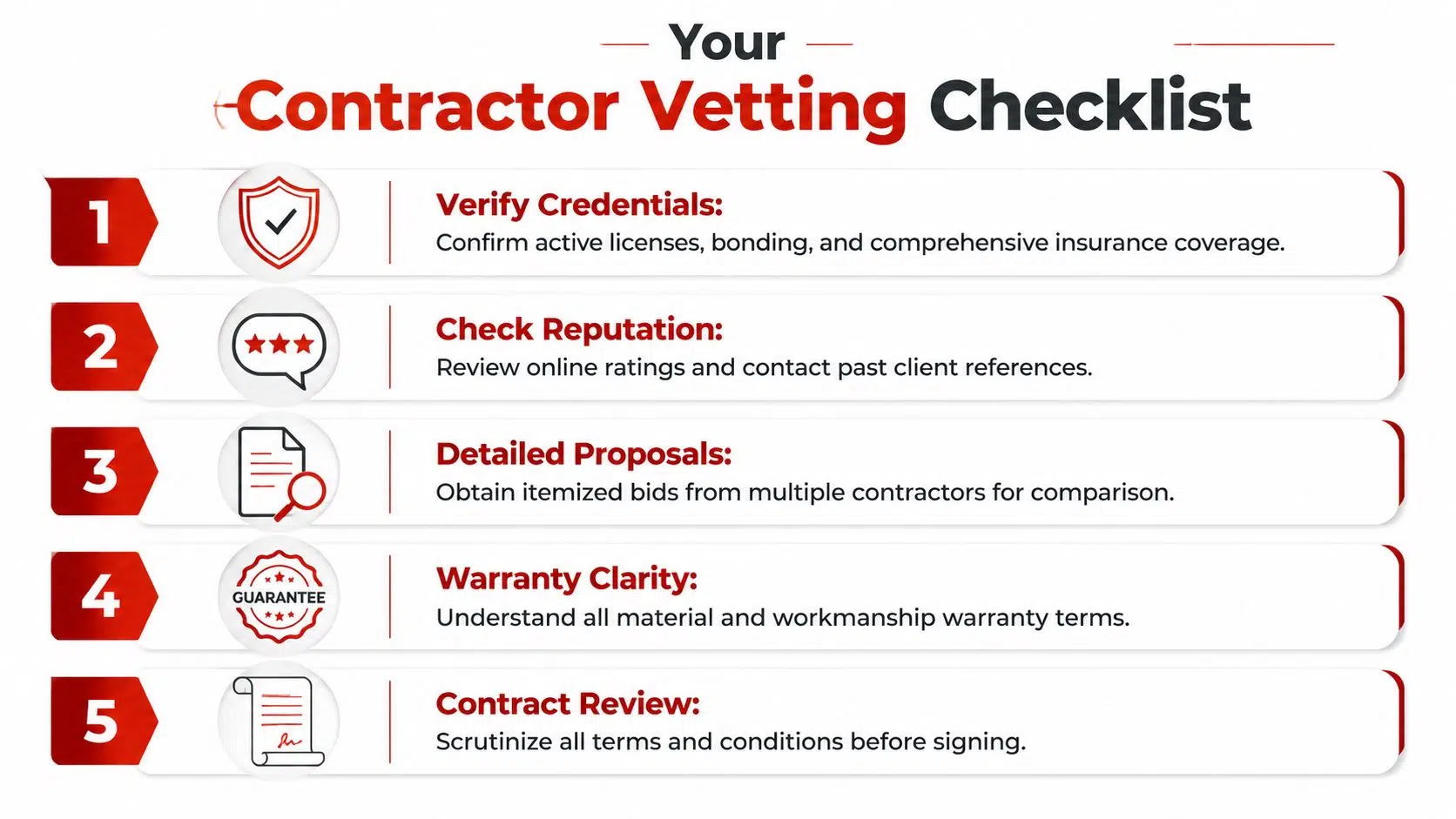
One issue deserves attention right away. A major content gap for many contractors is pricing transparency. 73% of homeowners delay roofing decisions due to cost uncertainty, according to the discussion on First Choice Roofing's contact-related pricing gap page. That means your checklist has to press for itemization, allowance clarity, and financing terms before the contract stage, not after. If you're weighing payment options, it helps to review how roof financing typically works before estimates come in.
Ask for neighborhood-level proof
Don't settle for “we do work all over.” Ask for examples that resemble your own property.
- Request nearby project history: Ask for completed jobs in your neighborhood or in areas with similar building stock.
- Match project type: A suburban shingle replacement doesn't prove competence on a Chicago flat roof with parapets.
- Look for relevant details: Ask what problems came up on those jobs and how the contractor solved them.
A strong answer sounds specific. A weak answer stays broad.
Force clarity on the proposal
A roofing estimate should do more than state a lump sum and a material name. It should make the scope understandable enough that you can compare bids accurately.
Ask questions like these:
| Question | Why it matters |
|---|---|
| What exactly is included in tear-off and disposal? | Hidden exclusions often show up here |
| Are flashing details described clearly? | Vague flashing language leads to disputes |
| Is decking replacement handled as an allowance or separate charge? | Owners need to know how surprises are billed |
| Are masonry or chimney issues included, excluded, or noted for separate repair? | This is where many leak jobs break down |
| What is the payment schedule? | You want predictable terms, not improvisation |
A clean proposal is a sign of a disciplined contractor. Confusing paperwork usually leads to confusing accountability.
Test emergency response and winter readiness
Chicago roofing isn't only about installation. Service matters, especially in bad weather.
Ask these directly:
- Sunday emergency calls: Who answers and what's the process if active leaking starts during a storm?
- Winter conditions: Do they handle temporary protection when full repair isn't immediately practical?
- Snow and ice issues: Can they explain how they approach ice dam risk, drainage blockage, and rooftop access?
- Occupied buildings: What's their plan for tenant communication and interior protection?
These answers tell you how the company performs under pressure, not just during a sales appointment.
Check how they handle storm and insurance questions
This is another area where many contractors stay vague. That's a red flag. A serious contractor should be able to explain how they document visible damage, what they provide to support a claim, and where their role starts and stops when dealing with adjusters.
For Chicago owners, I'd ask:
- What does your storm inspection report include?
- How do you distinguish roofing damage from flashing or masonry-related water entry?
- Will you meet with the adjuster if needed?
- How do you document conditions on multifamily or commercial properties with multiple elevations?
Finish with one blunt question
Ask, “What kind of building are you not the best fit for?”
Good contractors answer that candidly. They'll tell you if a property needs heavy masonry restoration, complex low-slope detailing, or local permit fluency beyond their normal lane. That answer often tells you more than the sales pitch.
Next Steps for Your Chicago Roofing Project
First choice roofing and construction appears to be a credible contractor in its home market. That matters, and it's fair to say. If your property were in the Texas areas they actively serve, their history, certifications, and reputation would make them worth considering.
For a Chicago property, the standard should be higher and more specific.
The safest decision is usually the most local one
Chicago roofs don't fail in isolation. They fail where roofing meets brick, coping, chimneys, drains, flashing, and winter weather. That means your contractor should know not just roofing systems, but Chicago building behavior.
A top-tier local contractor should also be able to explain storm damage documentation and coordination with insurance adjusters, especially in a region where hail, wind, and ice dams drive thousands of claims annually, as discussed on First Choice Roofing's storm damage content gap page. And before you even request final proposals, it helps to understand what a new roof typically costs in Chicago so you can judge bids against local expectations.
What I'd prioritize from here
If you're deciding between an out-of-state contractor and a Chicago-based one, use a short filter:
- Local legal readiness: Can they work compliantly where your property sits?
- Chicago building knowledge: Do they understand flat roofs, parapets, chimneys, and winter water behavior?
- Integrated service capability: Can they address masonry-related leak sources, not just the roof covering?
- Reliable follow-through: Will they still be practical to reach when service is needed fast?
That framework usually makes the decision clearer.
The best contractor for your building is the one whose daily work already looks like your property.
A Texas contractor may be strong at Texas work. For a Chicago homeowner, landlord, condo board, or facility manager, the safer move is usually a contractor with deep roots in this market, a real grasp of local building conditions, and the ability to solve roof and masonry issues together.
If you want a second opinion from a contractor that knows Chicago buildings from the roofline down to the brickwork, contact Expert Super Seal Roofing & Tuckpointing. Their team serves Chicagoland with roofing, tuckpointing, chimney, parapet wall, and waterproofing expertise, which is exactly the kind of integrated local support many city properties need.