Yes. In Chicago, a metal roof typically costs $10 to $18 per square foot installed, while architectural shingles usually run $5 to $8 per square foot. On a 2,000-square-foot home, that’s about $20,000 to $36,000 for metal versus $10,000 to $16,000 for shingles.
That sticker shock is what sends a lot of homeowners and condo boards down the same path. Two quotes land on the table, one is manageable, the other feels like it belongs to a different building. The mistake is stopping there. The first invoice matters, but it doesn’t tell you what that roof will cost you over the next few winters, the next ownership cycle, or the next round of HOA budgeting.
In Chicago, roofing decisions get punished fast when they’re made on price alone. Snow sits. Ice dams back water up. Wind attacks edges and flashing. Freeze-thaw movement finds every shortcut. A roof that looked cheaper on day one can become the more expensive option once repairs, earlier replacement, and repeated disruption start stacking up.
The Real Answer to the Metal vs Shingle Cost Question
A Chicago homeowner in a bungalow or a property manager looking at a two-flat usually asks the same thing in a different way: “Why is this metal quote so much higher?” The short answer is simple. Metal is a premium system. It costs more to buy, more to detail, and more to install correctly.
But “are metal roofs more expensive than shingles” isn’t really a one-line pricing question. It’s a time-horizon question. If you’re planning to move soon, your answer may be different than someone who expects to own the building for decades. If you manage a condo association, the answer changes again because repeated tear-offs, resident disruption, and reserve planning matter just as much as the initial contract amount.
Here’s the practical way to look at it:
| Roofing type | Typical installed cost | Typical 2,000 sq ft roof cost | Best fit |
|---|---|---|---|
| Metal roof | $10 to $18 per sq ft | $20,000 to $36,000 | Long-term ownership, harsh exposure, owners who want durability |
| Architectural shingles | $5 to $8 per sq ft | $10,000 to $16,000 | Lower upfront budget, shorter ownership timeline, simpler replacement |
The bigger quote doesn’t automatically mean the better decision. I’ve seen plenty of properties where shingles were the right call because the owner needed a solid, dependable roof without stretching capital. I’ve also seen buildings where choosing shingles again was just kicking a more expensive problem down the road.
Practical rule: If you only compare the contract price, shingles usually win. If you compare decades of ownership in Chicago weather, the answer gets more complicated.
That’s where most national articles fall short. They talk about roofing like every house sits in mild weather and every owner has the same goals. Chicago roofing doesn’t work that way.
Breaking Down the Upfront Installation Cost
A Chicago owner usually feels the price gap before anything else. On paper, asphalt shingles are still the cheaper contract. Installed pricing for metal often runs $10 to $18 per square foot, while architectural shingles usually fall around $5 to $8 per square foot, according to Pitch Roofing’s metal roof vs. shingles cost breakdown. On a 2,000-square-foot roof, that puts metal at roughly $20,000 to $36,000 and shingles at $10,000 to $16,000.
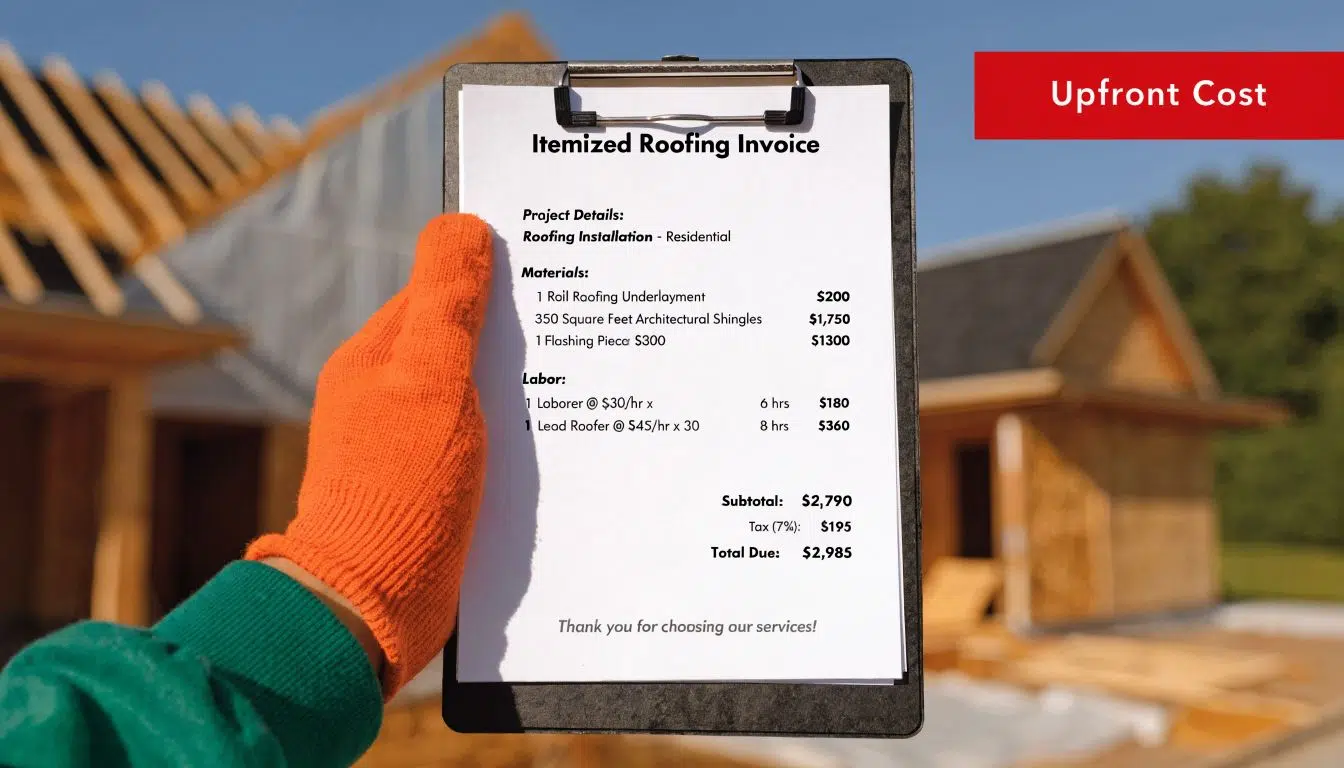
Chicago projects often come in higher than national ranges. Labor costs are steeper here, tear-off and disposal are rarely simple on older housing stock, and multi-unit buildings can add staging, access, and coordination costs that a national average does not capture. Pitch Roofing notes Chicago pricing can run 10 to 20 percent higher than broader market averages. If you want a local baseline before reviewing bids, compare those numbers against typical new roof costs in Chicago.
Why metal costs more on materials
Material category matters more than many owners expect. “Metal roof” can mean exposed-fastener corrugated panels, stamped metal shingles, or a standing seam system with concealed fasteners. Those are different products with different price points, and they should not be lumped together in the same mental budget.
The same source lists these common installed ranges:
- Standing seam metal: $10 to $16 per sq ft
- Metal shingles: $8 to $14 per sq ft
- Corrugated metal: $4 to $7 per sq ft
- Architectural shingles: $5 to $10 per sq ft
- 3-tab asphalt shingles: $3 to $6 per sq ft
That spread matters in Chicago. A homeowner in a bungalow neighborhood may be comparing architectural shingles to metal shingles for curb appeal. A condo board on a low-slope overbuild may be looking at standing seam because it sheds snow more cleanly and holds up better at details. Those are not the same buying decisions.
Pitch Roofing also notes that metal type changes cost. Steel sits in the practical middle for most residential work, while premium metals like copper move the project into a different budget class. For most Chicago-area properties, the main comparison is architectural shingles versus painted steel systems.
Why labor widens the gap
Labor is where the estimate separates fast.
Shingles go on with larger crews, simpler layout, and more familiar flashing details. Metal takes more setup, tighter measurements, cleaner substrate conditions, and installers who know how to handle panel alignment, trim sequencing, penetrations, and movement from expansion and contraction. A crew can make a shingle roof look acceptable while hiding small mistakes. Metal is less forgiving, especially around chimneys, skylights, parapet walls, and the odd framing conditions you see on older Chicago homes and six-flats.
Modernize’s cost guide for metal roofing puts installed metal roofing at roughly $7 to $18 per square foot, depending on system and material. That tracks with what owners see in the field. The premium usually reflects more skilled labor, longer install time, and more accessory metal at edges and transitions, not contractor padding.
For condo associations and multi-unit buildings, labor costs can climb even faster. Crew access, protection of landscaping and parked cars, stricter debris handling, and resident communication all add real hours. On a simple single-family ranch, the difference between shingles and metal may look straightforward. On a courtyard building with limited access and heavy winter exposure, the upfront gap can widen quickly.
A Head-to-Head Performance and Durability Comparison
Price gets attention first. Performance decides whether the roof keeps paying you back or keeps coming back for repairs. In Chicago, that matters more than it does in a mild climate because roofs here deal with wind, snow load, ice buildup, sun exposure, and repeated freeze-thaw cycles.
Here’s the side-by-side view.
| Performance factor | Metal roof | Shingle roof |
|---|---|---|
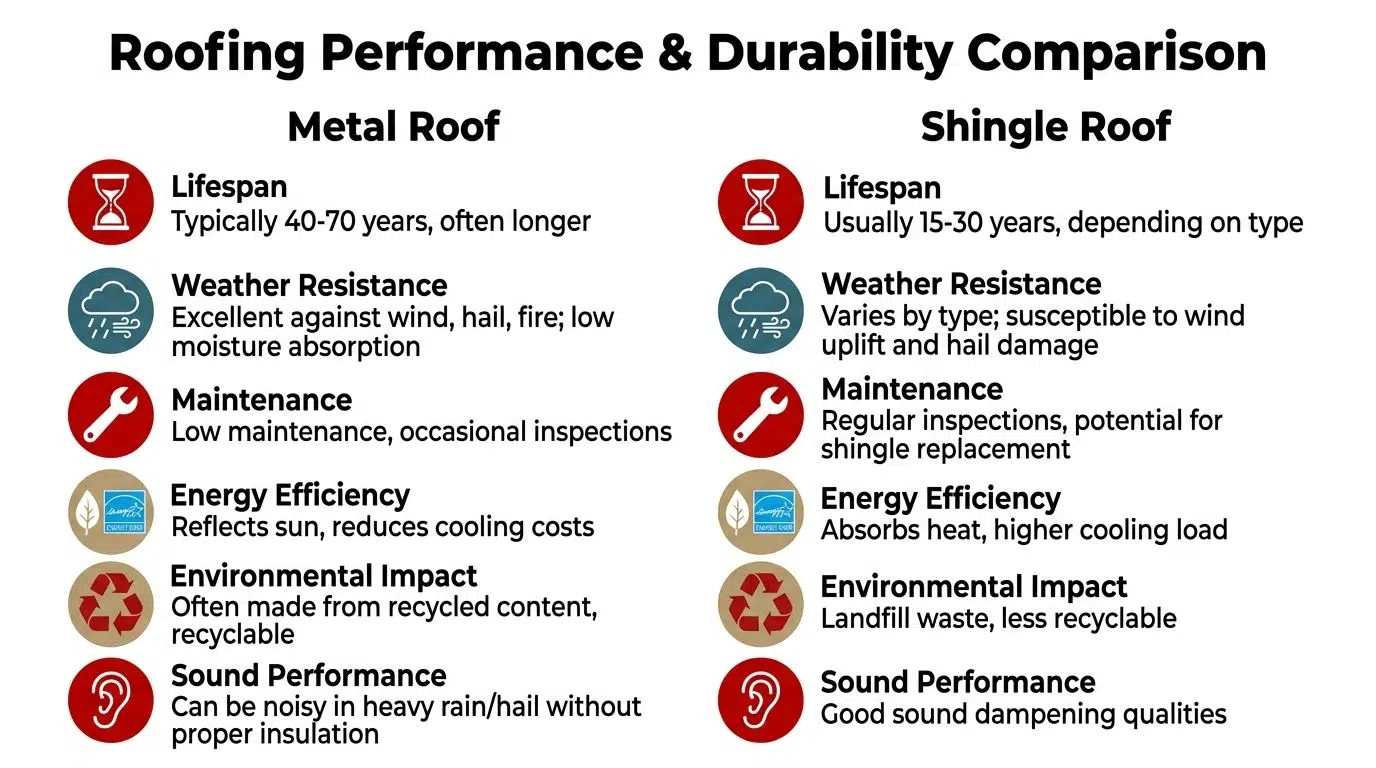
| Lifespan | 40 to 70+ years | 15 to 30 years |
| Wind resistance | Exceeds 140 mph | Around 110 mph |
| Maintenance pattern | Lower routine maintenance, but details must be correct | Easier small repairs, but more wear over time |
| Freeze-thaw handling | Better long-term durability in hard climates | More vulnerable to cracking and surface wear |
| Noise | Can sound louder in heavy rain or hail without proper assembly | Generally quieter by default |
Lifespan and wind exposure
The biggest physical advantage for metal is service life. The verified comparison from Worthouse places metal at 40 to 70+ years and shingles at 15 to 30 years, with metal also rated for 140+ mph winds versus about 110 mph for shingles in the same source. If you want more local context on expected roof service life, this Chicago roof lifespan guide is a useful companion.
That doesn’t mean every metal roof reaches the high end automatically. Installation quality still controls the outcome. A badly detailed standing seam roof can fail early just like a badly installed shingle roof. But when both are installed correctly, metal has a much longer runway.
Chicago winters expose the difference
Shingles take a beating in freeze-thaw conditions. Granules loosen. Tabs can crease or tear in wind. Repeated thermal movement can open up weak points around penetrations and transitions. On older Chicago homes with dormers, chimneys, and complicated valleys, those weak points add up.
Metal handles those cycles better, especially on buildings that see regular snow accumulation and hard winter exposure. Its smoother surface helps snow shed more readily, which can reduce the amount of time moisture sits on the roof. That can help with ice dam pressure in the right roof design, though it doesn’t magically solve ventilation or insulation problems by itself.
Good roofing in Chicago starts below the outer surface. If the attic, ventilation, and flashing details are wrong, either system can disappoint.
Repairs and upkeep aren’t the same thing
Shingles are easier to patch in small sections. If a few tabs blow off or a localized repair is needed, the repair process is straightforward and most roofers handle it routinely. That’s one reason shingles remain a practical choice for many owners.
Metal is different. Routine upkeep tends to be lower over time, but repairs are more system-specific. Matching panel profile, finish, seam type, and trim detail matters. On exposed-fastener systems, maintenance may involve fastener adjustments. On standing seam systems, the repair work needs a contractor who understands that profile.
A practical comparison:
- For easy spot repairs: shingles usually win.
- For lower wear over long ownership: metal usually wins.
- For complicated roofs with many penetrations: the installer matters more than the material.
- For basic sloped roofs in harsh exposure: metal often holds up better.
What works and what doesn’t
Metal works well when the system is matched to the building. Standing seam on a long-term residence or multi-unit building makes sense. Cheap panel work on a visually prominent front slope often doesn’t.
Shingles work well when budget control matters and the owner accepts a shorter service life. They don’t work well when someone expects premium longevity from an entry-level replacement.
The wrong decision usually isn’t “metal” or “shingles.” It’s expecting one to behave like the other.
Calculating the True Lifetime Value and Return on Investment
A Chicago owner who keeps a building for 20 years is not buying the same roof as someone planning to sell in 5. That is where the metal-versus-shingle math usually gets distorted.
Metal usually costs more on day one. Over a long hold period, that higher first cost can be offset by fewer replacement cycles, less disruption, and lower exposure to future material inflation. That matters more in Chicago than in mild climates because tear-offs, winter leak calls, and repeat capital projects are expensive on older homes, two-flats, and multi-unit buildings.
Where the return actually comes from
The biggest financial gain is usually simple. You may buy one metal roof during the time another owner buys two shingle roofs.
That does not make metal the automatic winner. It makes it a long-hold asset.
For an owner-occupied house, the payoff depends on how long you stay, how much cash you want tied up now, and whether you care more about lowest initial price or fewer major projects later. For a landlord, HOA, or condo board, the equation is broader. Repeat replacements mean new mobilization costs, new dumpster and tear-off costs, more resident disruption, and another round of reserve planning or special assessments.
Energy savings can help, but I would not sell a Chicago client on metal based on cooling alone. Our summers matter, especially on top-floor units and low-slope sections with strong sun exposure, and 2025 rebates for qualifying cool-metal roofs can improve the numbers on some projects. Still, the larger financial case is usually durability and replacement timing, not a dramatic utility-bill drop.
Why boards and landlords look at this differently
Multi-unit buildings force a more disciplined cost analysis. A 6-unit condo association does not just compare roof quotes. It has to compare reserve pressure, financing options, disruption to residents, and the risk of having to do the job again before the current owners are gone.
Metal Construction Association explains in its metal roofing lifecycle cost overview that lifecycle cost often changes the comparison because longer service life can narrow the gap between a higher upfront price and lower-cost systems that need replacement sooner. In practice, that matters even more in Chicago, where shingle prices have climbed, labor is not getting cheaper, and many buildings have parapets, valleys, dormers, or ventilation issues that make every future replacement more expensive than the last one.
If you are reviewing how a major roof project may be treated from a tax standpoint, this Illinois roof replacement tax deduction overview is a useful starting point.
A roof can stabilize capital planning for years, or force the same painful budget decision again on the next board.
The comparison that gives owners the wrong answer
A lot of estimates compare premium metal against a standard architectural shingle and stop there. That is only a price comparison. It is not an ownership comparison.
The better question is narrower and more useful: what will this roof cost your household, rental, or association over the time you expect to own the property?
For a short ownership window, shingles often remain the practical choice. For a long-term hold, especially on a Chicago building where another tear-off 15 to 20 years from now will almost certainly cost more than owners expect, metal can shift from "too expensive" to "priced upfront."
Unique Roofing Considerations for Chicago Properties
Chicago changes the metal-versus-shingle discussion because our buildings and weather are harder on roofs than generic national guides admit. A ranch in a mild climate is not the same as a brick two-flat on a windy street, a condo building with aging attic ventilation, or a home that deals with drifting snow on one side every winter.
Snow loads and ice dams
Metal’s slicker surface can help snow move off the roof more readily than shingles. That can be a real advantage on some Chicago-area properties, especially where snow tends to sit and refreeze. But owners should hear the full truth: material alone doesn’t fix ice dams.
Ice dams usually point to a system problem. Heat loss from the building warms the roof deck, snow melts, and water refreezes at colder edges. If insulation, ventilation, air sealing, and flashing aren’t right, you can still have trouble with either roofing material.
For Chicago buildings, the smart approach is:
- Check attic and roof assembly conditions before choosing the outer roof covering.
- Review drainage paths and edge details so melting snow has a clean exit.
- Match the roof type to the building geometry instead of forcing one material onto every slope and transition.
Why condo and HOA boards should look beyond bid day
Multi-unit buildings feel the pain of repeated roof work more than single-family homes do. Residents deal with access issues, noise, leaks, and assessments. Boards deal with reserve pressure and deferred maintenance history.
According to this Chicago-focused guide on metal roofs versus shingles for multi-family properties, metal roofs in Chicago’s multi-family market can increase resale value by 20 to 40% and may qualify for 2025 state rebates for cool-roof installations that reduce effective cost by 10 to 15%. The same source says asphalt shingle costs have risen 15 to 20% due to supply chain issues, which makes metal more competitive than many boards expect.
That’s especially relevant for condo associations trying to avoid the cycle of “replace with the cheapest option, then assess again later.”
What works well on Chicago building types
Different properties call for different answers.
- Brick bungalows and older single-family homes: Shingles still make sense when budget is tight and the owner needs a solid replacement without premium material cost.
- Long-hold rentals and two-flats: Metal becomes more attractive when owners want fewer major exterior projects over time.
- Condo buildings and HOAs: The ability to spread a longer-lived investment across the building can make the premium easier to justify.
- Buildings with chronic winter trouble spots: A roof upgrade should be paired with insulation, ventilation, and flashing corrections, not treated like a cosmetic material swap.
On Chicago properties, the roof covering is only one part of the weather-defense system. The details around it decide whether the investment pays off.
One more local reality. Older building stock often has chimneys, parapets, valleys, and tie-ins that punish sloppy workmanship. If the roof has complex transitions, don’t buy based on material alone. Buy based on whether the installer understands Chicago building conditions.
When a Metal Roof Is Worth the Premium
Metal is worth the premium when the ownership plan is long, the weather exposure is harsh, and the owner wants fewer replacement cycles. That’s the cleanest answer.
For a forever-home owner, metal is usually a strong fit. You pay more now, but you’re buying a roof system built for a much longer service life. If you don’t want to revisit full replacement in the same ownership period, that matters.
For a condo board tired of recurring assessments, metal often makes sense if reserves, financing, and building design support it. A bigger project that lasts longer can be easier to defend than another lower bid that restarts the same conversation years later.
For a landlord holding property long term, metal can be attractive because it reduces the chances of repeated major capital disruption. That doesn’t eliminate maintenance. It does reduce the pattern of replacing the whole roof system as often.
Shingles remain the better choice in several common situations:
- You need the lowest upfront cost: shingles are usually the practical answer.
- You expect to sell relatively soon: the full long-term value of metal may not come back to you in time.
- The roof needs a straightforward replacement on a tighter budget: shingles can deliver reliable performance when installed well.
- Future spot repairs matter more than maximum lifespan: shingles are simpler for many small repair scenarios.
The best decision is tied to ownership strategy
A roof isn’t just a material choice. It’s a financing and planning choice.
If you want the lowest immediate number, shingles win. If you want a roof built around long-term cost control, metal often wins. If the building has design complications, winter moisture issues, or board-level budgeting concerns, the answer depends on whether the full roof assembly is being corrected or just re-covered.
That’s the part many owners miss. The right roof is the one that fits the property, the budget, and the amount of time you plan to live with the decision.
Frequently Asked Questions About Roofing Costs
Does a metal roof lower homeowners insurance in Illinois
Sometimes, but it depends on the insurer and the specific roof system. Some carriers may look favorably at more durable roofing materials, but you should ask your agent before treating that as savings in your budget.
Is a small metal roof repair more expensive than a shingle repair
Usually, yes. Shingle repairs are typically simpler and easier to match. Metal repairs often require a contractor familiar with the exact panel type, seam detail, and trim configuration.
Can you install metal over old shingles to save tear-off cost
Sometimes, but only if the existing roof, decking, ventilation setup, and local code conditions allow it. It’s not an automatic shortcut. On many Chicago homes, a full tear-off is the better way to inspect the deck and fix hidden trouble before a new system goes on.
Which roof is better for a condo building
For many long-held condo properties, metal can make a strong long-term case because it may reduce repeat replacement cycles and can align better with reserve planning. But the board still has to weigh structure, design, budget, and resident impact.
If you’re weighing bids and want a straight answer based on your building, not a generic sales pitch, Expert Super Seal Roofing & Tuckpointing can help. Their Chicago team has served the area since 1972 and handles residential, multi-unit, commercial, and industrial roofing with the kind of local experience that matters when snow, ice, wind, and older building details are part of the job.