
No. A properly installed and maintained roof should not leak in heavy rain in Illinois, even though the state averages 38 to 42 inches of annual precipitation and sees intense spring and summer storms. If water is getting inside, the leak is a symptom of damage, wear, or a weak point that Illinois weather has been working on for a while.
If you are reading this while listening to a drip hit a bucket, or while staring at a fresh brown ceiling stain, the stress is real. Homeowners often do not care how a roof system works until it stops working. Then every minute feels expensive.
In Chicago and the surrounding suburbs, this problem is common enough that people start asking the wrong question. They ask whether it's normal. The better question is why it happens so often here, and what you should do next.
Illinois roofs take a beating from hail, freeze-thaw movement, wind-driven rain, ice dams, and big seasonal swings. A leak during a storm usually means one part of the system has already failed. The good news is that leaks follow patterns. Once you know those patterns, the panic eases and the decision-making gets clearer.
Why Your Roof is Leaking During a Storm
The usual scene goes like this. A storm rolls in after dark, the rain gets louder, then you hear a tap on the floor or see water crawling down a wall near a window, chimney, or ceiling light. You put down a bucket, grab towels, and wonder whether this is just part of owning a home in Illinois.
It isn't normal for a sound roof to do that.

A roof leak in heavy rain is like a fever. The water you see is the symptom. The actual problem is the damaged shingle, failed flashing, cracked vent boot, backed-up drainage path, or hidden storm damage above it. The water may show up in one room while the opening is several feet away.
Practical rule: If water is entering during a storm, assume the roof assembly has a failed component. Don't assume it will dry out and solve itself.
Why people get confused about "normal"
Illinois homeowners see this often enough that it starts to feel routine. Older housing stock in the Chicago area adds to that impression. So do roofs that survived one storm season but lost some of their protection in the process.
What makes this frustrating is that many leaks don't begin the day damage happens. The roof can take a hit, keep looking mostly fine from the ground, and then fail later under pressure. That's why some owners swear the leak came out of nowhere.
What the leak is really telling you
When a roof leaks during heavy rain, it usually means one of three things:
- Water found an opening: A seal, shingle edge, flashing joint, or penetration failed.
- Water was pushed where it doesn't belong: Wind-driven rain can move uphill, sideways, and under components that look intact.
- Water couldn't drain fast enough: Gutters, valleys, flat sections, or low-slope areas may be holding or backing up water.
You don't need to diagnose the exact failure from inside the house tonight. You do need to treat the leak as a real defect, not a harmless annoyance.
How Illinois Weather Triggers Roof Leaks
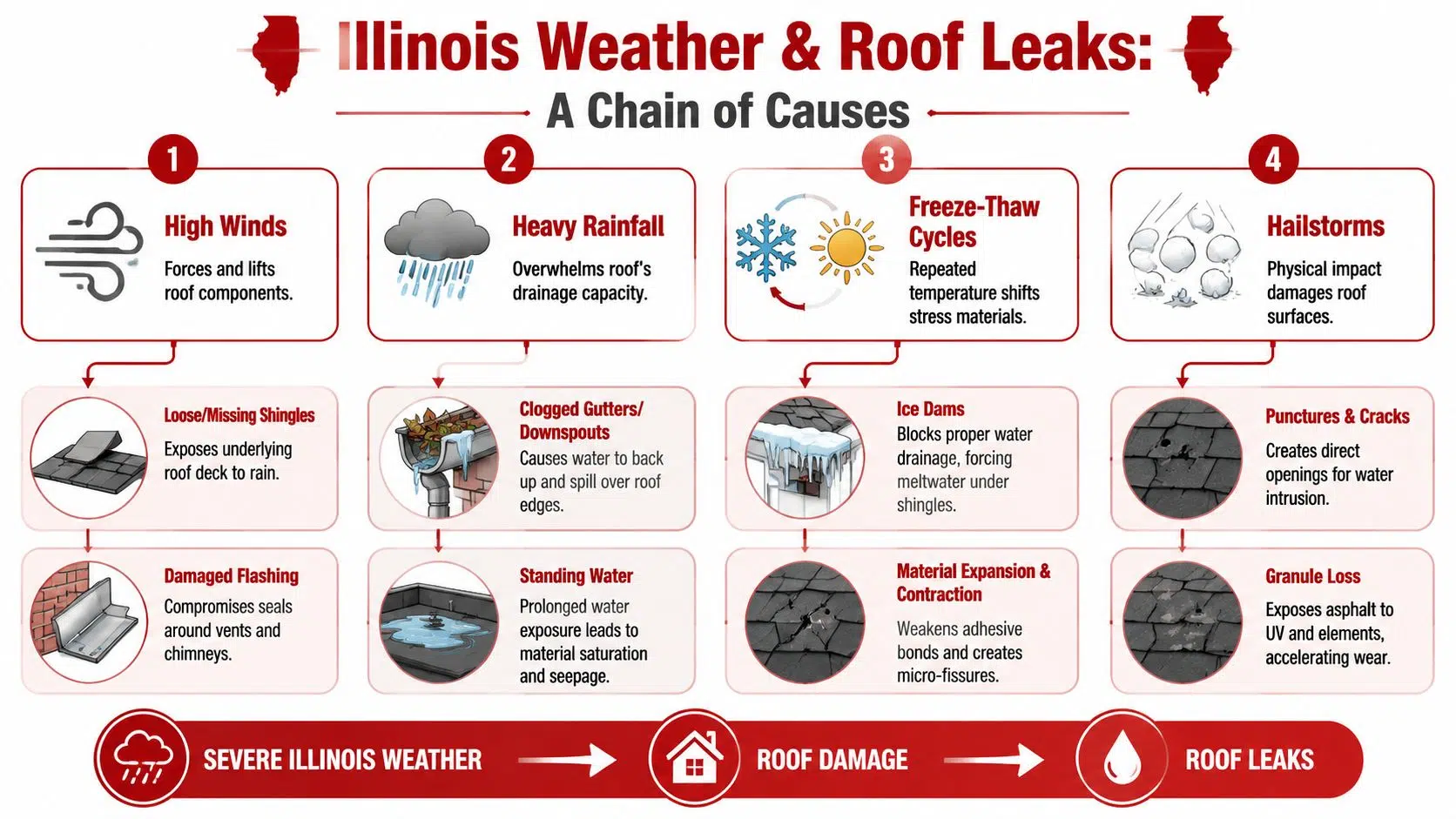
Illinois doesn't damage roofs in one simple way. It works them over season by season. That matters because generic roofing advice often treats a leak as a single bad shingle or one sloppy repair. Around Chicago, the climate itself is part of the failure chain.
Hail damage doesn't always leak right away
Illinois ranks #4 in the Top 10 States for Hail Claims, with $225 million in hailstorm roof damage claims in 2022, according to this Illinois hail damage overview. That's not abstract. Hail knocks granules off shingles, bruises the mat underneath, and creates tiny fractures that may hold for a while, then open up during the next hard rain.
A lot of owners expect hail damage to look dramatic. Sometimes it does. Sometimes it doesn't. A roof can look decent from the driveway and still be carrying enough impact damage to fail later under sustained rain.
If you've had a recent storm and want to understand what that kind of weather does to local roofing systems, this guide on the impact of severe storms on Chicago roofs is worth reading.
Freeze-thaw opens small weaknesses into real leaks
Water gets into tiny cracks. Then winter temperatures drop, the water freezes, and the material gets forced apart. That cycle repeats again and again.
Roof materials act much like a small split in a sidewalk that expands every winter. Shingles, flashing joints, sealants, and masonry-adjacent roof areas all shift. In Illinois, they move a lot.
This is why a roof that looked "fine enough" in fall can start leaking by late winter or during spring rain. The weather finished what the earlier wear started.
A roof in Illinois doesn't just need to shed water. It has to survive impact, movement, expansion, contraction, and backed-up meltwater.
Ice dams and wind-driven rain create sneaky leak paths
Ice dams are especially deceptive. Snow melts from heat loss, runs down the roof, refreezes at the colder edge, and traps more water behind it. That trapped water can push back under shingles where the roof was never meant to hold standing water.
Heavy storms add another problem. Wind-driven rain doesn't fall straight down like it does in product brochures. It gets pushed into laps, joints, around chimneys, and under lifted shingle tabs. Once one vulnerable point opens, the storm does the rest.
The hard truth is simple. In Illinois, a roof isn't judged by how it handles a calm rain. It's judged by how it handles repeated abuse.
Pinpointing the Most Common Leak Sources
If you want to understand is it normal for a roof to leak in heavy rain in Illinois, start by looking at the weak points. Roofs rarely fail in the middle of a broad, perfect field of material. They fail at transitions, penetrations, edges, and details.
The most frequent culprit most people never inspect
Pipe boot failure is the most common leak source, affecting 30 to 40% of service calls in Midwest climates, according to this breakdown of heavy-rain roof leak causes. These rubber seals wrap around plumbing vents, and they crack from UV exposure and thermal cycling. In practical terms, they often fail before the surrounding roof does.
They usually don't announce themselves with missing pieces you can spot from the street. They dry out, split, and let water wick inward during wind-driven rain. That's why a leak can show up around a bathroom, hallway, or top-floor closet even when the shingles still look serviceable.
Other places roofs commonly open up
Flashing is next on the suspect list. Anywhere the roof changes direction or meets another surface, metal flashing and sealant have to do precise work. Chimneys, valleys, skylights, dormers, walls, and vent penetrations all create leak opportunities.
Then there are the field issues. Shingles can crack, lift, lose adhesion, or get damaged by storms. Flat and low-slope roofs can hold water if drainage is poor. Gutters can back water up onto roof edges. None of these problems are mysterious once you know where to look.
From the ground, safely, these are the clues that matter:
- Around vent pipes: Cracked rubber collars, crooked boots, or staining in rooms near plumbing stacks.
- At roof-to-wall areas: Water stains near exterior walls, peeling paint, or visible flashing separation.
- In valleys: Concentrated wear, debris buildup, or repeat leaks during harder rain.
- Along eaves and gutters: Overflow, icicle history, or staining near soffits after storms.
- On flat roof sections: Persistent damp areas, interior drips after long rain, or bubbling on ceiling finishes.
Common Roof Leak Sources and Urgency
| Leak Source | What to Look For | Urgency Level |
|---|---|---|
| Pipe vent boot | Cracked rubber around plumbing vent, leaks near bathrooms or hallways | High |
| Flashing around chimney or walls | Ceiling stains near masonry, visible gaps, recurring leaks in the same spot | High |
| Damaged or lifted shingles | Missing tabs, uneven roof lines, leaks after wind-driven rain | High |
| Valley failure | Leak during prolonged rain, debris collecting in roof valleys | High |
| Clogged gutters or downspouts | Overflow at edges, water backing near eaves, stains on fascia or soffits | Moderate to high |
| Flat or low-slope drainage issue | Water intrusion after long storms, signs of standing water, interior dampness | High |
| Old sealant at penetrations | Small but repeat leaks around vents, skylights, or exhaust points | Moderate |
Don't chase the interior stain and assume that's the location of the roof opening. Water often travels before it drops.
What works and what doesn't
What works is a methodical inspection that traces the entry point from the roof details, not guesswork from the ceiling stain. What doesn't work is smearing roof cement over every suspect area and hoping one of those patches catches the problem.
Temporary patching has a place in an emergency. Blind patching as a strategy usually leads to a second leak and a bigger bill.
What to Do Right Now to Minimize Damage
When water is actively entering, your job isn't to fix the roof from inside. Your job is to limit interior damage and keep people safe until the roof can be repaired properly.

First protect people and belongings
Start simple. Put a bucket, deep pan, or plastic tote under the drip. Lay down towels or a waterproof drop cloth to protect flooring. Move furniture, electronics, rugs, and anything paper-based out of the leak zone.
If water is coming through a light fixture, near a ceiling fan, or down a wall with outlets, stay cautious. Electricity and water don't negotiate.
Then reduce the spread
Use these steps in order:
- Contain the water: Buckets first, towels second. Change them before they overflow.
- Relieve ceiling bulges carefully: If drywall is sagging with trapped water, that pocket can collapse. Only if you can do it safely, place a container underneath and make a small drain point so the water drops in a controlled way.
- Photograph everything: Take pictures of the ceiling stain, active drip, wet belongings, and any visible exterior storm conditions from the ground.
- Keep people out of the area: Wet floors and weakened drywall create a secondary hazard.
For a stopgap measure from indoors while you wait for field repairs, this guide on a temporary leak fix for a roof from inside covers what can help and what should be left alone.
What not to do
Don't climb onto a wet roof in a storm. Not on shingles, not on a flat roof, not "just for a minute." People get hurt that way.
Don't trust caulk from the hardware store as a real repair. And don't open up large sections of ceiling looking for the source unless there's an immediate safety reason.
If you're choosing between saving a section of drywall and risking a fall, save the drywall later.
Interior mitigation buys time. It doesn't solve the problem above the ceiling.
When to Call a Professional Chicago Roofer
Some leaks can wait until the storm passes and daylight returns. Others need immediate attention. The trick is knowing which is which.
Call immediately when the situation is active or unstable
If you have steady water flow, a bulging ceiling, water near electrical components, visible sagging, or repeated leaking in the same area, treat it as urgent. The same goes for leaks affecting multiple units, common areas, or commercial spaces where interior exposure can spread quickly.
Property managers should be especially cautious here. One leak report often means one visible symptom, not one contained problem.
Schedule an inspection even if the leak stopped
Illinois roofs often leak long after the storm that caused the damage. According to this explanation of delayed Illinois roof leaks, leaks commonly show up 3 to 6 months after a storm because hail and wind loosen materials first, then humidity and freeze-thaw cycles force water into those vulnerabilities over time.
That's why "it only leaked once" isn't reassuring. It may mean the roof only failed under a certain wind direction, rain volume, or saturation level. It may also mean the damage is still developing.
A practical triage guide
Use this as a decision filter:
- Emergency call now: Active water flow, sagging ceiling, electrical risk, repeated intrusion during the same storm, or commercial/common-area exposure.
- Call promptly for inspection: New stain after a storm, occasional drip during wind-driven rain, suspected hail or wind event with no interior leak yet.
- Don't delay at all: Leak near masonry chimneys, parapet areas, skylights, vent penetrations, or any roof section with a history of patchwork.
A lot of owners wait because the leak seems minor. That's understandable. But small leaks are good at hiding the size of the problem. Water can travel through insulation, decking, framing, and wall cavities before it becomes visible.
A roof leak doesn't need to look dramatic to be expensive.
If your building took hail or wind recently, inspection matters even if you're not seeing water today. In Illinois, the calendar between storm damage and leak symptoms is often longer than people expect.
Preventing Future Leaks with Proactive Maintenance
The best way to answer is it normal for a roof to leak in heavy rain in Illinois is to stop treating leaks as random bad luck. They usually aren't random. They come from neglected details, storm damage that wasn't caught, or maintenance that got postponed one season too long.
A realistic Illinois maintenance routine
For most Chicago-area properties, prevention comes down to disciplined basics:
- Inspect after major weather: Hail, high wind, and hard seasonal shifts deserve a closer look.
- Keep drainage open: Gutters, downspouts, roof drains, and valleys need to move water fast.
- Watch penetrations and flashing: Vent boots, chimneys, walls, and roof transitions age faster than many owners realize.
- Manage winter conditions: Snow buildup and ice dam patterns should never be ignored.
- Track small warning signs: Ceiling spots, peeling paint, musty odors, and repeat dampness are early messages, not cosmetic issues.
Homeowners and property managers often have trouble telling the difference between manageable maintenance and urgent structural risk. This article on handling a roof leak during a storm makes the point well. A minor leak can be a serious warning sign, and paying attention to water volume and staining patterns helps prevent fast escalation in Illinois conditions.
What good maintenance actually does
A maintenance visit isn't just a cleanup appointment. It catches the cracked vent boot before the next storm. It catches the loose flashing before freeze-thaw opens it wider. It catches drainage trouble before water starts backing up where it shouldn't.
If you want a practical starting point, review what a local affordable roof maintenance program should include and compare that against the age and complexity of your property. The right maintenance plan is always cheaper than discovering roof problems from inside your living room.
If your roof is leaking, or if a recent Illinois storm left you uneasy about what it may have started, Expert Super Seal Roofing & Tuckpointing can help. Since 1972, the company has served Chicago-area homeowners, property managers, condo boards, and commercial owners with inspections, repairs, maintenance, emergency response, and full roofing solutions for shingle, flat, TPO, EPDM, modified bitumen, metal, and masonry-adjacent roof systems. Reach out for a free estimate and get a clear diagnosis before a manageable problem turns into interior damage.