You’re usually looking for a cheaper alternative to repointing brickwork when the wall starts giving you small warnings. Mortar is falling out onto the sidewalk. The joints under a window look washed back. A chimney suddenly looks rougher than it did last winter. Then you get a quote, and the budget conversation starts fast.
That reaction is normal, especially in Chicago. Freeze-thaw weather is hard on mortar, and a lot of local buildings aren’t working with brand-new brick or forgiving modern wall systems. Older condos, two-flats, bungalows, and mixed-use buildings often need a repair that respects the original masonry instead of just covering over it.
The hard truth is simple. Some lower-cost options are smart. Some are temporary. Some are just camouflage. The right move depends on whether your problem is cosmetic, localized, or structural.
Why Search for Repointing Alternatives
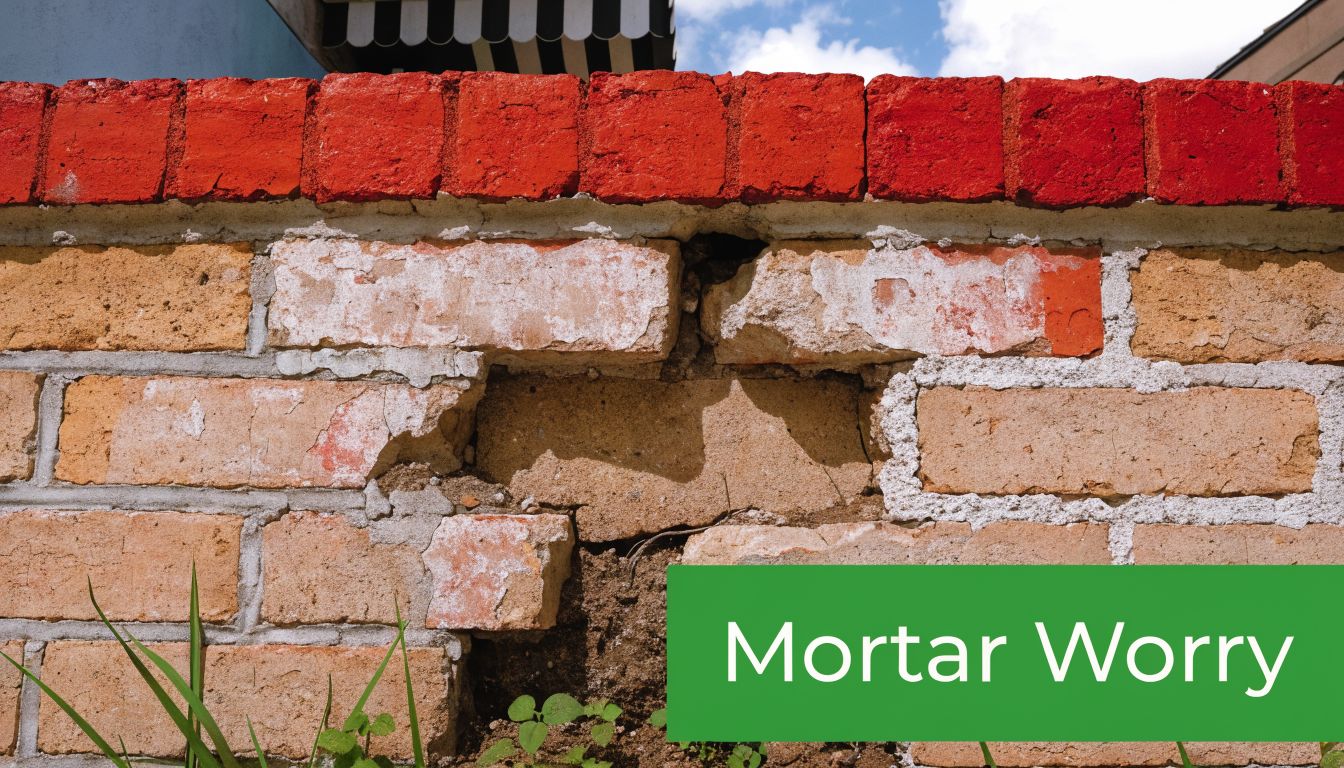
If you’ve got failing mortar, full repointing is the benchmark. It removes deteriorated mortar from the joints and replaces it with new mortar that seals the wall back up properly. That’s why property owners compare every other option against it.
Professional repointing typically runs $3 to $15 per square foot, with an average of $8 per square foot, and a 100 square foot project usually falls between $400 and $2,500 according to Angi’s repointing cost guide. That same source notes results can last up to 30 years, which explains why repointing remains the standard repair instead of a cosmetic patch.
Why the price feels high
People sometimes think they’re paying for “just mortar.” They’re not. They’re paying for controlled removal, proper joint depth, dust management, access, cleanup, and matching the repair to the wall in front of you.
On a Chicago building, that often means dealing with:
- Older mortar types that can’t be replaced carelessly
- Hard-to-reach areas around parapets, chimneys, or upper elevations
- Weather exposure that punishes shortcuts
- Visible front elevations where bad color matching stands out immediately
A lot of the labor is slow by necessity. Masonry repair isn’t like painting a fence. If the old joint isn’t cleaned out correctly, the new mortar won’t hold the way it should.
| Repair approach | Best use | Cost position | Structural value | Visual result |
|---|---|---|---|---|
| Full repointing | Widespread failing mortar | Highest upfront | Strongest long-term repair | Can be blended if done well |
| Selective repointing | Isolated damaged sections | Lower than full-wall work | Strong where needed | Usually the best value move |
| German Smear or surface finish | Cosmetic refresh on mostly sound walls | Lower than structural work in many cases | Limited structural benefit | Strong visual change |
| Sealants or patch products | Small, localized cracks | Lowest upfront | Limited and situational | Often obvious if overused |
Practical rule: If your wall is only failing in a few sections, you don’t always need an all-or-nothing repair. But if the whole wall is losing mortar, cheaper options can turn into expensive delays.
Most owners searching for a cheaper alternative to repointing brickwork aren’t trying to avoid proper repair. They’re trying to avoid paying for more repair than the wall needs. That’s a fair goal. The trick is knowing where saving money is smart and where it becomes false economy.
Signs Full Repointing Is Non-Negotiable
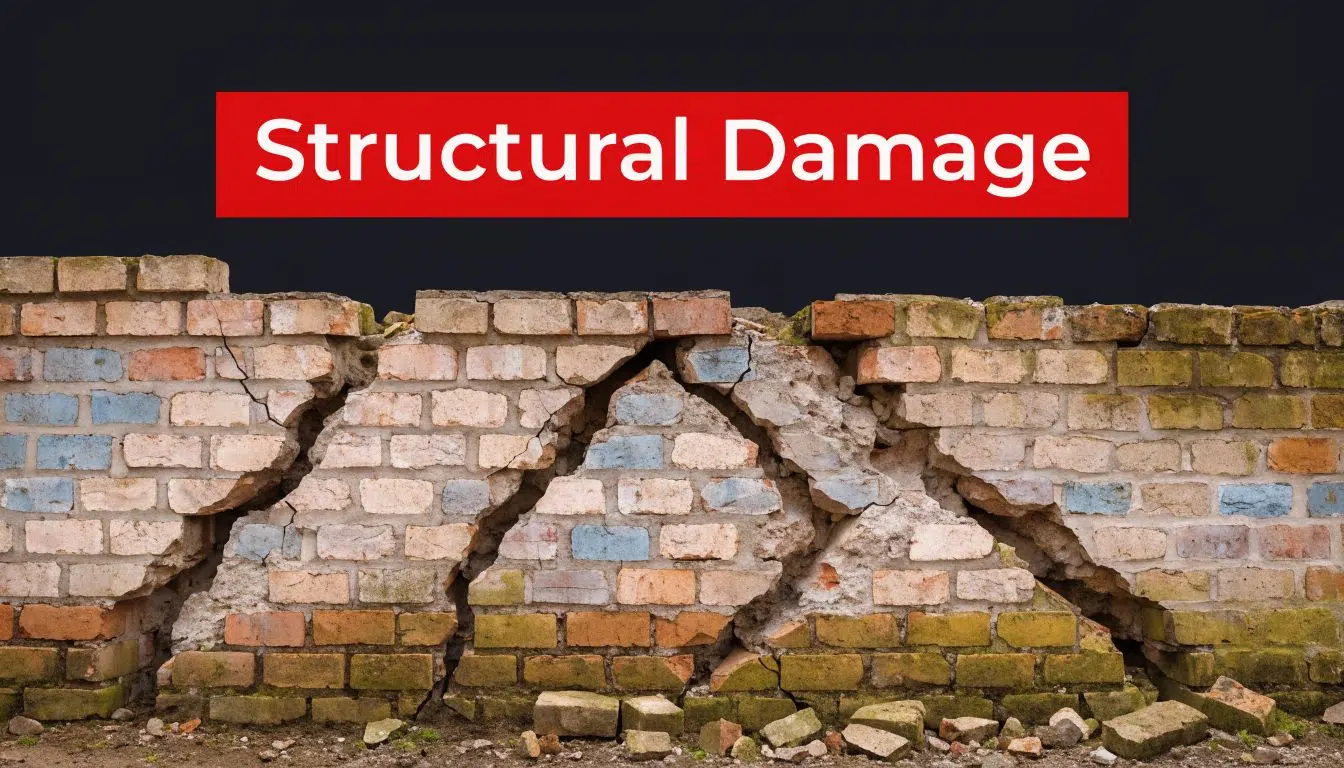
There are times when you should stop looking for a workaround. If the wall has crossed from surface wear into real envelope failure, full professional repair is the right call. Trying to save money at that point is like putting caulk over a rotten window frame. It may look better for a moment, but the underlying problem keeps moving.
Red flags you shouldn’t ignore
If you see these conditions, cheaper alternatives usually aren’t enough:
- Mortar loss across large areas rather than in a few isolated joints
- Loose or shifting bricks that move when pressed or show visible displacement
- Spalled brick faces where the outer surface is flaking, popping, or breaking down
- Water showing up inside near the same wall, especially around windows or parapets
- Vertical cracking patterns that suggest more than simple joint erosion
When that happens, the wall isn’t asking for a cosmetic touch-up. It’s telling you the joint system is no longer doing its job.
Why alternatives fail in these cases
Surface products can hide deterioration. They can’t replace missing joint depth. A skim treatment can improve appearance. It can’t stabilize loose masonry. Spot repairs can work well on a basically sound wall. They don’t solve a wall-wide failure pattern.
This matters even more on older Chicago masonry. Many historic brick buildings were built to dry out through breathable mortar joints. If the wrong material gets used, moisture can stay trapped inside the wall and force the brick to take the damage instead.
When bricks start sacrificing their faces, the wall has already been through more than a simple maintenance issue.
A proper contractor should tell you when the cheaper option is the wrong option. If every estimate you receive jumps straight to surface patching without discussing joint depth, brick condition, and water entry, keep looking. A detailed Chicago masonry repair assessment should start with diagnosing the failure, not prescribing the same fix for every building.
Typical situations where full work makes sense
A few examples come up again and again:
- Chimneys with broad mortar washout. Chimneys take weather from every direction and often fail faster than main walls.
- Parapet walls with open joints. These are exposed and vulnerable. Once water gets in, damage spreads.
- Rear walls with widespread softness. Long-term moisture often shows up there first.
- Older façades with mixed past repairs. If one section has hard cement patching and another has eroded lime mortar, partial cosmetic work often makes the wall perform worse.
If you’re seeing multiple failure signs at once, repointing stops being optional and starts being the least expensive way to stop the cycle.
A Practical Comparison of Repointing Alternatives
When full repointing isn’t necessary, you do have options. The key is matching the method to the problem instead of choosing whatever has the smallest invoice.
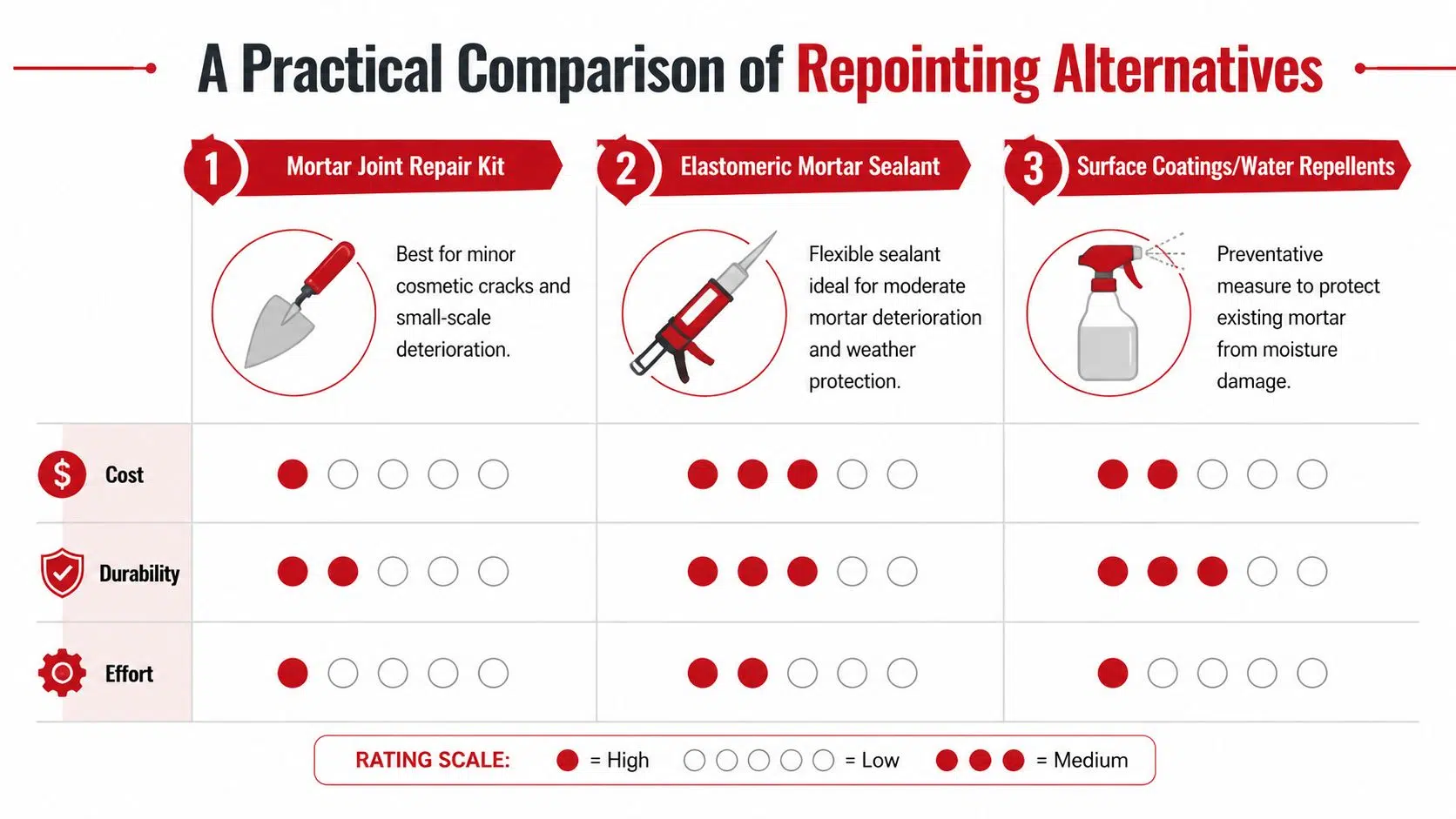
| Alternative | Where it works | Main benefit | Main drawback | Best fit |
|---|---|---|---|---|
| Mortar joint repair kit | Very small cosmetic defects | Low upfront cost | Limited durability and obvious mismatch risk | Tiny areas on non-prominent walls |
| Elastomeric mortar sealant | Narrow cracks where flexibility helps | Fast application and weather resistance | Can look artificial and won’t solve missing joint depth | Small maintenance repairs |
| Surface coatings or water repellents | Sound masonry that needs moisture defense | Preventive protection | Not a repair for failed joints | Maintenance on otherwise healthy walls |
| Selective repointing | Localized failing joints | Real structural repair where needed | Requires skilled matching and diagnosis | Best overall value in many cases |
| German Smear | Mostly cosmetic updates on aging brick | Lower-cost visual refresh | Changes wall appearance and is not a substitute for major structural repair | Budget-conscious aesthetic projects |
Mortar joint repair kits
These products appeal to owners because they seem straightforward. Small trowel, pre-mixed product, fill the crack, move on. For tiny areas, that can be acceptable.
The problem is scale. Once you move beyond a few joints, these kits start acting like a patch over a patch. Color mismatch is common. So is poor bonding when the joint wasn’t cleaned thoroughly enough first.
They’re best reserved for very minor cosmetic issues where failure won’t expose a larger structural problem. I wouldn’t treat them as a real substitute for professional joint repair on an exposed Chicago wall.
Elastomeric mortar sealants
Sealants have a place, especially where some flexibility helps. They’re useful in limited scenarios, but they often get overused by owners trying to avoid masonry work entirely.
That’s where trouble starts. Sealant can bridge a crack. It can’t recreate a properly cut and packed mortar joint. On older brick, a shiny or rubbery-looking repair can also stand out badly.
A sealant bead in a mortar joint is like using weatherstrip where you really need a new door jamb. It can reduce the draft, but it doesn’t rebuild the frame.
Use sealants for narrow, isolated trouble spots. Don’t use them as a blanket strategy for aging mortar across a façade.
Surface coatings and water repellents
These are maintenance tools, not true repairs. If the mortar is still sound and the goal is to help the wall resist moisture exposure, they can make sense.
If the joints are already open, recessed, or crumbling, coatings won’t fix that. In some cases, they just make the wall look more uniform while deterioration continues behind the finish. This is why surface products should follow diagnosis, not replace it.
Selective repointing
For many Chicago properties, this is the smartest middle ground. The mason identifies the sections that are failing, removes only the bad mortar, and repoints those areas properly.
That avoids paying for good joints to be disturbed just because bad joints exist elsewhere. It also keeps the repair focused on function instead of turning the whole project into a cosmetic makeover.
If you need help understanding where this sits against decorative mortar work, this guide on tuckpointing vs. repointing is useful because the terms get mixed up all the time.
German Smear
German Smear is one of the few cheaper alternatives that property owners ask for by name. It’s a thin mortar smear applied over the brick surface for an aged, old-world look. According to this German Smear cost comparison, it typically costs $5 to $12 per square foot, compared with $5 to $25 per square foot for repointing, and can deliver 30 to 60 percent savings.
That lower cost is real, but so is the trade-off. German Smear is mainly a visual treatment. It can conceal aging mortar and refresh the look of a wall, but it doesn’t replace the structural role of properly restored joints where the mortar has failed extensively or broadly.
It works best when:
- The wall is mostly sound
- The owner wants an intentional aesthetic change
- The existing brick suits a smeared finish
- The damage is superficial, not structural
It works poorly when the wall already has active movement, loose bricks, widespread voids, or serious moisture entry.
For owners trying to find a cheaper alternative to repointing brickwork, the practical answer usually isn’t one product. It’s choosing between cosmetic treatment, localized true repair, and preventive maintenance based on the actual condition of the wall.
The Hidden Costs of DIY Mortar Repair
DIY mortar work looks cheap right up until the wall has to be repaired twice.
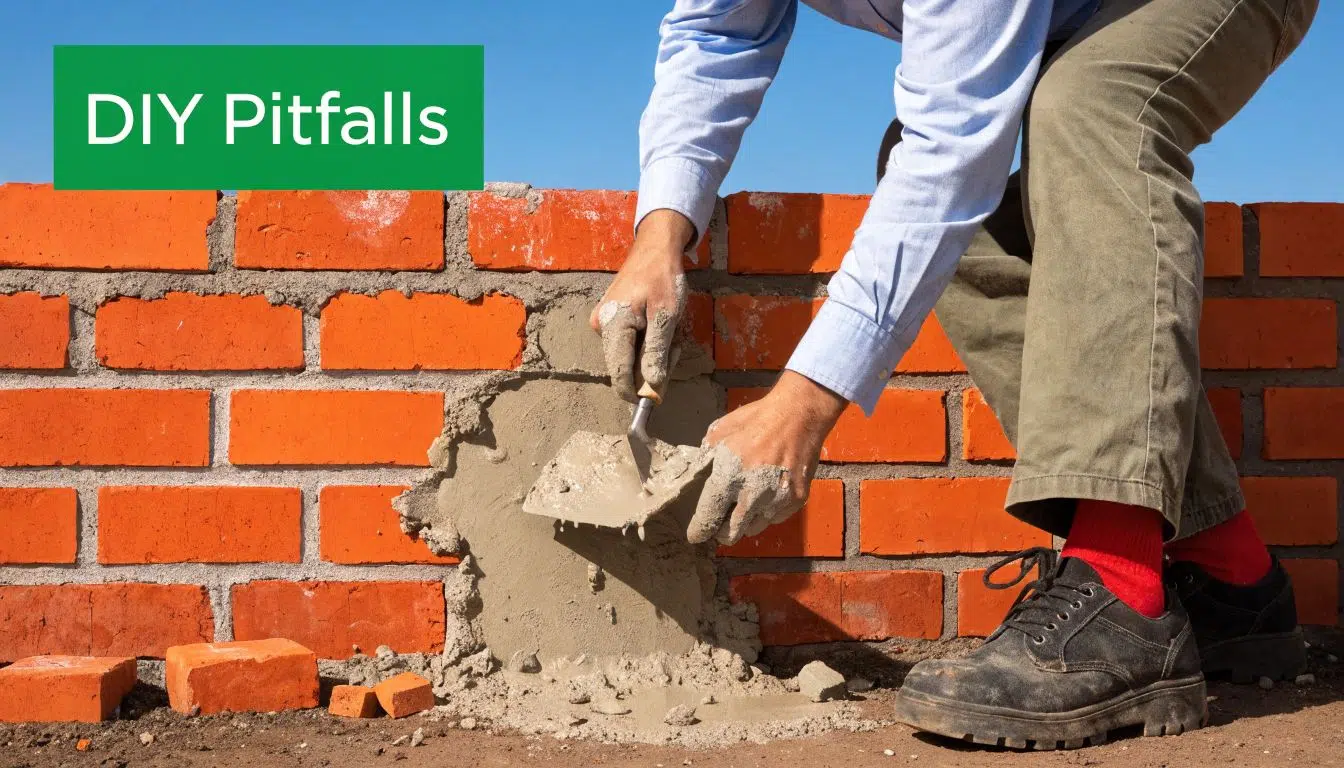
A homeowner sees a bag of mortar, a tuck pointer, maybe a joint raker, and assumes the difference between amateur and professional work is mostly labor cost. In masonry, that’s rarely true. The expensive part is getting the wall to perform correctly after the repair.
The upfront savings are real
DIY repointing can look attractive because materials may cost only $75, according to the source material gathered from this masonry repair video reference. For a small repair, that’s hard to ignore.
The same source also notes 30 to 50 percent of DIY jobs need professional fixes within 2 to 5 years because of common mistakes. It further warns that a failed job can turn initial savings into over $10,000 in structural repairs if problems like lintel rust jacking develop.
Those are the numbers that matter. Not the bag of mortar. The redo.
Where DIY work usually goes wrong
Most failed DIY repairs don’t fail because the owner didn’t work hard enough. They fail because masonry is material-specific and climate-specific.
Common mistakes include:
- Using the wrong mortar type for older brick
- Not removing enough of the old joint before filling
- Packing mortar too shallowly
- Smearing mortar across the brick face
- Working in poor weather conditions
- Treating water symptoms as surface cracks only
On historic brick, the wrong mortar can be especially damaging. Hard modern mortar on soft older brick shifts stress away from the joint and into the brick itself. In a Chicago winter, that can show up fast.
If the brick is older than the person repairing it, guessing on mortar type is a bad idea.
Why Chicago makes DIY riskier
Chicago weather doesn’t forgive half-repairs. Moisture gets into tiny openings, freezes, expands, and comes back for another round. A wall that looked acceptable in fall can start shedding faces or opening joints by spring.
That’s why a lot of DIY work fails in cycles. First the patch cracks. Then water gets behind it. Then the surrounding area starts to deteriorate too. By the time a pro is called in, the repair zone is larger and more expensive than it was at the start.
For very minor cosmetic touch-ups in a low-risk spot, DIY may be acceptable. For chimneys, parapets, lintel areas, upper elevations, or older façades, the margin for error is too small. Cheap only counts if it lasts.
The Financial Case for Selective Repointing
Selective repointing is the repair I’d call the most practical answer for many owners who want savings without gambling on the wall.
The logic is simple. If only part of the masonry is failing, repair only the failing part, but repair it correctly. That gives you a real masonry fix instead of a cosmetic disguise.
Why it often beats the other low-cost options
According to North Shore Brickwork’s comparison of tuckpointing and repointing, standard repointing delivers 40 to 60 percent immediate cost savings compared to decorative tuckpointing while maintaining identical structural protection. The same source states repointing in Midwest climates has a 25 to 30 year lifespan and a yearly cost of $0.27 to $0.60 per square foot.
Those numbers matter because they change the conversation. Selective repointing isn’t “cheap” in the bad sense. It’s efficient. You’re paying for real structural protection only where the wall needs it.
Why owners and managers like it
Selective work is often the best fit when:
- Damage is concentrated under sills, near chimneys, or at parapets
- Budgets are phased across a larger building envelope
- The façade is mostly sound
- The owner wants durability more than a full cosmetic reset
A good contractor should be able to identify the damaged sections and explain why those areas failed first. That’s especially important on multi-unit buildings where not every elevation ages the same way.
If you’re budgeting upcoming repairs, this breakdown of exterior brick repair cost in Chicago helps frame where targeted masonry work fits compared with broader restoration.
The key condition
Selective repointing only works when the unaffected sections are sound. If a contractor uses “selective” as code for “let’s patch over a much bigger problem,” the savings disappear later.
When the diagnosis is right, though, selective repointing is often the best cheaper alternative to repointing brickwork because it keeps the important part of repointing. The part that protects the wall.
Your Brickwork Decision Checklist
Use this as a field checklist before you approve any repair. Walk the wall. Check the chimney. Look under windows. Then answer the questions truthfully.
Start with the damage pattern
- Is the issue isolated or widespread? A few failed sections point toward selective repair. Wall-wide deterioration points toward full professional assessment.
- Are bricks themselves failing? If faces are popping, flaking, or crumbling, don’t treat this like a simple joint touch-up.
- Do any bricks move? Movement changes the job from maintenance to stabilization.
Look at location before price
Not all mortar failure carries the same risk.
- Chimney joints usually need more caution because they take weather from every side.
- Parapet walls and upper elevations are exposed and harder to patch casually.
- Below windows often signals recurring water entry, not just old mortar.
- Ground-level garden walls or non-critical features may tolerate simpler repairs if the damage is minor.
Small damage in a high-risk location can matter more than larger damage in a low-risk one.
Match the repair to your ownership goal
Ask yourself what you need from this building.
- Short-term appearance: A cosmetic treatment may be enough if the wall is sound.
- Long-term hold: Invest in real joint repair, not just a visual improvement.
- Historic preservation: Material matching matters. Old brick doesn’t always accept modern fixes well.
- Budget triage: Repair the highest-risk sections first instead of spreading money thinly across the whole property.
Decide whether the wall needs a mason or a bandage
A cheaper alternative to repointing brickwork makes sense when the wall is structurally sound and the problem is limited. It does not make sense when you’re trying to postpone a structural repair that the building has already requested.
If you can’t tell whether the problem is cosmetic or structural, that uncertainty is the answer. Get the wall inspected before choosing the low-cost option.
Choosing a Reliable Chicago Masonry Contractor
Hire the contractor the same way you’d hire a surgeon for an old building. You want judgment first, tools second.
Look for a company that is licensed, bonded, and insured for masonry work in Illinois. Ask whether they regularly work on Chicago brick buildings, not just suburban new-build veneer. Older city masonry needs a different eye, especially when lime-based mortar, parapets, chimneys, and lintels are involved.
Ask for a written scope that explains what they’re removing, what they’re replacing, and why that repair method fits your wall. A vague estimate usually leads to vague results. Good contractors also talk clearly about access, cleanup, color matching, and warranty coverage.
Finally, pay attention to whether they recommend the same solution for every building. The right contractor should be willing to say, “This area needs full repointing,” or “This section can be handled with selective repair,” instead of forcing one service onto every problem.
If you want an experienced local opinion on whether your wall needs full repointing, selective repair, or a lower-cost cosmetic option, Expert Super Seal Roofing & Tuckpointing serves Chicago and the surrounding suburbs with masonry and building envelope repairs. As a family-owned company serving the area since 1972, they offer free estimates, transparent quotes, and the kind of practical guidance that helps owners avoid paying for the wrong fix.