
You’re probably looking at a flat roof that has started telling on itself.
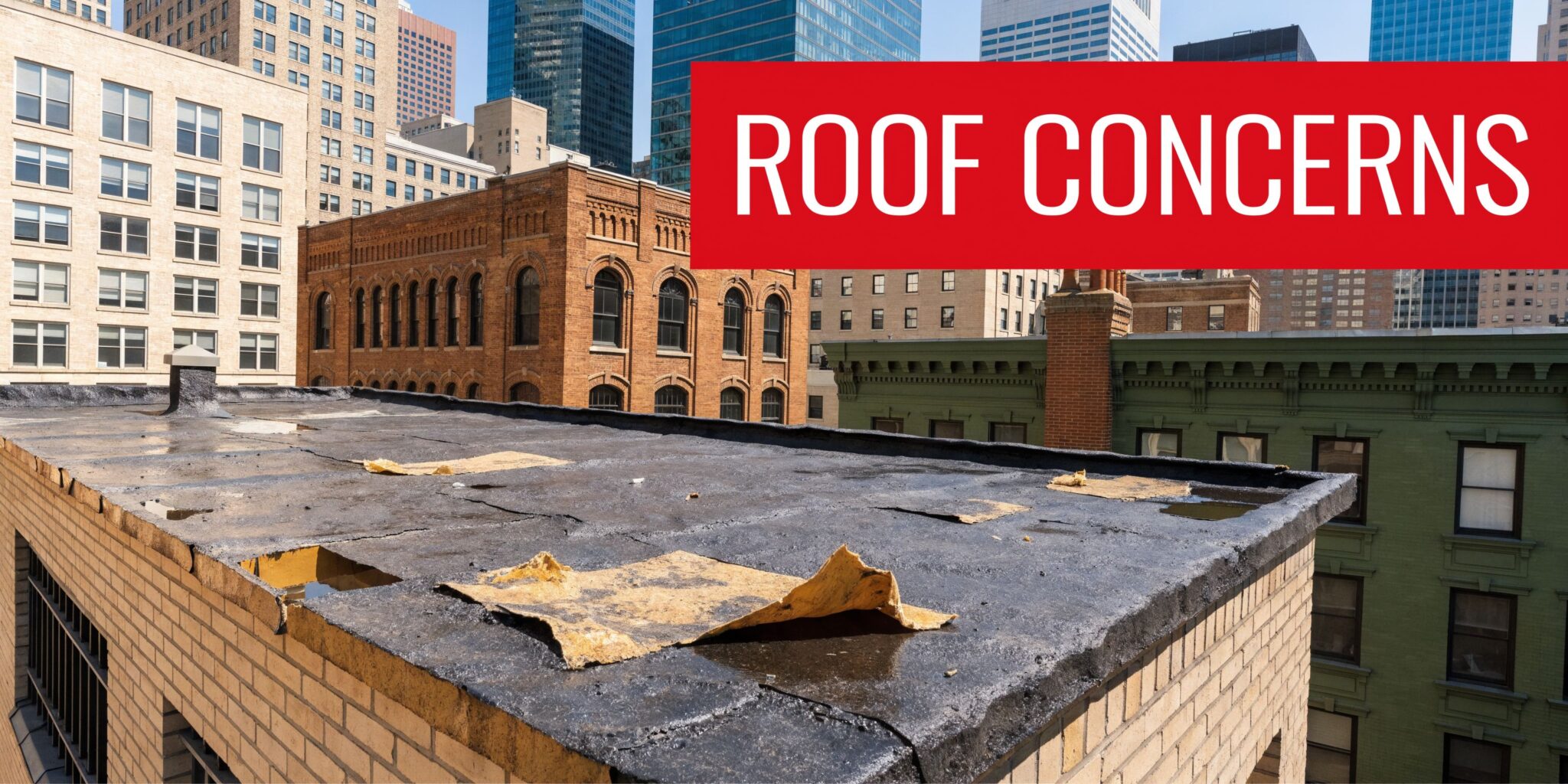
Maybe the top layer is splitting near a seam. Maybe water is sitting in the same low spot after every storm. Maybe a tenant reported a ceiling stain, or your maintenance person keeps patching the same flashing and the leak still comes back. On a Chicago building, that usually means the conversation has shifted from repair to replacement.
The cost of modified bitumen roof in chicago isn’t hard to price in broad strokes. The hard part is pricing it accurately. National calculators miss the things that drive bids here: winter installation conditions, alley access, parapet wall detailing, crane logistics, and what’s hiding under old roofing on masonry buildings. If you own a bungalow, a three-flat, a condo building, or a commercial property, those details decide whether your number stays reasonable or climbs fast.
Why Modified Bitumen Is a Chicago Flat Roof Staple
A common Chicago replacement job looks like this: an older flat roof, masonry parapet walls at the perimeter, a few HVAC curbs, and decades of patches layered over earlier work. On that kind of building, modified bitumen keeps coming up for a reason. It suits the way many Chicago roofs are built, and just as important, it suits the way they age.
Modified bitumen is an asphalt-based membrane made for low-slope roofs, with polymer modifiers that help it stay more flexible than older asphalt systems. If you want a plain-English explanation of the system itself, this guide on what modified bitumen roofing is covers the basics well.
Why it fits Chicago buildings so well
Chicago does not have a clean, uniform roof inventory. A lot of properties have older decking, uneven substrates, multiple penetrations, and parapet walls that need careful base flashing and termination work. Many national roof calculators treat a flat roof like an open rectangle. In Chicago, that misses the details that decide whether a system performs well for years or becomes a leak-chasing exercise.
Modified bitumen works well here because it is forgiving in the right ways. It can be built as a multi-ply assembly, which gives contractors more control at seams, transitions, penetrations, and perimeter details. That matters on older buildings where the challenge is often not the field of the roof. It is tying the new membrane into aging wall conditions, drains, curbs, and edge metal without creating weak points.
It also holds up well on roofs that get walked on. That is a significant issue in Chicago on mixed-use and commercial buildings with regular HVAC service traffic.
Why experienced Chicago roofers keep recommending it
Owners usually choose modified bitumen for practical reasons, not because it is trendy.
- It matches older building conditions well: On Chicago masonry buildings, the perimeter details often matter more than the membrane choice on paper. Modified bitumen gives crews a dependable way to flash those areas.
- It handles service traffic better than many owners expect: If maintenance staff and mechanical contractors are on the roof throughout the year, surface toughness matters.
- It is repairable: On the right assembly, an experienced flat-roof crew can isolate and address problem areas without guessing.
- It sits in a useful middle price range: It is rarely the cheapest option, but it often avoids the higher pricing attached to some premium systems while still giving owners a durable assembly.
That last point is why it has stayed popular across bungalows, three-flats, condo buildings, churches, schools, and commercial properties.
The Chicago trade-off owners should understand
Modified bitumen is not automatic right for every roof. If a building has unusual drainage issues, strict energy targets, or a layout that favors another membrane, I would say so. But on a large share of Chicago flat roofs, especially older masonry structures, it remains a dependable choice because it works with the building instead of fighting it.
That is the part many owners miss early in the process. The membrane itself is only part of the value. The bigger advantage is how well the system adapts to Chicago roof geometry, parapet conditions, and the kind of wear these buildings see year after year.
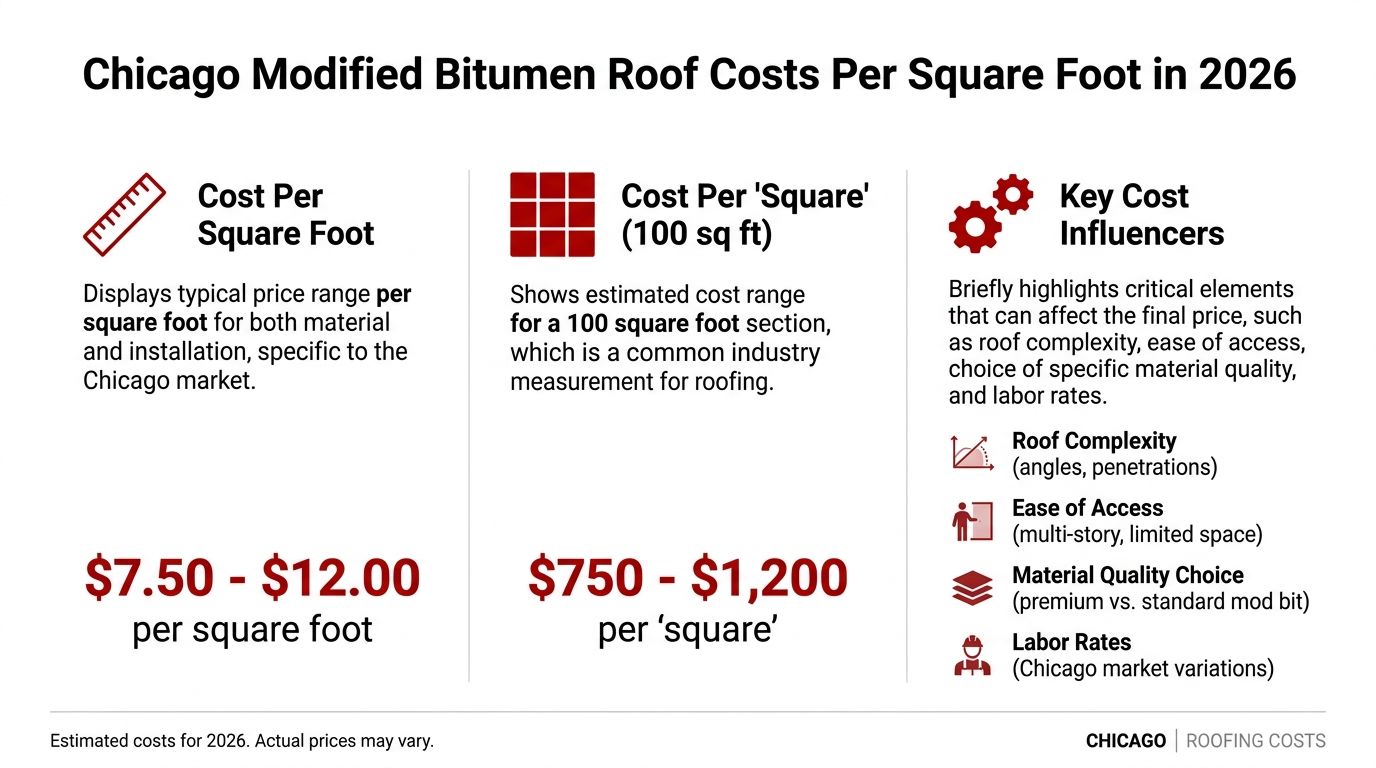
Chicago Modified Bitumen Roof Costs Per Square Foot in 2026
A Chicago owner gets three bids for the same flat roof and sees a spread of thousands of dollars. That happens all the time here. On paper, the square footage matches. In the field, the jobs do not.
For a practical planning range, many Chicago modified bitumen replacements land around $6.00 to $9.00 per square foot, with more complex commercial work climbing well above that once access, insulation, and detail work are included. On smaller roofs, that often puts a 1,000 square foot replacement around $6,000 to $9,000 before harder site conditions or code-driven upgrades enter the picture.
The numbers most owners should know first
Roofing estimates may use either square feet or squares. One roofing square equals 100 square feet.
| Unit | Chicago range |
|---|---|
| Per square foot | $6.00 to $9.00 |
| Per roofing square | $600 to $900 |
For larger or more demanding buildings, pricing often moves into a higher bracket. That is common on commercial properties with multiple penetrations, occupied spaces below, stricter safety setup, or insulation requirements tied to replacement work.
National averages miss Chicago by a wide margin. Labor costs are higher here. Winter installation windows are tighter. Dense neighborhoods slow material loading and debris removal. Older masonry buildings also bring more flashing and edge detail work than generic online calculators account for.
What those prices look like on common roof sizes
Square-foot budgeting still helps at the early stage.
| Roof size | Estimated Chicago cost at $6.00 to $9.00 per sq ft |
|---|---|
| 1,000 sq ft | $6,000 to $9,000 |
| 1,200 sq ft | $7,200 to $10,800 |
| 2,500 sq ft | $15,000 to $22,500 |
Use those numbers as a reserve target, not as a final contract expectation.
A 1,200 square foot roof on a simple building with clear access is one type of project. A 1,200 square foot roof surrounded by parapet walls, with rooftop equipment, limited alley staging, and a full tear-off is another. The membrane area may be identical, but the labor is not.
Why Chicago bids spread faster than owners expect
The hidden costs usually sit around the roof, not across the open field of membrane.
On Chicago buildings, crews often spend extra time tying into aging parapet walls, replacing base flashings, handling multiple existing roof layers, and protecting neighboring property during tear-off. City permit requirements can also add time, especially when the scope triggers insulation or deck-related corrections. If the work is scheduled in colder months, production slows and material handling gets harder. That affects labor cost even before the first roll goes down.
This is why a low bid deserves a hard look. If the proposal treats a Chicago flat roof like a wide-open suburban garage, something is probably missing.
Insulation changes the budget quickly
Insulation is one of the biggest price separators in modified bitumen work.
If a replacement triggers code-related insulation upgrades, the total can jump far beyond the base membrane number. Owners are often surprised by that because the roof may have performed for years without enough insulation by current standards. Once the existing assembly comes off, the project can shift from a straightforward replacement to a thicker, more expensive system with tapered layout, edge adjustments, and higher flashing heights.
That is where national estimating tools fall apart. They rarely price the Chicago realities well: older roof lines, parapet integration, and the extra labor needed to make new insulation work on buildings that were never designed around current code requirements.
What this means for budgeting
Start with three practical buckets:
- Basic replacement: Use $6.00 to $9.00 per square foot for a cleaner, lower-complexity Chicago project.
- More involved work: Expect a higher range when the roof has difficult access, parapet repairs, multiple penetrations, safety setup, or commercial staging needs.
- Replacement with insulation upgrades: Budget substantially more than membrane-only pricing.
Square footage gets you into the right conversation. The specific number comes from roof access, wall conditions, tear-off depth, insulation requirements, and how hard it is to run a crew on your particular block. That is how Chicago modified bitumen jobs are priced.
Deconstructing Your Estimate What Drives Roofing Costs
A Chicago owner gets three bids for the same modified bitumen roof and the spread is wide. One number looks low enough to feel like a win. Then the job starts, the crew opens the roof, and the change orders begin. That usually means the estimate was never built around the conditions on the building.
A solid proposal breaks cost into the parts that drive the job: membrane assembly, installation method, tear-off scope, insulation, sheet metal and flashing details, and concealed repairs. If those items are vague, the price is vague too.

Material system choices
Modified bitumen pricing starts with the assembly being specified.
A 2-ply system costs less than a 3-ply system because it uses less material and less labor. SBS and APP membranes also price differently depending on the application method, traffic level, and detail work around penetrations. On a simple roof with limited equipment, one system may be perfectly adequate. On a roof with service traffic around HVAC units, a tougher assembly often makes sense even if the upfront number is higher.
That choice should be stated clearly in the estimate. If the proposal just says "modified bitumen roof" without naming the system, you are not comparing apples to apples.
Tear-off, recovery, and what gets exposed
The next major cost question is whether the contractor is tearing the roof off or installing over an existing assembly where code and conditions allow it.
Recovery can reduce cost if the existing roof is dry, stable, and suitable for another layer. Full tear-off costs more because it adds labor, disposal, and a higher chance that hidden substrate problems will be exposed. On older Chicago buildings, that matters. Once the roof is open, crews may find wet insulation, deteriorated wood nailers, or sections of deck that will not hold a new system properly.
Owners often focus on the membrane number. The expensive part is often everything underneath it.
Installation method and safety requirements
Labor is not just "install roof." It includes how the membrane is applied, how materials are moved, how the crew protects the building, and how the contractor handles fire and safety rules.
Torch-applied work, cold-process systems, and fully adhered assemblies each carry different labor demands. The right method depends on building use, exposure, and detail conditions. A mixed-use property with residential tenants below may call for a different approach than a one-story warehouse with open access and fewer occupancy concerns.
Safety setup also affects cost. Rooftop tie-off points, warning lines, perimeter protection, and material handling time all show up in labor, especially on taller buildings.
Flashings, metal, and edge details
Field membrane is only part of the roof. Chicago flat roofs often have parapet walls, coping, scuppers, pitch pockets, equipment curbs, and older masonry transitions that need to be rebuilt or re-flashed. If those details are not included, the proposal may look cheap because it left out failure points.
I tell owners to read the metal and flashing lines carefully. On a brick building with aging parapets, that work can decide whether the new roof stays dry or starts leaking at the walls.
Concealed conditions and allowance language
Hidden conditions are the line items that turn a neat estimate into a disputed final invoice.
No contractor can see every problem before tear-off. Good estimates deal with that directly. They explain what is included, what is excluded, and how deck replacement, wet insulation removal, masonry patching, or nailer replacement will be priced if discovered. That language protects both sides.
If a quote has no allowance language and no unit prices for repair work, ask how change orders will be handled. Get that answer before the contract is signed.
What a usable quote should spell out
A useful estimate gives you enough detail to compare scope, not just total price. Look for these items:
- Roof system identified: APP or SBS, and whether it is 2-ply or 3-ply
- Removal scope: full tear-off, partial tear-off, or permitted recovery
- Insulation scope: new insulation, cover board, or no insulation included
- Flashing and sheet metal: parapet flashings, coping, edge metal, curbs, and penetration details
- Deck repair terms: how concealed damage will be documented and billed
- Cleanup and disposal: dumpster plan, haul-away, and site protection
- Warranty language: manufacturer coverage, contractor workmanship term, and any exclusions
A one-page lump-sum quote is hard to trust on a Chicago flat roof. The best estimates show where the money is going, where the risks are, and which parts of the job can change once the old roof comes off.
Chicago-Specific Factors That Impact Your Final Bill
A Chicago flat roof on paper can look straightforward. Then the crew arrives and finds a tight alley in Lakeview, no legal place for a dumpster, overhead service lines at the rear, and a 100-year-old parapet wall that cannot take another shortcut on flashing. That is how a national calculator turns into a bad budget.
The hidden costs in this city usually come from conditions around the roof, not just the membrane itself. Access, weather timing, permit coordination, and masonry tie-ins all affect labor hours, equipment, and risk. Those are job costs, and they show up fast on older buildings and occupied properties.
Access and staging can outweigh roof size
I have seen small roofs cost more per square foot than larger ones because the building was harder to work on.
A two-flat with a narrow gangway, no rear staging area, and heavy foot traffic out front slows every part of the job. Tear-off takes longer. Material loading takes longer. Cleanup takes longer. If a crane, lift, or street occupancy permit is needed, the price moves again.
Common Chicago access issues that raise bids include:
- Tight side yards and alleys: limited room for ladders, debris handling, and material staging
- Multi-story buildings: more handling time, more safety setup, and slower production
- Busy retail or mixed-use frontage: tighter scheduling and added protection for pedestrians and tenants
- Restricted loading conditions: parked cars, overhead wires, and neighboring structures that limit equipment options
On some buildings, access is the job.
Winter scheduling carries a premium
Chicago roofers work through cold weather, but winter production is slower and more expensive. Snow cover, ice, shorter daylight, and extra safety setup all affect crew output. Materials also need closer handling, especially when you are detailing flashings and transitions in freezing conditions.
Emergency timing makes it worse. If a roof is leaking in January, the owner is paying for urgency, not just roofing. Temporary dry-in work, return trips, and weather windows all add labor that an online estimator will never catch.
Old parapet walls add hidden scope
This is one of the most missed cost items on Chicago buildings.
Modified bitumen has to tie into parapet walls, coping, inside corners, reglets, and termination points that are often decades old. On brick buildings, those details are rarely perfect when the tear-off starts. Mortar joints may be open. Counterflashing may be buried or patched over. Wood nailers at the perimeter may be rotted. If those conditions are ignored, the new roof can still leak at the walls.
That is why roof replacement on older Chicago masonry buildings often includes related wall work. Three-flats, courtyard buildings, and mixed-use storefronts are the usual candidates.
Permits and city logistics are part of the price
Chicago adds friction that suburban estimates do not capture. Permit processing, street use coordination, occupied-building notices, and disposal logistics can all affect the final number. A clean replacement on an open site is one type of project. A roof above tenants on a dense city block is another.
If you are comparing systems, those same site conditions also affect single-ply pricing. A commercial TPO roof cost in Chicago can shift for many of the same reasons, especially on buildings with limited staging and difficult perimeter details.
Low bids usually leave out one of these city-specific costs. The number looks better at signing, then the change orders start once the crew has to deal with the building.
Comparing ModBit to TPO and EPDM for Chicago Properties
A Chicago owner usually narrows the flat-roof decision to three systems: modified bitumen, TPO, or EPDM. On paper, the spread can look small. On a Chicago building, the right choice often comes down to how the roof handles foot traffic, parapet conditions, repair access, and the kind of crew work the building will need five or ten years from now.
Modified bitumen stays popular here for a reason. It fits the way many Chicago roofs are built and used, especially on older masonry buildings, condo associations, mixed-use properties, and low-slope roofs with a lot of penetrations.
How the systems compare on real Chicago buildings
| Feature | Modified Bitumen | TPO | EPDM (Rubber) |
|---|---|---|---|
| Typical cost position | Usually competitive for replacement work on older flat roofs | Often competitive, depending on membrane spec and detail work | Can price higher once accessories and detail work are added |
| Best building fit | Older masonry buildings, traffic-heavy roofs, roofs with many details | Commercial properties seeking a single-ply membrane | Simple low-slope layouts with fewer complex transitions |
| Foot traffic tolerance | Strong choice where HVAC and service traffic are common | Can perform well, but protection paths matter | Works best when traffic is controlled |
| Repair familiarity in Chicago | Many local crews know how to diagnose and patch it well | Repairs require proper heat-welded membrane work | Straightforward in many cases, but puncture location and seam condition matter |
| Detail complexity | Handles layered flashing work well | Clean system, but detail quality matters a lot at walls and penetrations | Effective on simpler layouts, less forgiving on neglected edge conditions |
| Owner profile | Owners who want durability and a system Chicago crews see every day | Owners focused on reflective single-ply performance | Owners comfortable with a rubber membrane and disciplined maintenance |
Where modified bitumen usually makes the most sense
On Chicago roofs, details drive performance. A building with multiple curbs, vent stacks, inside corners, equipment supports, and older wall transitions often favors modified bitumen because it gives the installer a layered system to work with instead of relying on one exposed sheet across every condition.
It also holds up well where people are on the roof regularly. I recommend it often for buildings with active mechanical service, frequent vendor access, or maintenance staff crossing the roof throughout the year. That does not make TPO or EPDM poor systems. It means traffic patterns matter, and Chicago properties tend to have more rooftop activity than national estimating templates assume.
Where TPO can be the better buy
TPO gets serious attention on commercial buildings where owners want a single-ply system and are comparing first cost against energy goals, membrane thickness, and warranty options. On cleaner roof layouts, it can be a very practical choice.
If you are weighing that route, this guide to commercial TPO roof cost in Chicago gives a useful local comparison point.
The caution with TPO in Chicago is not the membrane itself. It is execution. Weld quality, edge securement, and flashing details have to be right, especially on roofs exposed to winter contraction, strong wind, and repeated freeze-thaw cycles.
Where EPDM still fits
EPDM remains a proven option for low-slope roofs, particularly when the layout is simple and the owner wants a membrane with a long track record. It can make sense on larger open areas without constant service traffic or a lot of complicated terminations.
The trade-off is practical. On dense Chicago buildings with tight perimeters, rooftop equipment, and older wall interfaces, EPDM can lose some of its simplicity once the detail work starts.
The choice should match the building, not the brochure
Owners sometimes compare these systems as if they are being installed on the same perfect roof. Chicago roofs are rarely perfect. A 30-unit brick condo in Lakeview, a small warehouse in Belmont Cragin, and a mixed-use building on the South Side may all need flat-roof replacement, but they do not present the same risks or labor conditions.
For many older Chicago properties, modified bitumen earns its place because it matches the building stock. For cleaner commercial layouts, TPO may be the sharper value. For straightforward low-slope applications, EPDM can still be a sound option.
A good contractor should explain the trade-offs clearly, including where each system gains cost, where it loses it, and which one makes the fewest problems likely on your specific building.
Maximizing Your Investment with Warranties and Maintenance
A new roof is only part of the investment. The other part is protecting that roof so it lasts as intended.
Modified bitumen can deliver a long service life in Chicago, but owners still lose years off a roof when drains clog, service trades damage flashing, or small seam issues go ignored through winter. The roof system matters. Maintenance discipline matters just as much.
Read the warranty for what it covers
Owners often hear “the roof is under warranty” and assume that settles it. It doesn’t.
There are usually two separate protections. One covers the roofing material itself. The other covers the contractor’s workmanship. If a roof leaks because of a bad termination, sloppy flashing, or poor tie-in at a wall, the workmanship side is the one that matters most.
Ask direct questions:
- What does the material warranty cover?
- What voids it?
- What does the workmanship warranty include?
- Who handles service calls if there’s a leak?
A good warranty isn’t just a PDF. It’s a clear service path when something goes wrong.
Maintenance is cheaper than emergency work
Chicago roofs take punishment from snow, standing water, heat, and wind-driven rain. That means small issues become larger ones fast if no one checks the roof.
The best maintenance habits are simple:
- Keep drains clear: Ponding water often starts with blocked drainage.
- Inspect after major weather: Look for open seams, lifted flashing, and punctures near traffic areas.
- Watch rooftop trades: HVAC, cable, and mechanical crews can damage a roof without realizing it.
- Fix small details early: A minor flashing issue is easier to correct before water reaches insulation or decking.
Most expensive flat-roof leaks start as ordinary maintenance problems that nobody addressed in time.
For owners who want a practical checklist, this guide to flat roof maintenance for Chicago properties is worth reviewing.
Think in cost per year, not just bid price
A lower bid isn’t automatically the better value. A roof that’s installed correctly, inspected regularly, and repaired promptly usually costs less over its service life than a cheaper roof that turns into recurring leak work.
That’s especially true on occupied properties. Every leak carries secondary risk: interior damage, tenant disruption, equipment exposure, and repeated service calls. Long-term value comes from installation quality, clean detailing, and steady upkeep.
Get a Transparent Chicago Roofing Estimate You Can Trust
The total cost of a modified bitumen roof in Chicago comes down to more than membrane and square footage. The roof size matters, but so do access, tear-off scope, insulation, wind-code attachment, deck condition, and the way the new system ties into parapet walls and penetrations.
That’s why broad online ranges help with planning but don’t replace an on-site evaluation. A local contractor needs to look at the roof, the building, the access path, and the hidden risk points before a number means anything.
If you own a Chicago-area home, condo building, commercial property, or industrial facility, the smartest next step is a detailed inspection and a written estimate that explains what’s included, what isn’t, and what conditions could change the price. Clear scope beats a low mystery number every time.
Expert Super Seal Roofing & Tuckpointing has served Chicagoland since 1972 and knows how Chicago roofs behave. If you want a free, transparent estimate from a family-owned local contractor that understands flat roofs, parapet walls, winter leak conditions, and dense-site logistics, contact Expert Super Seal Roofing & Tuckpointing.