You notice it from the ground first. The metal roof still looks serviceable, but the coating has started to bubble, peel, chalk, or separate around seams and fasteners. The leak may not be dramatic yet. What usually follows is more frustrating than the roof itself. You search for pricing and find plenty of articles about applying a new coating, and plenty about full replacement, but very little about the part that often decides whether the next system succeeds or fails. Removing the old coating.
That gap matters in Chicago. A failed coating is not merely ugly. It can trap moisture, hide rust, interfere with adhesion, and turn a straightforward restoration into a callback problem if the prep is done poorly. Property managers, condo boards, and commercial owners usually ask the same question. What does the removal part cost?
Decoding Metal Roof Coating Removal Cost in Chicago
Most online guides skip the part owners need most. They tell you what a new coating costs to install. They tell you what a brand-new roof costs. They do not tell you what happens in the middle, when the old coating is no longer sound and has to come off.
That is the hidden line item.
A Chicago owner usually reaches this point after seeing one of a few familiar conditions. The coating is peeling in strips on a standing seam roof. It has gone soft and patchy around ponding areas. It looks chalky across the field and brittle at laps and penetrations. Sometimes a previous contractor coated over rust, loose fasteners, or contaminated panels. The new failure does not start with the topcoat. It starts with bad prep.
Why the pricing feels unclear
The cost confusion is understandable because the market rarely breaks removal out cleanly. One of the clearest summaries of the problem comes from Custom Coatings on metal roof coating cost, which notes that most content focuses on application at $1.85 to $3.75 per square foot and leaves owners uncertain about the added cost of removal, which can be $1 to $3 per square foot extra.
That lines up with what experienced contractors see in the field. Removal is not one simple task. It may involve pressure washing, scraping, grinding, chemical stripping, or media blasting. On one building, only the failed sections need to come off. On another, the whole roof has to be stripped back to a stable surface before anything new goes on.
What property owners usually miss
The mistake is assuming a new coating fixes a failed old one. It does not.
If the existing coating has lost adhesion, coating over it usually buys time, not a solution.
A roof can still be a strong candidate for restoration even when the existing coating has failed. But the quote has to account for the work required to create a sound surface. That is where the Metal Roof Coating Removal Cost in Chicago is determined. Not in a generic national average, but in the condition of your specific roof, your access, your substrate, and the amount of failed material that has to be removed before the next system can hold.
Your 2026 Chicago Price Guide to Coating Removal
A Chicago owner usually calls after the coating has already failed. The roof still looks recoverable from the ground, but once a crew gets up there, the key question is not only what a new coating costs. It is what it takes to remove the failing one without damaging the metal underneath.
For budget planning, the clearest starting point is still the base removal range. HomeGuide roof coating and sealing cost data puts basic coating removal and disposal at about $1 to $3 per square foot. The same pricing summary shows why owners often explore restoration before replacement. Full tear-off replacement can run far higher, and restoration work can offer significant savings versus full replacement.
That spread matters in Chicago because coating removal is often the hidden line item. Many price guides talk about installing a new system. They skip the labor needed to strip off loose, brittle, or poorly bonded material first.
2026 estimated metal roof coating removal costs in Chicago
| Project Scope | Cost Per Square Foot Low End | Cost Per Square Foot High End | Sample Project Cost 2,000 sq ft Roof |
|---|---|---|---|
| Basic coating removal and disposal | $1.00 | $3.00 | $2,000 to $6,000 |
| Full tear-off replacement for comparison | $15.00 | $25.00 | $30,000 to $50,000 |
For owners comparing adjacent roof types on the same property, this flat roof coating removal cost in Chicago guide helps frame how scope can shift between metal and low-slope sections.
What those numbers mean in practice
A 2,000 square foot roof is a useful benchmark because it shows the math clearly. Using the base removal range above, basic removal and disposal lands at $2,000 to $6,000 before any unusual access issues, heavy prep, or repair work are added.
That is only a starting budget.
I have seen two roofs with the same square footage come in thousands apart. One had light peeling in open field areas and cleaned up fast. The other had failed coating locked around seams, curbs, fasteners, and oxidized laps, which meant slower removal, tighter cleanup, and more hand work.
A practical budgeting view
Use the base range to decide whether restoration is still on the table.
- Accessible roof, light failure: pricing usually stays closer to the low end.
- Patchy adhesion or detail-heavy areas: labor rises because removal slows down.
- Extra prep after removal: the coating comes off, but the metal still may need cleaning, fastening, rust treatment, or seam work before recoating.
A low number on paper does not help if failed coating is left behind. That usually leads to adhesion problems, uneven performance, and another repair bill sooner than expected.
The true value is not finding the cheapest removal price. It is finding out whether proper coating removal keeps the roof in restoration range, or whether the roof has crossed into replacement territory.
What Drives Your Metal Roof Coating Removal Cost
The square-foot range gives you a budget frame. The actual quote comes from the conditions on your building. Removal pricing is built like a stack of parts. Each part affects labor, equipment, cleanup, and risk.
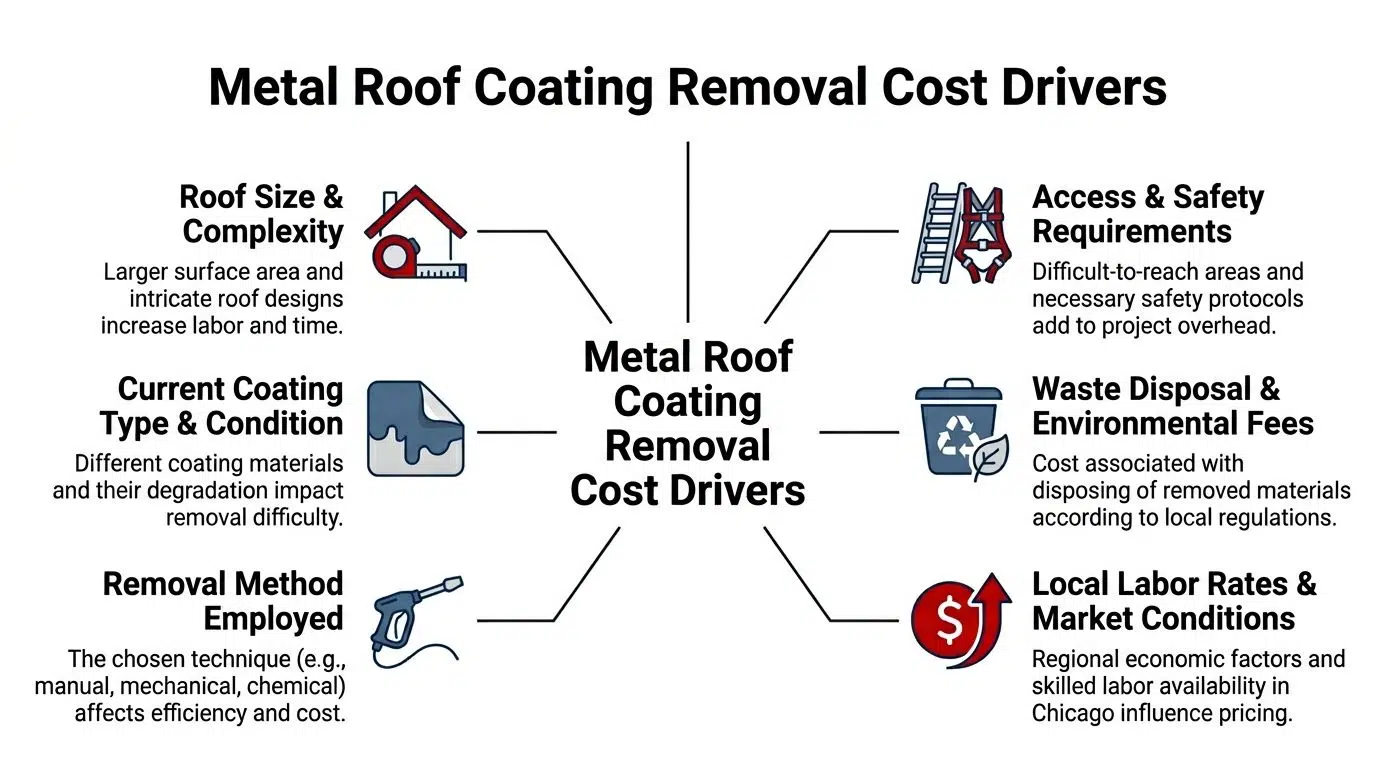
Roof size and roof complexity
Size matters, but not in the simple way owners might expect. Large open roof areas can move quickly. Tight roofs with transitions, curbs, skylights, equipment stands, and edge details slow a crew down.
A straightforward industrial roof often allows more efficient production. A condo roof with multiple elevations, limited staging, and occupied areas below usually requires slower handling and tighter cleanup.
Coating type and how badly it has failed
Not all failed coatings come off the same way.
Some coatings release easily with washing and mechanical prep. Others hang on in patches, especially when sections have weathered differently across the roof. A coating that is partly bonded and partly failing is often more labor-intensive than one that has failed uniformly, because the crew has to chase weak areas without damaging sound metal underneath.
The condition matters as much as the product. If the coating is blistered, brittle, contaminated, or layered over previous repairs, removal gets slower.
The removal method
Removal method drives both production speed and care level. Contractors may use pressure washing, scraping, grinders, chemical stripping, or media blasting depending on coating type and substrate condition.
The right method depends on what is present on the roof.
- Pressure washing works best when the coating is already loose and surface contamination is part of the problem.
- Scraping and mechanical removal help in detail areas and around transitions where control matters.
- Chemical stripping can be useful for stubborn sections, but it adds handling and cleanup considerations.
- Media blasting is often chosen when the surface has to be cleaned aggressively without sacrificing the metal panel itself.
A good contractor does not force one method across the entire job. Most successful projects use a mix.
Rust, corrosion, and contamination
Often, many low bids fall apart here. The coating is only one layer of the problem. Under it, the panels may have rust, oxidation, old sealant residue, road-salt contamination, or embedded dirt.
If the roof needs rust treatment and deeper surface cleaning before recoating, the labor increases. The quote should reflect that accurately. If it does not, the problem usually reappears as adhesion loss.
Access and safety
Access changes labor fast. A low-slope roof with clear perimeter access is easier to service than a roof over a busy commercial entrance, a dense urban lot, or an occupied multi-unit building with tight staging conditions.
Safety planning affects production too. Harness points, controlled access areas, debris containment, and protection for adjacent surfaces all add time. That is normal and necessary.
A contractor who ignores access limits in the estimate is not giving you a bargain. They are delaying the actual cost until the job starts.
Local market conditions
Chicago labor is not priced like a low-demand market. Harsh weather, scheduling pressure, and skilled-roofing demand all influence the quote. The issue is not only hourly labor. It is the level of labor needed to remove coatings correctly on an exposed metal system that still has to perform after the work is done.
Disposal and cleanup
Removed coating has to be collected, handled, and disposed of. Some jobs produce light debris. Others produce a surprising amount of waste once loose material, contaminated wash-off, and detail-area residue are accounted for.
Cleanup also protects the property. Owners often focus on square-foot pricing and forget that a careful removal job includes controlling debris around HVAC equipment, parking areas, landscaping, and tenant access points.
Why one quote is higher than another
A higher quote is not automatically overpriced. It may include work another contractor omitted.
Look for these differences:
- Scope clarity. Does the estimate describe what gets removed and how far?
- Surface prep after removal. Does it include cleaning and substrate prep for the next system?
- Detail work. Are seams, penetrations, curbs, and edge metal part of the removal plan?
- Containment and cleanup. Is disposal addressed clearly?
If those items are vague, the bid may look better on paper than it performs on the roof.
How Professionals Safely and Effectively Remove Old Coatings
A proper removal job starts before the first tool touches the roof. The crew has to identify what is failing, what is still bonded, what sits underneath the coating, and what needs protection around the work area. Good removal is controlled work. Bad removal is fast damage.
Containment comes first
The first concern is protecting the building and the property around it. A crew may need to shield walls, windows, rooftop equipment, drains, and traffic areas below. If debris or slurry moves where it should not, the cleanup becomes a bigger problem than the roof.
Occupied buildings need extra planning. On multi-unit and commercial properties, removal often has to be staged around entries, tenant access, parked vehicles, loading zones, and business operations. That planning is part of the job, not an add-on.
The coating does not all come off the same way
Here, experience matters. The old coating tells you how to approach it.
A roof with loose, weathered coating may respond well to pressure washing combined with hand prep in tighter areas. A roof with stubborn silicone or layered material may require more aggressive mechanical work or chemical stripping in selected zones. If corrosion is present, contractors may shift toward methods that clean the surface thoroughly without chewing up the panel profile.
The point is not to remove material at all costs. The point is to remove failed material while preserving the metal roof as the substrate for what comes next.
Detail areas take the most time
Large open roof fields look dramatic from the ground, but detail areas usually decide the labor. Seams, laps, fasteners, penetrations, curbs, and perimeter transitions are where coatings often fail first and where removal gets delicate.
That is also where shortcuts show up. If a contractor leaves unstable coating around a penetration because it is tedious to remove, the next coating system inherits the same weak point.
The hardest parts of the roof are often the parts that matter most. A clean field with poorly prepped details is still a bad job.
Cleanup is part of removal
A professional job includes constant cleanup, not only final cleanup. Debris gets collected as the work moves. Drain paths stay clear. Rooftop equipment stays protected. Removed material is handled so it does not scatter across the property or wash into places it should not reach.
That matters even more on commercial properties with sensitive equipment, foot traffic, or visible tenant areas.
Surface preparation decides whether the next system works
Once the failed coating is off, the roof still is not ready until the metal surface is properly prepared. Contractors inspect for rust, check seams and penetrations, remove residue, and confirm the surface is sound enough for a new coating or repair scope.
Owners often misunderstand what they are paying for at this stage. The visible removal gets attention. The invisible prep is what supports adhesion and long-term performance.
A good contractor leaves the roof ready for the next decision. Recoat. Repair. Or replacement. A poor contractor leaves behind a roof that looks cleaner, but still is not ready to hold a new system.
Choosing Your Path Recoat vs Full Replacement
Once the failed coating is removed, the true decision becomes clearer. Is the roof still a candidate for restoration, or has it crossed into replacement territory?
For many Chicago owners, the answer is restoration. Not because it is the cheapest immediate number, but because it can be the better long-term use of the roof you already have.
When recoating makes financial sense
According to West Roofing Systems on commercial metal roof restoration cost, restoring metal roofs by removing degraded coatings and applying new systems costs $3.50 to $10 per square foot, compared with $15 to $25 per square foot for a full tear-off. That same source states restoration can extend service life by 10 to 20 years and postpone a replacement that could cost over $30,000.
Those are not minor differences. On a metal roof with a sound underlying structure, restoration can preserve the asset without taking on the disruption and expense of full replacement.
For owners comparing coating systems after removal, this guide to the best EPDM roof coating in Chicago may help when adjacent roof sections or tied-in systems affect the choice.
When replacement is the better call
Restoration is not the right answer for every roof.
If the metal panels are too deteriorated, if seam failure is widespread, or if the roof has moved beyond practical repair, removal becomes a diagnostic step rather than a path to recoating. In that case, spending money on surface recovery can turn into throwing good money at a roof that no longer has a reliable base.
A seasoned contractor should tell you that plainly. Owners do not need optimism. They need a correct call.
A practical comparison
| Option | Typical Cost Range | Main Benefit | Main Trade-off |
|---|---|---|---|
| Remove failed coating and restore | $3.50 to $10 per sq ft | Extends service life and avoids immediate tear-off | Requires a sound underlying roof |
| Full tear-off and replacement | $15 to $25 per sq ft | New roof system from the deck up | Highest cost and greater disruption |
What works and what does not
What works:
- Removing failed coating before recoating
- Treating rust and preparing the substrate properly
- Choosing restoration when the roof structure still justifies it
What does not:
- Coating over adhesion failure
- Using price alone to choose between restoration and replacement
- Assuming a metal roof must be replaced because the coating failed
A failed coating does not automatically mean a failed roof. It means the roof needs an honest evaluation.
That distinction saves owners from both extremes. One extreme is overspending on replacement too early. The other is underspending on a cosmetic recoat that does not bond and fails again.
Behind the Quote How We Calculate Your Project Cost
A useful quote is not a single square-foot number copied from a pricing sheet. It is a roof-specific plan built from inspection findings.
For Chicago commercial properties, repair budgets that include coating removal commonly fall within $7.00 to $22.00 per square foot, and assessments may include infrared thermography scans at $0.10 to $0.20 per square foot to locate delamination, according to GM Exteriors commercial roof repair cost data. That kind of assessment helps target removal instead of guessing at it.
What a serious estimate should include
A proper estimate usually starts with an on-site inspection of the roof field, seams, penetrations, drainage paths, coating condition, and visible signs of corrosion or moisture trouble. The goal is not only to verify that coating is failing. It is to determine where and how much removal is required.
Infrared thermography can help on some commercial roofs because delamination and trapped moisture do not always show up cleanly in a visual walk-through. When a contractor can pinpoint weak areas more accurately, the scope gets tighter and the quote gets more credible.
For broader budgeting context tied to related repair scopes, owners can review roof coating repair costs in Chicago.
What separates a clear quote from a risky one
A trustworthy quote should answer these questions:
- Where is removal required. Entire roof, selected areas, or only around failed sections?
- Which method will be used. Washing, scraping, blasting, stripping, or a combination?
- What happens after removal. Cleaning, rust treatment, seam work, and prep for the next system.
- How is debris handled. Collection, disposal, and protection for the building.
If those answers are missing, the owner is not comparing equal proposals.
Why transparency matters
The best quotes are not always the shortest. They are the ones that make surprises less likely. On coating-removal work, hidden conditions are common. Old repairs, buried corrosion, or trapped moisture can change the scope once the surface opens up. A good contractor explains that possibility in advance and defines how changes will be handled.
That is how you turn a price into a plan. Not by pretending every roof is simple, but by inspecting carefully, spelling out the work, and pricing what the roof needs.
Your Coating Removal Questions Answered
On-site, the same concerns come up over and over. The short version is that owners usually want to know whether they can avoid removal, whether waiting will save money, and whether the roof is a candidate for another coating at all. Those are fair questions. The wrong answer is expensive.
The first issue is coating over failure. If the old coating is peeling, blistering, heavily chalked, or loose at seams and fasteners, a new coating does not fix that bond failure. It covers it. I have seen owners pay for a fresh top layer, only to watch it lift with the old material underneath after one Chicago winter. In that situation, removal is not an upsell. It is the prep required to give the next system a chance to last.
Timing matters too. Chicago weather does not create every coating failure, but it exposes weak areas fast. Freeze-thaw movement, standing moisture, and seasonal dirt work their way into open edges and small blisters. A roof that might have needed targeted removal in spring can turn into a larger tear-off and prep job after another season of neglect.
Some owners ask whether they can handle removal in-house to save labor. On a garage roof, maybe they can scrape a small test patch. On a commercial or industrial metal roof, that approach usually creates more cost than it saves. Removal work has to protect the panels, the seams, rooftop equipment, the building exterior, and the people below. It also has to leave a surface that will accept primer or a new coating system. Miss that step, and the next contractor inherits a problem instead of a roof.
Full removal is not automatic.
We find roofs that need complete stripping, and we find roofs where failed sections can be isolated and removed while sound areas stay in place. The difference comes from adhesion testing, moisture checks where needed, rust evaluation, and a close look at transitions, laps, penetrations, and prior patching. That is why broad promises over the phone are not worth much on this kind of work.
Warranty questions deserve the same scrutiny. Owners should ask what the contractor stands behind after removal, what surface prep is included before recoating, and whether the installed system warranty depends on conditions that are not yet verified. Prep failures usually show up long before coating chemistry becomes the issue.
Before calling for pricing, gather what you know about leaks, the age of the existing coating, past repairs, access limits, and how the building is used. That information helps. The inspection still decides the job.
If your metal roof coating is peeling, bubbling, or failing, get a clear answer before the problem spreads. Expert Super Seal Roofing & Tuckpointing has served Chicagoland for many years and provides free estimates, transparent quotes, and practical guidance on whether your roof should be stripped and restored or replaced. Contact their team for a no-obligation inspection and a straight assessment of your next step.