A lot of Chicago owners start this decision the same way. A ceiling stain shows up after a hard rain, the maintenance guy says the flat roof is near the end, and suddenly you’re comparing EPDM and TPO while trying to figure out whether the cheaper bid turns out to be the expensive one later.
That’s the true question behind Which is Better EPDM or TPO. Not which membrane looks better on a brochure. Not which one wins a generic national comparison. The question is which roof gives you the best total cost of ownership on a Chicago building that sees humid summer heat, lake-effect snow, rooftop equipment, freeze-thaw stress, and foot traffic from trades all year.
Choosing the Right Flat Roof for Your Chicago Property
A flat roof replacement in Chicago usually lands on your desk at the worst time. It might be a six-flat with tenants calling after a storm, a warehouse with ponding water around rooftop units, or a condo board trying to stretch reserve funds without buying a second roof by mistake.
On most low-slope replacements, the conversation narrows fast to two systems. EPDM, the long-proven rubber membrane. TPO, the reflective thermoplastic membrane that has become common on commercial and multi-unit properties. If you need a quick primer on how these systems fit into the broader category of low-slope assemblies, this overview of membrane roofing systems is a useful starting point.
The wrong way to choose is by looking only at the square-foot price. Chicago roofs don’t live in a mild climate. They bake in July, move in January, and get tested hard around drains, parapet walls, curbs, and penetrations. A membrane that looks inexpensive on bid day can become costly if it fights your building’s use, your energy profile, or your winter conditions.
The best roof for a Chicago property is the one that matches the building’s workload, not the one with the most aggressive sales pitch.
Owners usually want a simple answer. The practical answer is better. TPO often wins on summer energy performance and seam strength. EPDM often wins on cold-weather flexibility and long-term predictability. The right call depends on what your building asks the roof to do.
Understanding the Contenders EPDM and TPO
EPDM as the old reliable rubber roof
EPDM stands for ethylene propylene diene monomer. In plain language, it’s a synthetic rubber roofing membrane. Roofers have used it for decades because it’s flexible, familiar, and forgiving on a lot of Chicago roof layouts.
That flexibility matters on older local buildings. A roof with odd transitions, multiple penetrations, and movement from seasonal expansion and contraction often suits EPDM well. It’s the workhorse option. It doesn’t pretend to be fancy, but on the right building it performs with very little drama.
TPO as the modern reflective membrane
TPO stands for thermoplastic olefin. It’s a single-ply membrane known for its white reflective surface and heat-welded seams. Those seams are one of its biggest selling points because they create a tighter, more monolithic surface than glued or taped joints.
TPO built its reputation on two things. First, it helps control heat gain in warm weather. Second, it handles traffic and rooftop equipment well when the system is designed and installed correctly. That makes it attractive on commercial properties where cooling loads and maintenance access matter.
The practical difference that owners should remember
If you strip away the chemistry terms, the decision is easier to understand:
- EPDM is the proven rubber option. It’s known for flexibility, repairability, and strong cold-weather performance.
- TPO is the reflective thermoplastic option. It’s known for energy efficiency, welded seams, and better resistance to punctures.
- Neither one is automatically better. The roof has to fit the building, the exposure, and the owner’s budget horizon.
A small apartment building with a tight replacement budget may lean one way. A restaurant with rooftop grease exposure may lean the other. A warehouse with heavy HVAC service traffic may point to a different answer than a vintage masonry building with a more complicated roof plan.
Head-to-Head Comparison Key Roofing Metrics
A Chicago owner usually asks two questions first. What does it cost now, and what is it going to cost me after ten or fifteen winters?
That is the right way to compare EPDM and TPO. Spec sheets matter, but total cost of ownership matters more on buildings that bake in August, ice up in January, and move through constant freeze-thaw cycles all year.
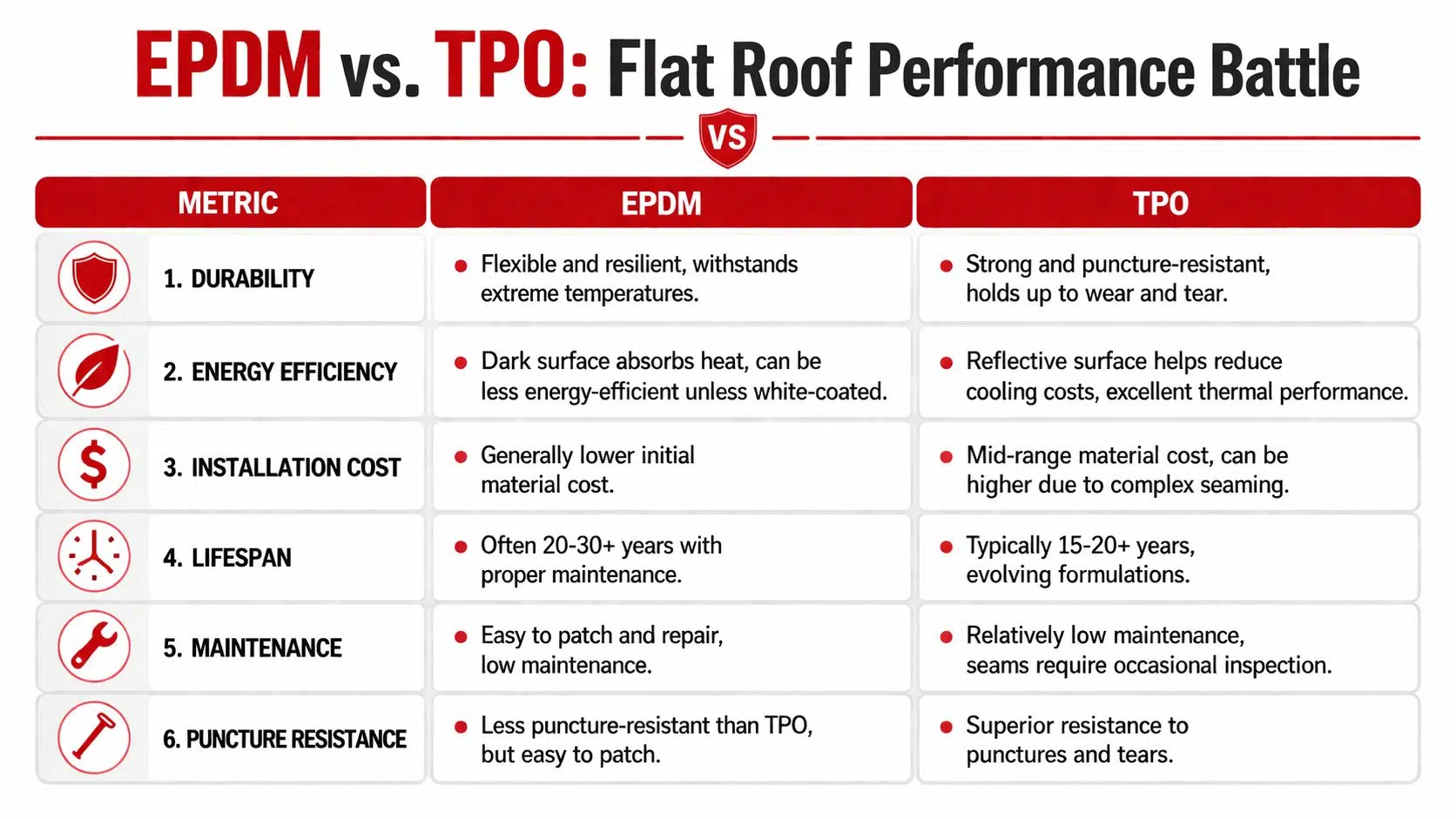
| Feature | EPDM (Rubber Roofing) | TPO (Thermoplastic Roofing) |
|---|---|---|
| Material type | Synthetic rubber membrane | Thermoplastic single-ply membrane |
| Typical cost position | Lower upfront material cost | Higher upfront material cost |
| Energy profile | Standard black surface absorbs heat | White reflective surface reduces heat gain |
| Seams | Adhered or taped seams | Heat-welded seams |
| Cold-weather behavior | Strong flexibility in low temperatures | Some formulations can stiffen in extreme cold |
| Foot traffic and puncture resistance | Serviceable, but less puncture-resistant | Stronger puncture resistance |
| Best-fit buildings | Cold-weather-focused properties, complex details, long-hold assets | Cooling-heavy buildings, grease exposure, high-access roofs |
Installed cost and ownership cost
EPDM usually comes in cheaper at the start. Buckeye State Roofing’s EPDM vs TPO comparison lists EPDM at $3.50 to $5.50 per square foot and TPO at $4.00 to $6.00 per square foot for material, with installed TPO often cited at $6.00 to $10.50. On a big commercial roof or a multi-building portfolio, that gap gets attention fast.
But Chicago owners should not stop at the bid sheet. A lower entry price can lose its advantage if the roof drives higher cooling costs, takes more abuse from rooftop traffic, or becomes harder to maintain around equipment, curbs, and penetrations. On some properties, TPO earns back part of its higher upfront cost. On others, EPDM stays the better value because the building does not need reflectivity badly enough to justify the premium.
Energy use, seams, and day-to-day abuse
TPO usually holds the edge on summer energy performance and rooftop toughness. In the same American WeatherStar single-ply comparison, the company notes that TPO’s heat-welded seams are nearly four times stronger than adhered or taped EPDM seams, and that reinforced TPO membranes offer better puncture resistance. That matters on Chicago roofs with regular HVAC service calls, satellite work, plumbing access, or contractor traffic from other trades.
It also matters which TPO you are pricing. Membrane thickness changes how the roof handles abuse over time, especially around walk paths and equipment zones. If you are sorting through options, this guide to TPO roofing thickness is worth reviewing before you compare proposals line by line.
For buildings with high summer cooling demand, TPO also brings a real operating-cost argument because its white surface reflects heat instead of absorbing it. That benefit shows up more clearly on warehouses, top-floor offices, low-slope condo buildings, and properties where adding a lot more insulation is not practical.
Lifespan, repairability, and long-hold value
EPDM still makes a strong case for owners who plan to keep a building for decades. American WeatherStar notes that EPDM offers a proven lifespan of 30+ years, while TPO is generally in the 20 to 30 year range. In the field, that longer track record matters. Chicago roofs do not fail all at once. They age at seams, flashings, drains, corners, and around service work.
EPDM is often simpler to patch and maintain over the long run, especially on older buildings where repairs are part of ownership, not a rare event. TPO can perform very well, but it depends more heavily on membrane condition, welding quality, and installer discipline at details. That is a practical difference, not a small one.
My rule after decades of looking at Chicago roofs is simple. If the building needs the lowest entry cost and dependable cold-weather flexibility, EPDM deserves a hard look. If the building runs hot, sees a lot of roof traffic, and can benefit from a tougher reflective surface, TPO often wins on total ownership cost even with the higher starting price.
Performance in Chicago's Climate Heat, Cold, and Storms
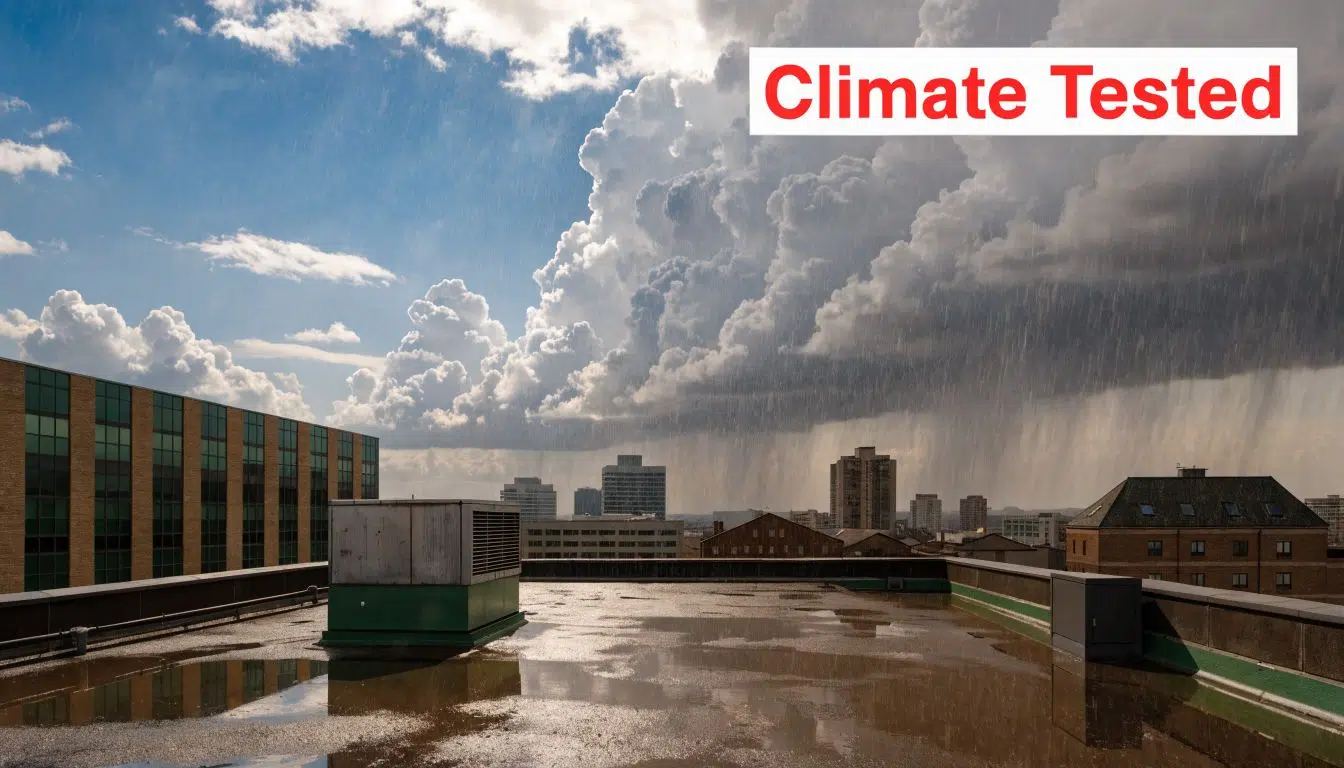
A Chicago flat roof can see ponding rain in April, rooftop temperatures that bake the membrane in July, and ice sitting at drains in January. Spec sheets matter, but the better question is what those conditions do to your repair budget, energy use, and service life over 20 or 30 years.
Summer favors reflectivity
Chicago summers are humid, bright, and harder on top floors than many owners expect. On buildings that already struggle with heat gain, TPO has a real advantage because the white surface reflects more solar load instead of storing it in the roof assembly.
That difference matters most on big open roofs with full sun exposure. Warehouses, retail buildings, top-floor office space, and condo roofs with limited insulation depth often see the benefit first. Lower roof surface temperatures can reduce strain on cooling equipment and make the upper occupied space easier to control.
EPDM can still work well in summer. It just usually asks the owner to solve heat gain in other ways, such as more insulation or better ventilation, which changes the total ownership math.
Winter favors flexibility and forgiving details
Winter is where Chicago roofs earn their keep. Cold alone is not the whole problem. Repeated expansion, contraction, snow load, ice at drains, and movement at penetrations create the failures we end up repairing.
In David Maines’ EPDM vs TPO review, he notes that Chicago sees more than 50 freeze-thaw cycles annually, and in that same review he notes EPDM can withstand temperatures down to -40°F without becoming brittle. He also points out that some TPO formulations can stiffen in extreme cold, which raises the risk at seams and other detail areas.
That does not make TPO a bad Chicago roof. It means workmanship and product quality matter even more in winter conditions. If the membrane is less forgiving in the cold, small installation mistakes show up faster around corners, pipes, curbs, and transitions.
Storms expose the whole assembly
A hard storm tests more than the membrane. It tests edge metal, drain layout, flashing height, attachment, and whether rooftop equipment was detailed by someone who understood how water moves across an old Chicago building.
That is why older masonry properties and parapet-heavy buildings need extra caution. Those roofs move, settle, and hold moisture differently than newer suburban boxes. A membrane can be perfectly good on paper and still give an owner trouble if the flashing work is sloppy or the drainage was never corrected.
Three conditions raise risk fast:
- Older masonry buildings with uneven deck conditions. Movement and irregular transitions put more stress on seams and flashings.
- Parapet-heavy roofs and complicated perimeters. More wall flashing and edge detail means more places for water to get in.
- Roofs crowded with units, conduit, and pipe penetrations. Every added detail increases labor sensitivity and long-term service needs.
In Chicago, leaks usually start at details, not in the middle of a clean field membrane.
Which climate pressure should carry the most weight
The right choice comes from the building’s actual weak points, not from a generic material ranking.
TPO usually pencils out better where summer cooling cost, rooftop traffic, and direct sun exposure drive ownership cost. EPDM often holds its value better where winter flexibility, easier long-term repair work, and predictable cold-weather behavior matter more. For Chicago owners, that is the core EPDM versus TPO question. Not which membrane sounds better in a brochure, but which one fits the way the building takes weather all year.
Best Use Cases for Chicagoland Properties
Different buildings ask for different things from a roof. That’s where the EPDM versus TPO debate gets practical.
When TPO usually makes more sense
TPO is a strong fit for properties that fight summer heat, take regular roof traffic, or have exposure that punishes weaker seams.
Consider TPO for these building types:
- Large commercial roofs with high cooling demand. Warehouses with conditioned space, retail boxes, and office sections often benefit most from the reflective surface.
- Restaurants and food-related facilities. TPO performs well in oil and grease exposure settings, which is one reason it’s often the better low-slope choice there.
- Multi-unit condo buildings with a lot of rooftop equipment. If service crews are up there often, the stronger seams and reinforced membrane are valuable.
- Roofs with open sun exposure and little shade. TPO’s biggest strength shows up where the sun has a long, clean shot at the roof.
When EPDM often delivers better value
EPDM earns its keep on buildings where cold-weather behavior, long-term confidence, and repair flexibility matter more than peak summer reflectivity.
It tends to fit well on:
- Long-held industrial properties where the owner wants a proven membrane with a long service record.
- Buildings with complicated roof geometry. Older Chicago properties often have awkward transitions that benefit from a more forgiving membrane.
- Cold-exposed sites where winter movement is a bigger concern than cooling load.
- Owners planning around restoration options later rather than a full tear-off at the first sign of age.
The long-hold industrial angle
This is one area where the total cost of ownership conversation gets sharper. C-Port’s review of EPDM, TPO, and PVC roofing notes that some newer, cheaper TPO formulations have shown premature UV degradation in recent industry reporting. The same source points to EPDM’s 30+ year track record and its compatibility with silicone restoration coatings that can extend service life by another 10 to 15 years.
For a property manager in an industrial corridor, that matters more than the sales language around “latest generation” materials. Predictability is worth money. A membrane that can be restored instead of replaced can change reserve planning, tenant disruption, and long-term operating cost.
A roof that performs in year eight is good. A roof strategy you can still trust in year twenty is better.
The Chicago-specific takeaway
If you own a cooling-heavy building with active rooftop use, TPO often comes out ahead. If you own a long-term asset in a cold-exposed environment and you value flexibility plus restoration options, EPDM is hard to dismiss.
That’s why “better” depends on the property type. On Chicagoland buildings, the smart choice usually comes from building use first, membrane second.
Making Your Choice and Getting It Done Right
If you’re still asking which is better EPDM or TPO, the fastest way to decide is to answer a few blunt questions.
Ask these questions before you sign a contract
Is your main budget concern upfront cost or long-term operating cost?
If capital is tight right now, EPDM may be easier to justify. If you’re focused on ownership cost over time, TPO may earn back the higher initial spend on the right building.Does your building fight cooling bills or winter stress more aggressively?
Cooling-heavy roofs often point toward TPO. Buildings that live through rough winter movement and freeze-thaw punishment may point toward EPDM.How much traffic and equipment does the roof carry?
A roof crowded with HVAC units, access paths, and regular service activity changes the risk picture. Tougher seams and puncture resistance matter more there.Are you holding the property for a long time?
If yes, service history, repair options, and restoration planning should weigh heavily in the decision.
What works and what doesn’t
What works is matching the membrane to the building.
What doesn’t work is buying TPO just because it sounds newer, or buying EPDM just because the proposal came in lower. Either mistake can cost you later. The wrong membrane on the right building is still the wrong roof.
A second mistake is ignoring coatings and restoration planning. If you’re evaluating EPDM for a long-hold property, it’s worth understanding how EPDM roof coatings in Chicago fit into lifecycle planning.
Installation decides whether the material pays off
This part matters more than owners want to hear. The best membrane on paper will still fail if the crew does sloppy seam work, weak flashing details, poor termination, or lazy drain treatment.
Ask direct questions before you hire anyone:
- Who supervises the installation on site
- How they handle penetrations, parapets, and edge details
- What membrane thickness they’re specifying and why
- What warranty terms apply to both labor and material
- How they document hidden deck issues if they find them
Good roofing decisions are rarely glamorous. They’re usually careful, detail-heavy, and based on the building in front of you. That’s how owners avoid paying twice.
Frequently Asked Questions About EPDM and TPO Roofing
Which roof handles foot traffic better
On roofs with regular HVAC service, TPO usually holds up better to repeated traffic. Its surface and reinforcement tend to resist scuffs and punctures better under service paths, tool drops, and equipment work.
That said, foot traffic will shorten the life of either membrane if the roof was not set up for it. On Chicago commercial buildings with a lot of rooftop activity, walkway pads and proper service routes matter just as much as the membrane choice.
Can you install TPO over an existing EPDM roof
Sometimes. I would never approve that decision from a proposal sheet alone.
The existing roof has to be checked for trapped moisture, attachment, insulation condition, deck integrity, and code compliance. In Chicago, freeze-thaw cycles punish wet roof assemblies. If water is already in the system, covering it up usually turns a manageable problem into a more expensive one later.
Does membrane thickness matter
Yes. Thicker membranes generally give you more durability and better resistance to punctures and jobsite abuse.
On paper, a lower-cost thinner membrane can look attractive. Over the life of the roof, that savings can disappear fast if the building has frequent service traffic, sharp-edged equipment, or exposure to snow removal and storm debris. That is part of total cost of ownership, and it gets overlooked all the time.
Is EPDM easier to repair
In many cases, yes. EPDM is often straightforward to patch and maintain, which is one reason a lot of long-term owners still choose it.
That matters in Chicago, where roofs take a beating from summer heat, winter contraction, and spring freeze-thaw movement. If you plan to hold the property for years and want practical repair options instead of full tear-offs at the first problem, EPDM has a real advantage.
So which is better, EPDM or TPO
There is no universal winner. There is a better fit for your building.
TPO often makes sense when energy performance, reflectivity, and regular rooftop use are high priorities. EPDM often makes sense for long-hold properties where cold-weather flexibility, repairability, and proven performance through Chicago winters carry more weight. The smart choice is the one that gives you the lowest ownership cost over time, not just the lower bid this month.
If you want a straight answer for your building, Expert Super Seal Roofing & Tuckpointing can inspect the roof, explain whether EPDM or TPO makes more sense for your Chicago property, and give you a clear recommendation based on real conditions, not a canned pitch. They’ve served Chicagoland since 1972, and that kind of local experience matters when your roof has to survive both August heat and January freeze-thaw cycles.